Showing posts with label foreign literature. Show all posts

Saturday, 31 July 2010

The Decameron (Giovanni Boccaccio)

--The blurb--
"1348. The Black Death is sweeping through Europe. In Florence, the plague has carried off one hundred thousand people. In their Tuscan villas, seven young women and three young men tell tales to recreate the world they have lost, weaving a rich tapestry of comedy, tragedy, ribaldry and farce."

--The review--
At around 700 pages, modern readers often expect an unreadable epic that is trapped in the past in which it was created. What you are treated to with The Decameron, however, is a relatively accessible collection of one hundred short stories, which can be enjoyed at your leisure and in a similar manner to Bible stories (mostly minus the preaching): anybody expecting something boring is proved wrong with the collection of thoroughly engaging thrills, chills and spills.

The project is an obviously ambitious undertaking, and it would be unreasonable to expect something of this magnitude to succeed entirely. For one thing, it is impossible, even having read all of the short stories, to remember the details of each and every one. Some of the longer stories also fail to hold the reader's interest: this is not necessarily because they are long (Boccaccio himself, at the end of the short stories, defends in his conclusion the inclusion of the longer stories by simply saying "well, if you had anything better to do, you wouldn't be reading any of these stories at all - long OR short", which seems fair enough) but because they are tedious. By their nature, the shorter stories are snappier and more concise, and in any case, even if all of the stories were of exactly the same length, it would be difficult for any author to sustain their prowess equally across such a large number of stories.

Content-wise, some of the stories can also become repetitive: the vast majority involve adultery of some kind, and the confusion of lust for love by our naive Italian forefathers. Lust and love are treated interchangeably and for the modern reader this can become wearying or frustrating. However, Boccaccio is an absolute master of the witty comeback and most of the stories are not boring at all. The predecessor of Keats' poem Isabella, or the Pot of Basil, was very illuminating to read in its original prose form, and the very first story of the collection, about a saint whose behaviour was so appalling that he should never have really been one in the first place, carries many fascinating implications about the foundations of religion.

Even though the stories are not always beautifully or tersely written, quite often Boccaccio's surrounding descriptions are, and the structure of smaller stories within a larger framework is refreshing and accessible, even if we do not really get to know the storytellers themselves very well at all (they are portrayed as mere vessels for the stories, which are the real stars of the show). The breadth and detail of content means this is a collection that readers can return to over and over again; it is easy to see how the process of getting to know the stories one by one could become a real pleasure.

Other works by Giovanni Boccaccio
The Crow (c.1365)
On Famous Women (c.1375)
The Elegy of Lady Fiammetta (c.1343)
The Filocolo (c.1336)
The Filostrato (c.1340)
Teseida (c.1341)
On The Fates of Famous Men (c.1355)


Sunday, 25 July 2010

Le roi des fougères (Jean Anglade)


--The blurb--
"How did the young Antilles boy, Zébédée Lhasard, son of Pamphile Lhasard, tramway driver from Clermont-Ferrand, become Prince of the Ferns? How did he come to share the cave of a forger of Roman antiquities on the slopes of the Puys? Jean Anglade unveils, with humour and poetry in equal measure, this strange destiny, and traces a beguiling portrait of the Auvergne at the edge of the 1950s."

--The review--
The King of the Ferns, by Jean Anglade (not to be confused with actor Jean-Hugues Anglade!), is not available in English, and the author himself is virtually unknown outside of France (which is perhaps not helped by his reclusive nature even in France, with him rarely if ever appearing on television, and with him not having won any literary prizes in nearly 50 years). However, in France his output at least is extremely prolific, with him having released 40-50 novels and novellas, as well as multiple history books, plays, poems, translations and essays, among other projects. At the age of 95, he's still writing, with his most recent attempt having been released just a few months ago. But is what he's writing any good?

While imperfect, it thankfully appears that quantity is not being prized over quality. Anglade has produced a lovely readable little novella (just 96 pages in all) that is concise, compelling, and carries the reader along with its imagery. It peters out a bit due to its predictable ending, but this is compensated for by the vivid setting of Clermont-Ferrand and the eccentric and minimal cast with which we are presented.

Although only available in French, those who are not fluent in the language should still easily be able to handle The King of the Ferns: if anything it makes good practice for those who are in the process of learning it.

The only other difficulty - apart from the ending - is perhaps determining this story's target audience. While fairytale-ish (due to its light style and happy ending), it is absolutely not for children, as proved by one fairly sombre and horrible scene - teens and up might be a better target.

Selection of other works by Jean Anglade
L'Immeuble Taub (1957)
La Foi et La Montagne (1961)
Une pomme oublié (1974)
La Noël aux prunes (1983)
La soupe à la fourchette (1999)
Les délices d'Alexandrine (2009)
Des chiens vivants (2010)

Monday, 30 November 2009

Bookish Bits & Bobs: Lost in Translation

In September 2008, I emigrated to France, with the idea of remaining here permanently. And here I remain, and here I am happy (for now, but with the hope of that never changing). I was in the fortunate position of already having a fair grasp of the language before coming here, and while the best way of improving one's day-to-day use of the language comes through contemporary engagement with it (e.g., through French speakers - check -, through contemporary print media such as free metro magazines - check -, and through other contemporary media sources such as television and radio - erm, half a check, since we don't have and have no intention of acquiring a TV), I do also enjoy the privilege of being able to read books in the language. While this may not improve my contemporary French much (in the way of idioms and whathaveyou), it can only solidify other things, such as grammatical knowledge and vocabulary.

The joy of reading is pleasantly widened when one is given the chance to read in multiple languages, not only by the access to a greater range of stories but also in terms of cultural and linguistic access. And yet this joy is paradoxically tainted: very few novels are translated into English (relative to the number that are actually released in their original language) and while in some cases it is perhaps for the best, the aforementioned joy is at times tainted with the paradox that others will not be able to share it with you, since the lack of translation means there is no way that they will be able to read it in the near future.

This, to me, is still something of a puzzle. Why is so little work translated into the most popular languages (let's say, for the sake of argument, that these are English, Spanish and Chinese)? Why wouldn't publishers and agents want their authors' work to have maximum worldwide exposure? Is it due to a lack of interest from readers (perceived or actual)? Is it to do with the financial risk involved? Is it down to a lack of translators? Or something else?

Certainly the translator's task is no easy one; this is something that David Lodge acknowledges publicly in the foreword to his 2008 novel Deaf Sentence, which frequently draws on puns relating to deafness and death, including in the novel's title. To this end, he offers up his novel as a dedication to the translators by way of advance apology. But it is not only the translation of idioms that challenges translators - the uses of language that inextricably bind culture into them, such as the French 'tu' and 'vous', can often go horribly wrong in translation. In one particular translation of Pippi Longstocking, where the Swedish equivalent of this is handled quite badly, it took me years to understand what the series' original author, Astrid Lindgren, had been driving at in Pippi's rudeness towards her teacher.

This is certainly an issue of unending contention. However, we can only expect it to decline further if more literature lovers do not take languages at school and university (in the wake of the UK Labour goverment's policy by which foreign languages are no longer compulsory after the age of 14, when most only take up a second language at 11 as it is, fewer and fewer choose to study another language further and with any gravity). If the importance of other languages is not emphasised, so that the sharing of ideas the world over can be facilitated, even more books can be expected to be lost in the gulf of translation.

Wednesday, 28 October 2009

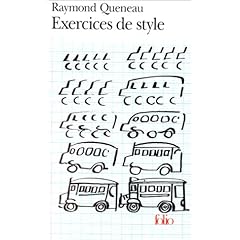
Exercices de style (Raymond Queneau)

--The blurb--
"On a crowded bus at midday, Raymond Queneau observes one man accusing another of jostling him deliberately. When a seat is vacated, the first man appropriates it. Later, in another part of town, Queneau sees the man being advised by a friend to sew another button on his overcoat. "Exercises in Style" retells this unexceptional tale ninety-nine times in ninety-nine different styles. An 'Abusive' chapter heartily deplores the events, 'Opera English' lends them grandeur. Raymond Queneau rendered Barbara Wright (the English translator) his 'heartiest congratulations', adding, 'I have always thought that nothing is untranslatable. Here is new proof'."

--The review--
While a great deal of foreign literature is translated, it often remains a niche interest, with very few people being aware of the authors and works in question. Raymind Queneau is one of these hidden gems, being in his lifetime a prolific poet and essayist as well as academic and author. He has not even risen to stardom significantly more following the publication of a graphical version of Exercices de style by Matt Madden four years ago. So how does such a successful French author remain so minor when his works are translated into English?

Queneau relies heavily, in several of his works, upon wordplay, which may not always translate well or hold appeal for a wider audience. Others may not resonate well with the sense of humour of other countries, or run the risk of seeming so pretentious that they pass the regular reader by. Liking some of Queneau's novels perhaps relies on a love for the surreal or absurd, and none of these qualities build up a picture of an author whose works might be lovable in any sort of mainstream way. Certainly Exercices de style, one of his most well-known works, is best when taken in small doses. The repetitive nature of its construct means there is no narrative thread as such that needs to be followed each time the book is picked up. However, despite the repetitive nature of it, there is, perhaps surprisingly, always something new to find.

Queneau is consistently innovative and imaginative throughout this novella, not only employing voices that will appeal to linguists (the past and present tenses, subjunctive mood, and passive voice appear to name but a few), but also those that appeal to a wider range of interests (such as the chapters centred on gastronomic, zoological, and medical themes). As a classicist I was especially tickled by the chapter on Hellenicisms. This keeps the central, very simple narrative interesting, lacing the story with surprising variety.

The author's style is therefore something of the unexpected. It's unrealistic to expect any work of art to appeal to everyone, but there should be something in this to reach out to a good 90%. It's relatively short, and yet contains a great enough multitude of perspectives to keep readers returning. A great, accessible and slightly wacky introduction to the unconventional Queneau which will take any adventurous reader on a great journey.

Other works by Raymond Queneau
Witch Grass (1933)
The Last Days (1936)
Children of Clay (1938)
A Hard Winter (1939)
Pierrot (1942)
The Skin of Dreams (1944)
We Always Treat Women Too Well (1947)
The Sunday of Life (1952)
Zazie in the Metro (1959)
The Blue Flowers (1965)
The Flight of Icarus (1968)