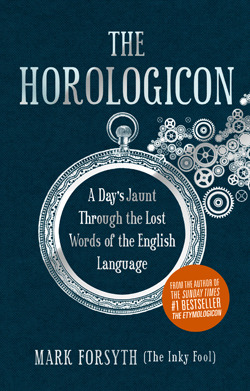
"The Horologicon (or book of hours) gives you the most extraordinary words in the English language, arranged according to the hour of the day when you really need them. Do you wake up feeling rough? Then you're philogrobolized. Pretending to work? That's fudgelling, which may lead to rizzling if you feel sleepy after lunch, though by dinner time you will have become a sparkling deipnosophist. From Mark Forsyth, author of the bestselling The Etymologicon, this is a book of weird words for familiar situations. From ante-jentacular to snudge by way of quafftide and wamblecropt, at last you can say, with utter accuracy, exactly what you mean."
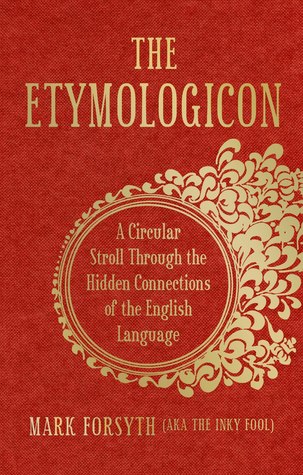
"Do you know why...a mortgage is literally a death pledge? ...why guns have girls' names? ...why salt is related to soldier? You're about to find out... The Etymologicon is a completely unauthorized guide to the strange underpinnings of the English language. It explains: how you get from "gruntled" to "disgruntled"; why you are absolutely right to believe that your meagre salary barely covers "money for salt"; how the biggest chain of coffee shops in the world (hint: Seattle) connects to whaling in Nantucket; and what precisely the Rolling Stones have to do with gardening."
--The review--
While not a particularly fashionable interest, there are many secret word-hoarders out there. Some of them are secret, merely reading books like Mark Forsyth's Etymologicon and Horologicon in their spare time (ideally on a Kindle so that even fewer people can guess what they are reading) and writing angry letters to newspapers about typos. Others are not-so-secret, boasting of their championship in Scrabble competitions and making their living as English teachers (where they get paid to point out the grammatical mistakes of others...cough).
Mark Forsyth, the author of these books, is clearly of the not-so-secret variety of logophile, having started blog The Inky Fool in 2008 and taken it to extreme heights - in the form of these two books and a TED lecture - before the age of 40. With these two books having been reviewed by such eminent journals as The Sunday Times and The Financial Times, Forsyth has certainly burst onto the scene in style. So how do these two volumes of word-based wandering pan out?
In truth, it seems amazing that (disregarding content for a moment) both texts can be by the same author. While The Etymologicon can be characterised by its awkward tone of voice, stream-of-consciousness mode, and general lack of organisation, The Horologicon is a work of far greater expertise: its sense of humour is more refined, and one has a far greater impression of the writer imparting fascinating and usable knowledge, rather than an impression of a socially maladroit dinner party guest leaving awkward silences in the wake of his ramblings. Forsyth also promises that The Horologicon could potentially be used as a reference book, and given the precision of its organisation (with chapters on everything from getting up in the morning to trying to get out of doing your work), this seems genuinely possible.
The Horologicon, thanks in part to its readable structure but also thanks to its concision, equally lends itself well to reading in one sitting - even though the author himself advises against this. Thankfully, dipping in and out of it is just as appealing and realistic a prospect. Conversely, dipping in and out of The Etymologicon is a necessity due to its monological flavour. The description of Financial Times reviewer Michael Skapinker, stating that "it is a plunge on a toboggan where the only way to stop is to fall off", seems apt, and not necessarily in a positive way - hence the apparent gulf in quality between these two volumes.
Thanks to the high standard of the Horologicon, though, Forsyth's place among wordsmiths such as David Crystal, Bill Bryson, and Stephen Fry - and thanks to its usefulness as a reference book as well as a source of great humour, even those secretive word-lovers should come out from behind their Kindles and purchase a copy for proud display at home, while eagerly awaiting his next offering.
The Etymologicon and The Horologicon can be purchased separately, or in a boxed gift set.


