Showing posts with label misery lit. Show all posts

Monday, 12 November 2012

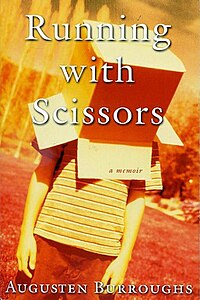
Running With Scissors (Augusten Burroughs)

--The blurb--
"This is the story of a boy whose mother (a poet with delusions of grandeur) gave him away to be raised by her psychiatrist, a dead ringer for Santa Claus and a certifiable lunatic into the bargain. Suddenly at the age of 12, Augusten found himself living in a dilapidated Victorian house in perfect squalor. The doctor's bizarre family, a few patients and a paedophile living in the garden shed completed the tableau. Here, there were no rules or school. The Christmas tree stayed up until Summer and valium was chomped down like sweets. [And w]hen things got a bit slow, there was always the ancient electroshock therapy machine under the stairs..."

--The review--
The book market these days seems to be shifting towards a different trend to that of the late 1990s and early 2000s, swapping the once highly-popular misery lit genre for stuff inspired by vampires. It's difficult to say what's preferable. Augusten Burroughs' Running With Scissors doesn't quite combine the two, but almost matches both in terms of wackiness. At any rate, it was one of the most popular misery lit books of its time, with it being published in 2002 and made into a film in 2006. So now that we all have the chance to read this autobiography away from the prism of its whirlwind trend of several years ago, how does it stack up?

Running With Scissors' blurb suggests that the plot line might at least be darkly humorous, but this is difficult to find amongst the hackneyed portrait of the abusive relationship with the child caught in the middle, the doctor acting at the pinnacle of unprofessionalism, and the repeated name-dropping of famous brands such as Pucci. British readers will also be distracted by the inherent wrongness of the line "Sebastian gave her a shag" (N.B., the author is referring to a style of haircut and not a casual sexual encounter). Isn't this what editors of international editions are supposed to be for? Throw in incidents of bestiality, lesbianism and adultery and it's not difficult to understand why readers may begin to find all of this a little unbelievable.

In spite of all of this, the plot is essentially predictable. Yet all the while we are amazed at every turn that such people were (or should that read 'are'?) ever permitted to have, let alone keep, children. It is a shame, then, that Burroughs does not let us in on how he managed to escape this existence to become a reasonably well-functioning adult (a courtesy that at least Dave Pelzer does do us). Burroughs keeps us on our toes in other ways, but not always positively; even though he can at times be thought-provoking, touching and even spooky in his writing, he is also gruesome and uses immature similes involving Sea Monkeys. Although the author is occasionally darkly funny, such instances are rare, and are not enough to compensate for the rest. 

Burroughs maintains to the end of the book that events as described were really true, but allegations have emerged since relating to defamation and fabrication, leading Burroughs to admit that the events within it were "only loosely" based on his own life. To many, this can be considered a relief that he did not really suffer the traumatising events described. However, this could also incite anger in others, as it could be perceived as a devaluation of, or lack of respect for, those that really do suffer on a similar scale. If the world of literature really has moved on - albeit only to vampire-based slush - this is arguably better than people being tempted into reading mawkish lies that ultimately are only masquerading as fact.

other works by Augusten Burroughs
Sellevision (2000)
Dry (2003)
Magical Thinking (2004)
Possible Side Effects (2006)
A Wolf At The Table (2008)
You Better Not Cry: Stories For Christmas (2009)

Saturday, 28 July 2012

For A Dancer (Emma L Stephens)

--The blurb--
"Brought up in an environment riddled with substance abuse and neglect, Emma has big dreams and little chance of ever reaching them. By the age of fourteen she is on her own, determined to escape the mentality that has crippled her family, but to succeed would mean leaving behind her sister and betraying the only life she's ever known. From the Virginia countryside to the streets of Paris, through teenage motherhood and higher education, share Emma's tears and triumphs as she searches for acceptance in an exclusive world and finds love in the most unlikely of places."

--The review--
Over the past few years, it has become clear to the media, to universities, and most importantly to many students themselves and their families that a university education is no longer a golden ticket. Once the 'open sesame' to many prestigious jobs, it is now little more than an expensive library card, and the dismay associated with unemployment or having to take a job in a totally unrelated profession to one's degree is augmented by those who have got where they are on connections, or those who have renounced the idea of a degree altogether and gained their status through work experience. Through poor advice given to them combined in some cases with a lack of proactivity, many graduates languish upon graduation and begin to feel that their hard work has been worthless. 

Initially, Emma Stephens' story seems like a rerun of this plot line at the start of For A Dancer, where she laments having gone to business school only to find that the very market she has been learning about has essentially collapsed by the time of her graduation. Of course we all want someone to blame when something goes wrong in our lives; accepting that we have made bad choices (such as not getting the right work experience, or enough work experience, or have not done enough to seek the right advice or get the highest grades we could) is a very difficult thing to do, after all. The whining tone that starts off this memoir therefore means the writer runs the risk of alienating their audience. Even if readers have gone through similar tribulations themselves, running the "why me?" gamut of emotions can be tiresome to read and unhelpful in real life. However, there is thankfully more to Stephens' memoir than this initially unpromising opening, so readers are encouraged to persevere.

Although part of the highly popular 'misery lit' genre, any gruesome details are left out, meaning that reading For A Dancer does not feel (too) voyeuristic. She is also darkly humorous in several places (although whether this is intentional or not is unclear), making this different to your average misery memoir. This is not to say that the reader never feels sad or frustrated on the writer's behalf: at times when many would give up, she is able to determinedly restore her courage, work hard and carry on in a way that is truly inspiring. Several readers will also recognise aspects of the author in others (or perhaps even in themselves), bringing home the sobering reality of Stephens' childhood and youth.

One cannot help but feel, though, that this autobiography requires some tidying up still, and it is therefore a surprise to find that it is already out in paperback despite linguistic errors such as "affect change" rather than "effect change" and "si vous plait" for "s'il vous plaƮt". Some parts of the story also feel rather rushed, and the mention of love in the book's blurb is curious given that the writer seems to experience every shade of lust, but rarely, if ever, love. In addition, the 'dancer' connection is far too tenuous and is never carried strongly through the story; while the lyrics of the Jackson Browne song to which it refers are highly relevant to Stephens' tale, this link is at no point handled with dexterity.

As with a lot of self-published work, then, it proves that writing is more difficult than Stephens (and many others) anticipate: you cannot just wordvomit onto a page and call it writing. It needs further crafting and thought than this, and cannot just be treated as yet another in a long line of professions the 'author' wants to try their hand at (Stephens acknowledges in her final chapter, more or less, that she views writing as such, having already attempted careers in medicine, real estate, acting, and others). On the plus side, Stephens is well aware of her flaws (like most of us) and knows that blame for the way her life has turned out is laid at her own door for equally valid reasons for laying blame with others. And, like most, she resolves to make the best of those mistakes, and although writing this memoir as a cathartic exercise is surely part of this process for her, For A Dancer certainly needs further editing and refinement before it is served to more members of the general public.

Sunday, 24 June 2012

Blackbird (Jennifer Lauck)

--The blurb--
"To young Jenny, the house on Mary Street was home -- the place where she was loved, a blue-sky world of Barbies, Bewitched, and the Beatles. Even her mother's pain from her mysterious illness could be patted away with powder and a kiss on the cheek. But when everything that Jenny had come to rely on begins to crumble, an odyssey of loss, loneliness, and a child's will to survive takes flight...."

--The review--
The genre of misery lit has pervaded Western book stores for at least the past ten or fifteen years, with some bookshops even having whole sections dedicated to the genre. The term coined by The Bookseller magazine refers chiefly to autobiographies which focus on the narrator's triumph over trauma and abuse, and while the first writer to truly break this market was possibly Dave Pelzer in the mid-1990s, the popularity of the genre still persists unabated, as perhaps evidenced by the release of Jennifer Lauck's final volume of her memoir, Found, in 2011 - a story which kicked off with the first instalment, Blackbird, in the year 2000.

It's easy to see why this type of literature has caught on. Inspiration and voyeurism combine to make an emotionally intense product, written in an accessible style that all can read easily, at least in terms of its literary level if not its gruelling content. Equally, it's escapism; we feel that this could never happen to us, and feel relieved that it has not. Blackbird also fits into this framework of description - once we start reading, we are easily swept up into the story of Jennifer's childhood and our horror at her role as carer. Although at times the sequence of events can seem unrealistic given that bad things seem to pile on top of bad things unrelentingly, this is sadly the case for some people's lives, and as readers of this type of autobiography, it is perhaps more our role to listen than to judge.

In contrast to the events that take place, the characters seem on the whole to be very realistic indeed: Jennifer and her brother annoy each other as smaller children and then only later find affection for each other and things that they have in common, as is usual for siblings, and the development of this relationship made for a touching read. To the same degree, Jennifer's father comes across just as a nice guy trying (albeit failing in some respects) to do right by his kids. Perhaps understandably, the exceptions to this portrayal of characters and relationships come in the form of Jennifer's mother, who is accorded love and light in seemingly infinite amounts, and Jennifer's stepmother, who is portrayed as nothing less than a purveyor of evil.

This inconsistency is arguably carried through into the way in which Lauck controls events: at some moments, such as when she finds herself in a situation where she is vulnerable to abuse, we have the feeling that unlike in some 'misery lit' memoirs, she retains her privacy and keeps some of the more gruesome details to herself. However, there are also moments where Blackbird feels rushed, and some important details are left out, leading to confusion in the plot (we do not know why she is sent away so suddenly, or why she is so suddenly separated from her family).

What we therefore have is a noble attempt at a contribution to this genre, but something which needed further tidying up prior to publication (which is perhaps somewhat surprising given Lauck's prestigious journalistic background). The pioneer of high-quality literature in this category still, to me, remains Frank McCourt, rather than Dave Pelzer, Jennifer Lauck, or any other exponents of this type of writing that I have so far encountered. It would be my advice to seek out McCourt's writing instead. 

Other works by Jennifer Lauck
Still Waters (2002)
Show Me The Way (2004)
Found (2011)