Showing posts with label autobiography. Show all posts

Sunday, 29 December 2013

Love Is A Mixtape (Rob Sheffield)

 --The blurb--
"Mix tapes: Stick one into a deck and you’re transported to another time in your life. For Rob Sheffield, author of Turn Around Bright Eyes, that time was one of miraculous love and unbearable grief. A time that spanned seven years, it started when he met the girl of his dreams, and ended when he watched her die in his arms. Using the listings of fifteen of his favourite mix tapes, Rob shows that the power of music to build a bridge between people is stronger than death."

 --The review--

Writers from Nick Hornby to Jonathan Coe have reminisced on the music of days gone by, invoking images of vintage records, past romances, and even political landscapes. Rob Sheffield has now joined the ranks of these British authors by producing an American rival in the form of Love is a Mix Tape, published in 2007. By capitalising on the 80s and 90s nostalgia of a mix tape, this iconography is set to draw in a whole new generation of music lovers’ ruminations on the tracks they treasure(d).

Such books are arguably better suited to life as audiobooks due to their hybrid nature. By giving each chapter the title of a mix tape that he has made, Sheffield makes the reader want, while they read, to be able to hear the music that each chapter is set to. However, the book’s interdisciplinary nature is even more layered than this, making its genre even more difficult to categorise: it crosses the borders of fiction, non-fiction, autobiography and popular history, to name but a few. This makes its appeal very broad, and this is further emphasised by the accessible style in which it is written.

Accessibility, though, should not be read as debased. Despite the narrator’s matter-of-fact personality, he can also be heartbreakingly poignant in what is also one of the greatest love stories (or should that be songs?) ever told, effectively making the book a paean to his first love, RenĂ©e, without putting her up onto too much of a pedestal. The reason for this becomes apparent as we read, adding further to the narrative's pathos.

Nonetheless, this does not result in depressing the reader: by the end of Love Is A Mix Tape, we not only want to go out and discover the unknown tracks recommended to us by the author, but we also feel even more grateful for our lives, giving us the urge to pass on Sheffield's story to others, in a way that even Nick Hornby is perhaps unable to do.

other works by Rob Sheffield
Talking to Girls About Duran Duran (2010)
Turn Around, Bright Eyes (2013)  

Thursday, 31 October 2013

Swimming and Flying (Mark Haddon)

--The blurb--
"Prize-winning novelist Mark Haddon, author of THE CURIOUS INCIDENT OF THE DOG IN THE NIGHT-TIME and most recently THE RED HOUSE, explores his childhood fear of swimming and his adult fear of flying in a[n..] essay that unfolds into [...] reflections about the craft of writing and about life itself."

--The review--
A quick search on Amazon reveals a staggering choice of nearly 592,000 results in the field of biography - so you'd think that the market was saturated. However, in the midst of all the celebrity fluff and traditional chronological structures has come a breath of fresh air in the form of Mark Haddon's effort, entitled Swimming And Flying. While some cunning individuals have uploaded it to the web as a PDF, it is unfortunately only officially available as a Kindle Single, which is a shame, as this could potentially block out a significant number of Haddon's fans: those who don't own a Kindle, mainly, but also those who just prefer 'real' books.

This is also a great shame due to the fact that Swimming And Flying, as mentioned, truly refreshes the biography genre thanks to its clear yet 'patchwork' style: Haddon's structuring of the text into short passages, rather than chapters, allows for true pauses for thought, and the text's genesis as a series of speeches (or 'stand-up serious', as Haddon himself dubs it) lends this biography an especially intimate, down-to-earth aspect.

There is, equally, plenty of mileage not just in this autobiography's style but also in its premise of 'swimming and flying': while Haddon does address his fears of these two pursuits (as a child and as an adult respectively), the metaphorical translations of 'swimming' and 'flying' through life itself is also heavily implied thanks to Haddon's ability to overcome these fears and to deal with other good and bad times in his life so far. This wide basis of the memoir ensures that all readers will find something within it that they can identify with, and, moreover, repeatedly: the accessible method of using short passages means that rereads are merited, as readers can dip in and out, making further connections between different sections and between the author's life and theirs.

By laying his fears bare, Haddon shows that he is as flawed as anyone else. However, by also showing details of how he has overcome them, he is inspirational without being smug. Tales of determination are always of value - and it is simply to be hoped that this mini-memoir will eventually be published beyond the Kindle Single format, so that many more readers can benefit.

other works by Mark Haddon
The Curious Incident of the Dog in the Night-time (2003)
A Spot of Bother (2006)
The Red House (2012) 

Sunday, 21 April 2013

Don't Sleep, There Are Snakes (Daniel Everett)

--The blurb--
"Although Daniel Everett was a missionary, far from converting the Pirahas, they converted him. He shows the slow, meticulous steps by which he gradually mastered their language and his gradual realisation that its unusual nature closely reflected its speakers' startlingly original perceptions of the world. He describes how he began to realise that his discoveries about the Piraha language opened up a new way of understanding how language works in our minds and in our lives, and that this way was utterly at odds with Noam Chomsky's universally accepted linguistic theories."

--The review-- 
Those studying linguistics generally do it as part of a pre-meditated choice. They perhaps were good at languages at school and took an interest in this when visiting foreign countries before taking languages to an even higher level at university. However, Daniel Everett fell into this field almost accidentally via missionary work - and it is the story of this extraordinary accident that forms the interdisciplinary memoir Don't Sleep, There Are Snakes.

In spite of the many opportunities for sentimentality in this missionary basis, Everett is unabashedly frank: he acknowledges the errors he made in trying to impose Western values on the Piraha (pronounced Pir-ha-DAN) people and in putting his wife and children (as well as himself) into grave danger. He also avoids the temptation to make this more about himself than about the people that he meets along the Maici river - so while this is a memoir, it also forms a unique blend with social and anthropological research as well as linguistics, culture, geography and psychology.

Everett's wild yet believable anecdotes are seared onto the brain through his matter-of-fact style of storytelling, and while he could get easily carried away with technicalities of the Piraha language, he sensibly keeps up the pace. However, the story arguably doesn't go as far as it might, lacking a satisfying conclusion before proceeding to the more technical section, which is of more interest to serious linguists than to the general reader (and even the serious linguist might struggle to follow it late at night). Regardless of this, the colours, sounds and experiences of Everett's recount are indelible, and come highly recommended.

Other works by Daniel Everett
The Crucial Educational Fusion (2013)
Language: The Cultural Tool (2013)
Wisdom from Strangers (release date tba) 

Sunday, 24 March 2013

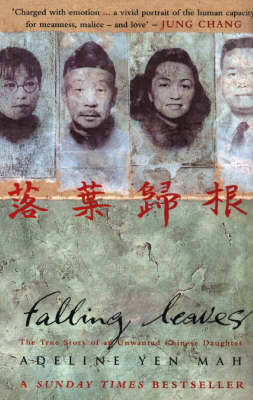
Falling Leaves (Adeline Yen Mah)

--The blurb--
"Thought to bring bad luck because her mother died giving birth to her, Adeline Yen Mah was discriminated against by her family all her life. Falling Leaves is both the[...]story of how she survived that rejection and [a] saga of a Chinese family, from the time of the foreign concessions to the rise of Communist China and the commercial boom of Hong Kong."
adapted from Amazon.co.uk

--The review--
My family stretches all around the world, from London to Dublin and from Paris to Shanghai. Since reading Paul French's Midnight in Peking, visiting Thailand in 2005, hearing about my parents' recent trip to China to see my delightful 11-month-old half-Chinese half-English cousin, and beginning to plan my own trip to Japan in 2014, my own interest in all things Asiatic has increased. So when one of my students said that she had purchased the adult version of Adeline Yen Mah's memoir Chinese Cinderella (which we are currently studying) and offered to lend it to me, I gratefully accepted.

Chinese Cinderella is naturally a shorter book and focuses on Adeline's childhood, going from her birth to her departure for university. With more focus on specific childhood incidents, it is geared more towards children's sense of humour and pathos. As befits its target audience, Falling Leaves diverts from these focal points, giving a broader overview of China's history throughout Adeline's life and going beyond the scope of Chinese Cinderella, passing through the writer's adult life right up to 1990. 

Naturally there is some repetition of stories, so those who have read Chinese Cinderella may find aspects of Falling Leaves a little tiresome. However, these stories are glossed over and are interspersed with new information, so they are not greatly to Falling Leaves' detriment. Newcomers to the events of the Cultural Revolution and the Tiananmen Massacres will be left with jaws dropped and minds opened, as Yen Mah incites the reader to want to know more.

Equally shattering are the attitudes and behavioural patterns of the majority of the writer's family members. As these patterns and attitudes were ongoing throughout Yen Mah's life, it is difficult at times to understand why she continued to be so generous towards them emotionally and financially when she would have been better to cut all ties with them, especially when she does prove herself able to cut ties with destructive forces at other points in Falling Leaves. However, at the same time, it is easy to see how each of us is all of our ages at once, and how inside Adeline is still the little girl desperately seeking the approval of Joseph, Jeanne, and her siblings. In this way, her treatment to the last by them is simultaneously predictable and unfair.

Comforting elements in this story include the power of hope and imagination in the face of adversity, and the notion that our real family can at times be the people we choose for ourselves. Equally inspiring is the encouragement that it gives to us all to face up to our past - whether our personal past or that of our country - and use it to create a better tomorrow. Yen Mah remained dignified, poetic and concise throughout, without losing lucidity or becoming patronising. Anyone who has ever felt unwanted by their family or simply been interested in Asian history should read Falling Leaves - and further to this, you'll find me ordering a copy of A Bitter Revolution online, so that after beginning to understand Adeline's struggle, I can perhaps begin to comprehend the struggle of China itself.

other works by Adeline Yen Mah
Chinese Cinderella (1999)
Watching The Tree (2000)
A Thousand Pieces of Gold (2002)
Chinese Cinderella and the Secret Dragon Society (2003)
China, Land of Dragons and Emperors (2008) 
Chinese Cinderella: The Mystery of the Song Dynasty Painting (2009)

Monday, 12 November 2012

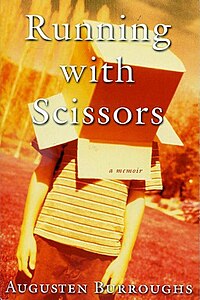
Running With Scissors (Augusten Burroughs)

--The blurb--
"This is the story of a boy whose mother (a poet with delusions of grandeur) gave him away to be raised by her psychiatrist, a dead ringer for Santa Claus and a certifiable lunatic into the bargain. Suddenly at the age of 12, Augusten found himself living in a dilapidated Victorian house in perfect squalor. The doctor's bizarre family, a few patients and a paedophile living in the garden shed completed the tableau. Here, there were no rules or school. The Christmas tree stayed up until Summer and valium was chomped down like sweets. [And w]hen things got a bit slow, there was always the ancient electroshock therapy machine under the stairs..."

--The review--
The book market these days seems to be shifting towards a different trend to that of the late 1990s and early 2000s, swapping the once highly-popular misery lit genre for stuff inspired by vampires. It's difficult to say what's preferable. Augusten Burroughs' Running With Scissors doesn't quite combine the two, but almost matches both in terms of wackiness. At any rate, it was one of the most popular misery lit books of its time, with it being published in 2002 and made into a film in 2006. So now that we all have the chance to read this autobiography away from the prism of its whirlwind trend of several years ago, how does it stack up?

Running With Scissors' blurb suggests that the plot line might at least be darkly humorous, but this is difficult to find amongst the hackneyed portrait of the abusive relationship with the child caught in the middle, the doctor acting at the pinnacle of unprofessionalism, and the repeated name-dropping of famous brands such as Pucci. British readers will also be distracted by the inherent wrongness of the line "Sebastian gave her a shag" (N.B., the author is referring to a style of haircut and not a casual sexual encounter). Isn't this what editors of international editions are supposed to be for? Throw in incidents of bestiality, lesbianism and adultery and it's not difficult to understand why readers may begin to find all of this a little unbelievable.

In spite of all of this, the plot is essentially predictable. Yet all the while we are amazed at every turn that such people were (or should that read 'are'?) ever permitted to have, let alone keep, children. It is a shame, then, that Burroughs does not let us in on how he managed to escape this existence to become a reasonably well-functioning adult (a courtesy that at least Dave Pelzer does do us). Burroughs keeps us on our toes in other ways, but not always positively; even though he can at times be thought-provoking, touching and even spooky in his writing, he is also gruesome and uses immature similes involving Sea Monkeys. Although the author is occasionally darkly funny, such instances are rare, and are not enough to compensate for the rest. 

Burroughs maintains to the end of the book that events as described were really true, but allegations have emerged since relating to defamation and fabrication, leading Burroughs to admit that the events within it were "only loosely" based on his own life. To many, this can be considered a relief that he did not really suffer the traumatising events described. However, this could also incite anger in others, as it could be perceived as a devaluation of, or lack of respect for, those that really do suffer on a similar scale. If the world of literature really has moved on - albeit only to vampire-based slush - this is arguably better than people being tempted into reading mawkish lies that ultimately are only masquerading as fact.

other works by Augusten Burroughs
Sellevision (2000)
Dry (2003)
Magical Thinking (2004)
Possible Side Effects (2006)
A Wolf At The Table (2008)
You Better Not Cry: Stories For Christmas (2009)

Monday, 5 November 2012

Seeing Things (Oliver Postgate)

--The blurb--
"For over forty years Oliver Postgate was synonymous with the best in children's television, including Bagpuss, The Clangers, and Ivor the Engine. Oliver wrote and narrated the stories, while Peter Firmin illustrated the characters and made the puppets. In this autobiography Oliver Postgate describes how he came to create his stories and characters, developing innovative techniques of animation and puppetry alongside his friend and co-producer Peter Firmin. Before his first TV production, Alexander the Mouse in 1958, he had already been a war evacuee; a conscientious objector; a farm labourer; a relief worker in post-war Germany; an artist; an actor; and an inventor. The story of Oliver Postgate's extraordinary and adventurous life, and the wonderful characters who populated it, both real and imagined, is beautifully remembered and beautifully told." (from Amazon.co.uk; abridged by me)

--The review--
The wonder of video streaming sites such as Youtube and Vimeo has made the nostalgia of childhood even more accessible to adults on a day-to-day basis. Assuming you haven't had enough of children's television by the time your own children have finished melting your brain with endless reruns of In The Night Garden (or whatever today's young minds are being warped with), you can be watching a vintage episode of (for my generation) Playdays or Rosie and Jim at the click of a mouse.

But now fans of the wide-ranging and, it seems, endlessly beloved work of Oliver Postgate (of Noggin The Nog fame) can extend their wanderings through yesteryear with a copy of his autobiography, Seeing Things, which was published in 2000 originally before being pimped upon his death in 2008 for republication in fancier packaging. The hardback edition is a thing of beauty in itself, with a sparkling red and gold cover, and is replete with photographs reproduced on high-quality paper in both colour and monochrome.

What of the text itself, however? With the world and his dog seeming to have an autobiography out these days (often of the ghostwritten variety), perhaps it's normal to be cynical. And certainly Seeing Things is not perfect: it's unclear what the title refers to, and at times the prose can be akin to the description of Postgate himself, given by his son in the book's epilogue: "[it] would be like taking a clock apart to see how it worked: you end up with a pile of cogs and springs and none the wiser." Such a precise simile made me wish at times that Daniel Postgate, rather than his progenitor, had written Seeing Things: the prose emitted by the creator of Bagpuss is at times rambling and unfocused, causing the reader to lose interest as he dwells in excessive detail on subjects where he fails to engage us or realise that we are not as expert as he is.

However, the parts that are of interest (and there are many) are absolute gold mines. There are many amusing anecdotes relating to how programmes like The Clangers were received, as well as stories relating to his relationships with the programmes' commissioners. And for those of us that enjoy all of the behind-the-scenes, "how did they do that?" kind of hocus-pocus, Postgate does not disappoint us there either, letting us in on all kinds of staging secrets. In these cases his fondness for extravagant minutiae is put to good use, and we are left full of admiration for the patience and tireless work that his magical creations required for their success.

Ultimately, in spite of its longwindedness, Seeing Things is a fascinating read that will bring fans back again and again. Now, I'm off in search of the autobiographies of John Cunliffe and Ivor Wood - creators of many programmes that I also enjoyed as a child, including Postman Pat, Charlie Chalk, and Bertha.

other works by Oliver Postgate
The Writing on the Sky (1982)
Becket (1989; with Naomi Linnell)
Columbus, The Triumphant Failure (1991; with Naomi Linnell)
The Sagas of Noggin The Nog (2001; with Peter Firmin) 
The Burglarproof Bath Plug- A Collection of Memories, Thoughts and Small Stories Including "The Trouble with Magic" (published posthumously in 2008)

Saturday, 28 July 2012

For A Dancer (Emma L Stephens)

--The blurb--
"Brought up in an environment riddled with substance abuse and neglect, Emma has big dreams and little chance of ever reaching them. By the age of fourteen she is on her own, determined to escape the mentality that has crippled her family, but to succeed would mean leaving behind her sister and betraying the only life she's ever known. From the Virginia countryside to the streets of Paris, through teenage motherhood and higher education, share Emma's tears and triumphs as she searches for acceptance in an exclusive world and finds love in the most unlikely of places."

--The review--
Over the past few years, it has become clear to the media, to universities, and most importantly to many students themselves and their families that a university education is no longer a golden ticket. Once the 'open sesame' to many prestigious jobs, it is now little more than an expensive library card, and the dismay associated with unemployment or having to take a job in a totally unrelated profession to one's degree is augmented by those who have got where they are on connections, or those who have renounced the idea of a degree altogether and gained their status through work experience. Through poor advice given to them combined in some cases with a lack of proactivity, many graduates languish upon graduation and begin to feel that their hard work has been worthless. 

Initially, Emma Stephens' story seems like a rerun of this plot line at the start of For A Dancer, where she laments having gone to business school only to find that the very market she has been learning about has essentially collapsed by the time of her graduation. Of course we all want someone to blame when something goes wrong in our lives; accepting that we have made bad choices (such as not getting the right work experience, or enough work experience, or have not done enough to seek the right advice or get the highest grades we could) is a very difficult thing to do, after all. The whining tone that starts off this memoir therefore means the writer runs the risk of alienating their audience. Even if readers have gone through similar tribulations themselves, running the "why me?" gamut of emotions can be tiresome to read and unhelpful in real life. However, there is thankfully more to Stephens' memoir than this initially unpromising opening, so readers are encouraged to persevere.

Although part of the highly popular 'misery lit' genre, any gruesome details are left out, meaning that reading For A Dancer does not feel (too) voyeuristic. She is also darkly humorous in several places (although whether this is intentional or not is unclear), making this different to your average misery memoir. This is not to say that the reader never feels sad or frustrated on the writer's behalf: at times when many would give up, she is able to determinedly restore her courage, work hard and carry on in a way that is truly inspiring. Several readers will also recognise aspects of the author in others (or perhaps even in themselves), bringing home the sobering reality of Stephens' childhood and youth.

One cannot help but feel, though, that this autobiography requires some tidying up still, and it is therefore a surprise to find that it is already out in paperback despite linguistic errors such as "affect change" rather than "effect change" and "si vous plait" for "s'il vous plaît". Some parts of the story also feel rather rushed, and the mention of love in the book's blurb is curious given that the writer seems to experience every shade of lust, but rarely, if ever, love. In addition, the 'dancer' connection is far too tenuous and is never carried strongly through the story; while the lyrics of the Jackson Browne song to which it refers are highly relevant to Stephens' tale, this link is at no point handled with dexterity.

As with a lot of self-published work, then, it proves that writing is more difficult than Stephens (and many others) anticipate: you cannot just wordvomit onto a page and call it writing. It needs further crafting and thought than this, and cannot just be treated as yet another in a long line of professions the 'author' wants to try their hand at (Stephens acknowledges in her final chapter, more or less, that she views writing as such, having already attempted careers in medicine, real estate, acting, and others). On the plus side, Stephens is well aware of her flaws (like most of us) and knows that blame for the way her life has turned out is laid at her own door for equally valid reasons for laying blame with others. And, like most, she resolves to make the best of those mistakes, and although writing this memoir as a cathartic exercise is surely part of this process for her, For A Dancer certainly needs further editing and refinement before it is served to more members of the general public.

Sunday, 24 June 2012

Blackbird (Jennifer Lauck)

--The blurb--
"To young Jenny, the house on Mary Street was home -- the place where she was loved, a blue-sky world of Barbies, Bewitched, and the Beatles. Even her mother's pain from her mysterious illness could be patted away with powder and a kiss on the cheek. But when everything that Jenny had come to rely on begins to crumble, an odyssey of loss, loneliness, and a child's will to survive takes flight...."

--The review--
The genre of misery lit has pervaded Western book stores for at least the past ten or fifteen years, with some bookshops even having whole sections dedicated to the genre. The term coined by The Bookseller magazine refers chiefly to autobiographies which focus on the narrator's triumph over trauma and abuse, and while the first writer to truly break this market was possibly Dave Pelzer in the mid-1990s, the popularity of the genre still persists unabated, as perhaps evidenced by the release of Jennifer Lauck's final volume of her memoir, Found, in 2011 - a story which kicked off with the first instalment, Blackbird, in the year 2000.

It's easy to see why this type of literature has caught on. Inspiration and voyeurism combine to make an emotionally intense product, written in an accessible style that all can read easily, at least in terms of its literary level if not its gruelling content. Equally, it's escapism; we feel that this could never happen to us, and feel relieved that it has not. Blackbird also fits into this framework of description - once we start reading, we are easily swept up into the story of Jennifer's childhood and our horror at her role as carer. Although at times the sequence of events can seem unrealistic given that bad things seem to pile on top of bad things unrelentingly, this is sadly the case for some people's lives, and as readers of this type of autobiography, it is perhaps more our role to listen than to judge.

In contrast to the events that take place, the characters seem on the whole to be very realistic indeed: Jennifer and her brother annoy each other as smaller children and then only later find affection for each other and things that they have in common, as is usual for siblings, and the development of this relationship made for a touching read. To the same degree, Jennifer's father comes across just as a nice guy trying (albeit failing in some respects) to do right by his kids. Perhaps understandably, the exceptions to this portrayal of characters and relationships come in the form of Jennifer's mother, who is accorded love and light in seemingly infinite amounts, and Jennifer's stepmother, who is portrayed as nothing less than a purveyor of evil.

This inconsistency is arguably carried through into the way in which Lauck controls events: at some moments, such as when she finds herself in a situation where she is vulnerable to abuse, we have the feeling that unlike in some 'misery lit' memoirs, she retains her privacy and keeps some of the more gruesome details to herself. However, there are also moments where Blackbird feels rushed, and some important details are left out, leading to confusion in the plot (we do not know why she is sent away so suddenly, or why she is so suddenly separated from her family).

What we therefore have is a noble attempt at a contribution to this genre, but something which needed further tidying up prior to publication (which is perhaps somewhat surprising given Lauck's prestigious journalistic background). The pioneer of high-quality literature in this category still, to me, remains Frank McCourt, rather than Dave Pelzer, Jennifer Lauck, or any other exponents of this type of writing that I have so far encountered. It would be my advice to seek out McCourt's writing instead. 

Other works by Jennifer Lauck
Still Waters (2002)
Show Me The Way (2004)
Found (2011)

Saturday, 9 June 2012

On The Edge (Richard Hammond)

--The blurb--
"Richard Hammond is one of our most in-demand and best-loved television presenters. On September 20, 2006, he suffered a serious brain injury following a high-speed car crash, and the nation held its breath. On the Edge is his [...] account of life before and after the accident and an honest description of his year of recovery [...] It is also, perhaps, his explanation of why, as a married man and father of two young daughters, he was prepared to risk all by strapping himself to the front of a jet engine with the power of eleven Formula One cars. A daredevil and a petrolhead long before his association with Top Gear, Richard tells the story of his life as an adrenalin junkie, from the small boy showing off with ridiculous stunts on his bicycle to the adolescent with a near-obsessive attraction to speed and the smell of petrol. After a series of jobs in local radio, he graduated to television and eventually to Top Gear, one of the world's most popular shows, upgrading his car with each step up the ladder. [...] It was whilst filming for Top Gear, driving a jet-powered dragster at speeds over 300mph, that a tyre burst and the car left the track and rolled over, burying him in the earth. He was airlifted to hospital and hovered near death for several days. His wife Mindy tells the story of the anxious hours and days of watching and waiting until he finally emerged from his coma."

--The review--
Ghostwriting is something that some find to be quite a distasteful aspect of the publishing industry: why should so many genuinely talented writers struggle to get into the business while people who cannot string a sentence together get books written for them (which then go on to sell in their thousands or even millions)? The view of some others is that it is good for the economy and ultimately sells books in a time of fierce competition against all kinds of digital gadgetry. At any rate, it is unfair that some genuinely clever celebrities, such as Stephen Fry or Dawn French, who did write their own autobiographies, should suffer from this particular affliction of the celebrity autobiography genre.

Richard Hammond's status as a trained journalist means we can also be fairly sure that he wrote it with only the minimum of assistance from editors. However, two other things that make his autobiography different to others are that firstly he has co-written it with his wife Mindy, and that secondly the 'hook' is a major, life-changing accident (both of which help the book to stand out on the shelf a darn sight more than a collection detailing said 'sleb's latest trip to Tesco). The whole book does not centre on Hammond's famous jet-powered car crash of 2006 (which is good, as otherwise it may become wearying or self-pitying), but rather on his life-long love of speed and quick thrills, from being a small boy and wannabe daredevil teen to chasing his dream career. These differing episodes keep up the pace of the book and maintain momentum and interest in the lead-up to and aftermath of the crash, rather than being a long drawn-out account.

Equally interesting are the regularly alternating thought streams from both Mindy and Richard. The two distinctive voices again serve to add variety and different perspectives on the same situation - and the fact of the two being a husband and wife team also means that On The Edge can appeal to both men and women. Concisely woven and always engaging, we are given insight into Richard's life and situation in a way that is traumatic in some parts (but only because the events themselves are traumatic - not because they have been hammed up by the authors in any way) and restrained in others, giving us the impression that we now know more while also leaving us satisfied that in this age of letting it all hang out there are some details still that they have kept for themselves. Such discretion is rarer and rarer.

Perhaps because of its dramatic content, On The Edge is intense (in a positive way) yet highly readable and at times very funny with it. It would make an excellent Fathers' Day gift as well as a superb choice for others all year round. Definitely better than the ghostwritten output of the latest reality TV show moppet, On The Edge is a gritty, moving and humorous account of a turning point in a life that is of huge fascination to many members of the British public.

Other works by Richard Hammond
Car Science (2011)
Or Is That Just Me? (2010)
As You Do (2009)
A Short History of Caravans in the UK (2009)
Richard Hammond's Car Confidential (2006)
What Not To Drive (2005)

Sunday, 13 May 2012

Bookish Bits and Bobs: Writing Your Life

I have always been a fan of autobiography as a genre, and luckily so is my husband. As a young teen I would read autobiographies of my favourite pop stars, while today I am more likely to read autobiographies of my favourite writers and broadcasters. These sit on the bookshelf alongside Jean-Marc's choices (often autobiographies written by political figures like Charles de Gaulle). 

So with this being a source of entertainment consistently from teenagedom to adulthood, it hardly seems surprising that I was immediately drawn to the exhibition on autobiography being held at the Louis Vuitton Espace Culturel in Paris' 16th arrondissement. It's just lamentable that I only heard of it a week before it was due to close, meaning repeat visits are unlikely to be possible.

It seems bizarre that while the Louis Vuitton shop on the Champs Elysées teems with Chinese and Japanese visitors, who queue in droves outside the door of the flagship store, the Espace Culturel, which is immediately adjacent to it on the Rue de Bassano, is practically deserted. There are some visitors, but still plenty of space and quiet for you to explore the exhibits, which prove to be an entirely positive and fruitful experience.

The venue itself is spacious and clean-looking, with its white walls and surfaces allowing exhibits to just pop out at you. This is complemented by the panoramic view of Paris to be gained from its tall windows (seriously, don't ever pay to go up the Eiffel Tower when you can get views like this for free) and contrasted by the lift ride up to the exhibit space, which is an exhibit in itself - with your ride taking place in total darkness, the artist behind the exhibit wants to encourage riders to explore their senses differently.

As well as it being free to enter the Espace Culturel, another perk of this exhibition was the sumptuously-illustrated and bound catalogue, also free, which gave details of the artists and their work as you went round, and doubled as a satisfying souvenir. But the whole thing is more than worth paying for, with high quality artworks in a variety of different media providing something for everyone. The number of ways in which the artists have chosen to "write their lives" is incredibly far-reaching: aspects of life and experience are captured through wood sculpture, books, film, photography, watercolour, comic books, and more. 

But perhaps more to the point, the reasons why they have chosen to do this do a lot to make visitors think about what it truly means to be 'us', and what we gain - or do not gain - from exploring our lives' twists and turns. For some artists, such as David B, the aim is clearly catharsis, helping them to work through life events such as the illness of a relative. For others, such as Fiona Tan, the autobiography (an hour-long film entitled May You Live In Interesting Times) is a cruise through their family, lives, and history, in an attempt to find out who she really is (which, you understand, can be difficult when you're half Chinese, half Australian, have lived in Indonesia, and now live and work primarily in the Netherlands). This also raised important questions of identity for us: we are a bi-cultural couple (I am English, he is French) who have both lived in each other's countries and plan on possibly going to live in a third one in a few years' time (Belgium). As a teacher in an international school, I also frequently come across what are known in the industry as "third culture kids": children and young people who are caught between the culture of their parents, the culture of the place in which they live (at that particular moment: some stay for less than a year before moving on) and the culture of the expatriate and international school lifestyle. Now that's some autobiography.

Lucy Wadham is someone else who, although she hasn't written an autobiography, has explored this conundrum through the sociological (and, OK, semi-autobiographical) tome The Secret Life Of France, where she discusses not only her own difficult adaptation to French culture and how this has affected her life but also the voyage of discovery travelled by her children in getting to grips with their Britishness (being raised in France, even by an English mother, has understandably made them very French). 

This is less addressed in the Autobiographies exhibition, though, than pivotal moments that the featured artists feel have shaped their lives: Ernesto Sartori, for instance, illustrates a supernatural experience that he had while still a child through the medium of sculpture, and Frédéric Pajak focuses on a gift of a Tintin album and how this helped him to deal with the death of his father. Others are more gradual (as the reading room of autobiographies in the exhibition space also attests), systematic and analytical in their approach, such as On Kawara, who marks each day of his life so far with a dot on a calendar that has a tiny square for every single day for 100 years. This is colour-coded too, with a yellow dot representing an ordinary day, a blue dot showing a day where he produced one work of art, and a red dot indicating a day where he produced more than one.

The forms of autobiography, then, are clearly as varied in their form and purpose as the spectrum of human life and experience itself. But don't take my word for it: if you're passing through the French capital this week, don't hesitate to go and visit the Espace Culturel. Or, at the very least, view the video trailer of the expo here. And when you've done that, you'll find me watching the story of Roald Dahl's life and work that's still available on ITV Player.

The Autobiographies exhibition at the Espace Culturel (60 rue de Bassano, Paris) runs until May 20th.

Sunday, 1 April 2012

The Perfume Lover: A Personal History of Scent (Denyse Beaulieu)

 --The blurb--
"What if the most beautiful night in your life inspired a fragrance? Denyse Beaulieu is a [...] fragrance writer; it is her world, her love, her life. When she was growing up, perfume was forbidden in her house, spurring a childhood curiosity that went on to become a[...] passion. It is this passion she pursued all the way to Paris, where she now lives, and entered the secretive world of the perfume industry. But little did she know that it would lead her to achieve a fragrance lover’s wildest dream …When Denyse tells a famous perfumer of a [...] night spent in Seville under an orange tree in full blossom, wrapped in the arms of a beautiful young man, the story stirs his imagination and together they create a scent that captures the essence of that night. This is the story of that perfume. As the unique creative collaboration unfolds, the perfume-in-progress conjures intimate memories, leading Beaulieu to make sense of her life through scents. Throughout, she weaves the [...] history of perfumery into her personal journey [...]: the masters and the masterpieces; the myths and the myth-busting, down to the molecular mysteries that weld our flesh to flowers…[...]Your world will never smell the same."

--The review-- 
I always enjoy receiving books for review, but I especially enjoy receiving titles that are relevant to the multiple audiences of my very different blogs (and not only so that I can cross-post the review!), as such books quite frequently offer insights "behind the scenes" of the world we often get only limited glimpses of - in this case, the complex world of perfumery. Beaulieu's privileged position as perfume writer and general expert (she teaches courses on perfume in institutes in London and Paris) means that we are allowed access to this world at last, in a candid yet approachable fashion.

But there is more to it than this. This beautifully-presented edition of The Perfume Lover, which came wrapped in black tissue and pink ribbon, and with a sample of the perfume created by Beaulieu in the book, is a truly interdisciplinary adventure. Not only does Beaulieu effortlessly blend the history of perfume with her own selective biography, she also takes us on a rich journey through religion, art, literature, and etymology. By combining this with perfumers' secrets of the industry and the mechanics of making a perfume, we almost feel like she is doing the latter herself in book form as she mixes all of these 'notes' to make a unified whole.

We are certainly not disappointed by the amount or quality of insider information that Beaulieu gives us: we are let into how far celebrities are really involved in creating the scents bearing their names (answer: it varies!), told which perfumes are favoured by luminaries such as Michael Jackson (answer: Bal Ă  Versailles), and told why you'll never find a bad review of a perfume in a magazine or newspaper (answer: you'll have to read The Perfume Lover to find out). All of this sets us up for an intriguing read - but none of it is the main part of the story.

Throughout the book we are given tantalising views not only of the laboriousness of the perfume-making process (hundreds of formulae can be conducted in the creation of just one perfume, in the hope of hitting on the right combination) but also into the perfume that Denyse herself created, leaving us wondering what the perfume (whose sample is given with the book) will finally be like when we sprinkle it on our skins. When I finally did, I can't pretend it was completely as I had expected, and obviously reactions, likes, and dislikes will vary from person to person. But there is certainly a thrill to be had not only in knowing that you're testing a perfume that's not due out for another 6 months (it will be released by L'Artisan Parfumeur in the autumn), but also that you know the entire story and process behind it, in intimate detail.

This brings us to the only negative that I detected in this book. While Beaulieu is a master of beautiful description and detail, this does at time lead to too much information regarding her own sex life and what I perceive to be her personal levels of promiscuity (do readers really need to know that as a young girl she practised fellatio techniques on ice cream cones?!). Indeed, for someone who is clearly intelligent and talented, this promiscuity is disappointing; while perfume clearly has a sensual aspect, and Beaulieu is not wrong to emphasise this in the book, in some aspects of this she does take it too far for my liking.

This also means that despite her literary talents I am unlikely to read any more of the books that Beaulieu has worked on as a translator. I mention this because as a translator myself I wouldn't ever associate my name with anything I would be ashamed of or was contrary to my morals and interests. People see that a translator is associated with a work and it can influence their views on that person, even if they did not write it. With empty-headed chick lit on offer (mostly in French, but also in English) and a book about sex games and the history of sexuality (available in French and in English) among Beaulieu's translation repertoire, I somehow have the feeling that our interests don't coincide much, and it therefore doesn't endear me to her in terms of what she may put out in future. This is a great shame, as The Perfume Lover itself makes for an enjoyable and fascinating read. I'll therefore be very interested to see what Beaulieu has waiting in the wings for us.

This review has been cross-posted to Bianca's Beauty Blog

Saturday, 18 February 2012

Along The Cherry Lane (Richard Sparks)

--The blurb--
"At the height of Milton Okun's career, a critic wrote, "Of all producers, Milton Okun's range is the widest, from Placido Domingo to the Muppets". Conductor for Harry Belafonte, arranger and producer of Peter, Paul and Mary, and the man who brought John Denver to stardom and produced his most loved hits, Okun also founded Cherry Lane Music, publisher of Elvis and Dreamworks, among many other household names. He achieved great success in many different fields - often, as he tells it, almost by accident. And yet he expected to spend his entire working life as a music teacher in New York City public schools. From the Weaves to will.i.am and the Black Eyed Peas, Milton Okun has been a central figure in the continuing story of our musical heritage, his career ranging from the folk revival to the new technological landscapes of the twenty-first century. Along The Cherry Lane is a portrait of a unique career, told in stories by Okun himself and those who have been a part of his remarkable life in music."

--The review--
As a lover of all kinds of music (my iTunes library goes from Aaron Copland and Abba to Yann Tiersen and Yes, stopping via Mozart and Morcheeba), I was keen and curious to read a memoir of someone who'd had the honour of working with Placido Domingo AND the Muppets. In addition, I'm also a huge fan of "behind-the-scenes" type topics (only the other day I was scouring blog entries by those who'd participated in reality TV show Come Dine With Me), so to have the curtain lifted, allowing us to see the tough everyday details of the music industry, was equally appealing. As an aspiring writer, Milt Okun also epitomises what I consider to be the ideal kind of fame: people know who you are and respect you and your work, but don't mob you every time you go to the supermarket. In short, his autobiography, told with the help of his son-in-law Richard Sparks, ticked a lot of boxes.

Furthermore, I was not disappointed by this highly readable oeuvre. While the 'interview' style in which it is written, with its frequent interjections from co-workers and family members, takes some getting used to, it also marks Along The Cherry Lane as a unique form of memoir - rather than being ghostwritten by a desperate hack, Richard Sparks not only knows Okun as a family member but is also sensitive to the industry in which the great man works, having worked himself in TV, theatre, and the writing of lyrics, which combines to create a tautly-told tale of Okun's life.

As well as containing touching anecdotes from his personal life (such as his encounters with former students who remember him fondly, or the moment at the end of the book, when Milt realises that his wife is the one for him through their shared feeling of being underwhelmed by Maria Callas' musical abilities), the interviews are full of stories about the personalities of well-loved stars such as Harry Belafonte, without being gossippy or bitchy. It also brings to light surprises about the industry itself that, on reflection, are not really that surprising (that, for instance, some of his successful acts in fact could not sing that well, or that some singers worm their way into being credited with writing songs, alongside the real songwriters, just to receive more royalties) but help to give us a more honest view nonetheless, in a way that I suspect to be rare in autobiographies by other music moguls (can you see Simon Cowell being this honest about the likes of his Autotuned protégés?).

Even if you had not heard of all of Milton Okun's acts, or are not impressed or intrigued by them once you do know of them (I can't say I'll be checking out the apparently limited Peter, Paul and Mary anytime soon), there will be something in there for you, whether you're an Elvis fan or a Dreamworks aficionado (yes, he has really worked with these big names). But what really gives the book its heart is Milt Okun's modesty - despite his clear success, he feels it is just down to knowing the right people, and being in the right place at the right time, almost more than his manifest talent. The warmth exuded by his family members, artists on his books, and former students is also testament to the impact he has made on others through his patient personality. 

It also can't have been the easiest book to write; to write about someone while they are still alive, and to make an assessment of their career, life and personality, and to do it well, is no mean feat. This is not to mention the hybrid format of something that is not quite biography and not quite autobiography, as well as an interview. But Richard Sparks fulfils his brief more than successfully, and Along The Cherry Lane, by its end, fills its readers with a greater knowledge of and (in some cases) passion for the music industry and its artists than they had at the start - and encourages them to check out even more of Sparks' and Okun's work and achievements.

Other work by Richard Sparks
Diary of a Mad Poker Player (2005)

Sunday, 20 November 2011

Lunch Bucket Paradise (Fred Setterberg)

--The blurb--
"Here are the postwar dreams of a working-class California suburb, and the struggles[...]of those who came of age in that time and place[...] Fred Setterberg evokes that time when cake mixes, washer-drier combos, and a patch of lawn could inspire hope of even better things to come."

--The review--
Fred Setterberg's Lunch Bucket Paradise promises a vibrant picture of burgeoning America in its baby boom years. While this is achieved to a degree by the writer's occasionally eloquent prose and precise descriptions, as well as the way in which he brings his parents to life for the reader ('classic American characters', it's true, to quote some of the accolades on the back of the book), for the most part the novel was little more than a disjointed and dissatisfying read. This was exacerbated by a lack of resolution and the novel being inexplicably chopped into two different parts (one consisted of the main narrative, while another seemed to be made up of a rambling pseudo-political commentary), leading to a feeling of total disconnection from the book's original purpose. A greater sense of streamlining and focus would therefore appear to be required.

In many ways I was reminded while reading of the work of Doc Togden (although Setterberg's work is certainly better formatted as well as being better expressed in places). This is not a compliment; while we all have the story of our lives, it does not mean that all of our stories are worth telling. I was disappointed to find that Setterberg's work consisted mainly of swearing and discussion of sex and violence, which may appeal to ex-rugby players who miss the banter of the locker room, but did not appeal to me. The occasional moments of luminosity in description or character were not enough, for me, to save the novel as a whole.

I had also been hoping for a few more universal aspects of this novel which more of us would be able to relate to. Perhaps American baby-boomers can find things in here that they recognise on a personal level; as a British female born in 1980s England, I couldn't - not even in the loosest of ways. I now have no idea what to do with this review copy that the publisher so kindly sent me; perhaps I'll leave it lying around at work and see if an American baby-boomer picks it up.

Sunday, 27 June 2010

Me Talk Pretty One Day (David Sedaris)

--The blurb--
"David Sedaris moved from New York to Paris where he attempted to learn French. His teacher, a sadist, declared that every day spent with him was like giving birth - the Caesarean way. Inspired by the move, these essays chronicle his life so far, from childhood to his time in France."

--The review--
Openly gay entertainers tend to do one of two things with their sexuality: one is to turn it into a positive thing (Ă  la Graham Norton or Elton John), and the other is to adopt a somewhat self-pitying persona while curiously almost wanting to draw attention to their sexuality, in a way that almost makes you feel as if the person concerned should never have come out of the closet if it makes them feel this negatively self-conscious. Stephen Fry is one of these (judgement based on his autobiography Moab is my Washpot) and to an extent David Sedaris is as well. His sexuality is the first topic of conversation in Me Talk Pretty One Day and the emphasis given in the blurb on learning French in France is perhaps unfairly skewed: it is a thread that runs through the memoir, to be sure, but it's certainly not the focus and it definitely plays second fiddle to Sedaris' quest to 'find himself' (my words, not his) spiritually and sexually (although it's not a sexually explicit book).

I am also usually sceptical about books that claim on the front cover or within spitting distance of it to be hilarious or guaranteed to make you laugh aloud. I can think of only a handful of books that have ever made me do this; this wasn't one of them. The humour was at times quite American and smacked a little too much of trying a little too hard. However, saying this, the episodes where the French classes were described were amusing, even if not of the laugh-out-loud variety. Some of the humour was more dry, more 'British', and this mix of humours really made the memoir a mixed bag.

The structure of the memoir is both original and engaging: while it does follow a loose chronological pattern, it consists of snapshots of the most interesting or important parts of Sedaris' life, rather than giving the reader a blow-by-blow account, which is many ways is very refreshing. Equally, despite my previously ambivalent comments regarding Sedaris' humour, the memoir strikes me as being highly performative, relying heavily on tone of voice, facial expression, and other elements of comedy in order for the text's full potential to be realised. Me Talk Pretty One Day would therefore perhaps work better in some other format than as a written memoir, and it is maybe because of this, as well as the lacklustre ending, that the memoir is a little on the forgettable side.

Despite the high points, then, this autobiography was something of a disappointment to me. I don't know what I had expected but I still felt that I had expected something more than what I got. Still, I'm not usually one to write off an author completely after only sampling one of their books, so away from what is perhaps the amuse-bouche and towards the starter and main I go. If I'm lucky, I'll get as far as cheese, coffee, and dessert.

Other works by David Sedaris
Barrel Fever (1994)
Naked (1997)
Holidays On Ice (1997)
Dress Your Family in Corduroy and Denim (2004)
Children Playing Before A Statue of Hercules (2005)
When You Are Engulfed in Flames (2008)

Wednesday, 30 December 2009

Dear Fatty (Dawn French)

--The blurb--
"Dawn French is one of the greatest comedy actresses, encompassing a vast and brilliant array of characters. Loved for her irreverent humour, Dawn has achieved massive mainstream success while continuing to push boundaries and challenge stereotypes. This title chronicles the rise of this complex, dynamic and unstoppable woman."

--The review--
The barrage of criticism directed at the cult of the celebrity autobiography is a thoroughly comprehensible one: the profession of ghostwriting is not one that people necessarily want to feed to due its dubious moral quality, especially since it often still results in a low standard of writing, and in any case, is the aspiration to and admiration of celebrity status really something that's worth encouragement?

In Dawn French's case, she is something to aspire to, and her autobiography is certainly worth reading (especially, as is indicated by the quality of the writing and the lack of thinly-veiled acknowledgements, it was almost definitely written by her). The epistolary format is an original method of approaching the autobiography task and gives this tome at least one reason why it stands out on the shelf. Equally, as well as addressing the usual suspects (friends, family, and famous colleagues), French also writes to a few more unusual choices, including Madonna.

Lamentably, though, the Madonna letters were the weakest; while reading, one has the impression that these particular letters would be far more amusing if you were listening to French reading them rather than just reading them on your own in your head, so this could be a legitimate reason to recommend the audiobook over the print version. Refreshingly little time is given to The Vicar of Dibley, with French spending an equal amount of time on all of her various exploits, including her childhood and on her poignant attempts to conceive. The personal and professional aspects of the autobiography are well-blended (and not just because of French's well-known marriage to other famous comedian, Lenny Henry).

French's humour also, predictably, comes into full force, with the passage about babysitters' apologies being a surefire laugh-out-loud moment. She successfully manages to blend this humour with poignancy and high-quality writing to create a really excellent autobiography which should be stocked at the front of every bookshop's celebrity section (and if those by Jordan and other such ilk could languish in the bargain bin - or recycling bin - that would be great too).

Sunday, 23 August 2009

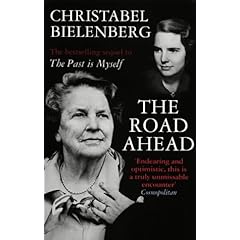
The Road Ahead (Christabel Bielenberg)

--The blurb--
"Following her wartime memoirs in "The Past is Myself", Christabel Bielenberg continues her story from the end of the war. Germany was devastated by war and its aftermath, while to the author Britain seemed grey and exhausted. She was soon appointed "The Observer"'s special correspondent in Germany and, reunited with her husband - technically an enemy alien - she joined the struggle for reconciliation with, and the rebuilding of, a defeated nation. A near-fatal accident to her husband, and her own illness, persuaded the young couple to turn their backs on England and Germany, and make a new start farming in Ireland. Although life was harsh at first, the beautiful scenery of the Wicklow Mountains provided a haven for the family and for the hosts of young people from all over the world who joined them each summer. Christabel became involved with the Peace Women of Northern Ireland, and learned as much as she could about her adopted country."

--The review--
Sequels to anything are usually quite the minefield. They have high expectations attached, both for the author's reputation and for the book itself. There are certainly many successful sequels, so it's clearly not impossible. But equally, there are just as many that fall by the wayside, and The Road Ahead distinguishes itself from the start given the general absence of memoir sequels.

Anybody expecting the same pace and style as found in The Past Is Myself may be disappointed: the war has come to a close, and so the atmosphere is different from the off (it is still charged, but perhaps with more melancholy, and there is more looking ahead than nostalgia). It is also arguably more complex in political content, which again falls prey to Bielenberg's weakness of being quite vague at times. The memoir can be seen at its strongest, perhaps, at Christabel and Peter's arrival in Ireland. Their farming exploits, from finding a property to delivering lambs, inject the memoir with a bit more vigour and humour, contrasting nicely with its previous languorous pace.

Readers of this novel, then, will perhaps be more interested in Christabel and her family on a personal level (even though we arguably hear less about the children than we do about Christabel and her husband), whereas readers of the prequel will perhaps be more history-centred in their interests. This perhaps shows, then, not that expectations for sequels should not be as high, but rather that expectations for follow-ups should certainly not be the same.

Other work by Christabel Bielenberg
The Past Is Myself (1968)

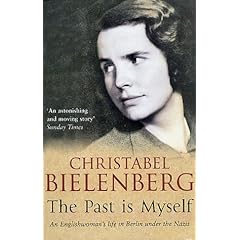
The Past is Myself (Christabel Bielenberg)

--The blurb--
"A story of a British woman, married to a German lawyer shortly before WW2 and her subsequent experience as a German citizen in the war under Nazi rule."

--The review--
There is certainly no shortage in the book market of war memoirs: as well as perhaps the most famous in Anne Frank, interested readers can also choose from those of Zlata Filipovic, Vera Gissing, and Christabel Bielenberg. While these four reflect various points of view of war from various different countries, Bielenberg's memoir differs in that it offers not just political insight, but also political involvement. The imprisonment of her husband, the execution of her friends and her interview with the Gestapo all cause readers to draw breath and admire the shrewd quickwittedness that is displayed by the author. An interesting extra dimension is also brought by the fact that Christabel is British and living in Germany with her German husband, as well as the fact that the memoir is not insular in terms of class (Bielenberg enjoyed a very middle-class upbringing, and this is highly evident, but she seems to slot in equally effectively with the rural working-class community of the tiny Black Forest village in which she lives).

The memoir is tightly-packed and full of plenty of good material from someone who is highly intelligent and humorous, and the quasi-nepotism that is exhibited in her entry to journalism is still grimly reminiscent of today's market. Bielenberg's skill in character development is also notable, which is perhaps further demonstrated by her introduction to the follow-up, where she explains that she has written it due to the curiosity of her readers as to what happened to her and her family next.

This does not mean that the memoir is without its faults: Bielenberg can be extremely vague at times, particularly on the more complicated points of the story, and this is something that also dogs the sequel. Nevertheless, this does happily not prevent the memoir from being an authentic, memorable and well-written piece of history, and should successfully spur all interested readers on to the next instalment.

Other work by Christabel Bielenberg
The Road Ahead (1992)

Thursday, 30 April 2009

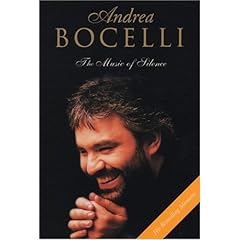
The Music of Silence (Andrea Bocelli)

--The blurb--
"Andrea Bocelli is currently the world's most successful male singer. He has sold an astonishing 60 million albums worldwide and has sung for the Pope and Bill Clinton. His concerts sell out in every continent, and his album Sacred Arias has become the biggest-selling album of all time by a classical vocalist. His single 'Canto Della Terra', was the BBC's official song of Euro 2000. Yet behind this man's extraordinary success lies a story of personal triumph more dramatic than any opera. Andrea Bocelli was blinded at the age of twelve, whilst playing football. Not only did he overcome his sight loss to qualify as a lawyer, but continued to pursue his childhood dream to sing, using Braille musical scores and lyric sheets. He was discovered singing in piano bars by the Italian star Zucchero, before Pavarotti took him under his wing. Bocelli's first CD, Romanza, became the third biggest global hit in 1998, rocketing him to international stardom. Everything he has released since then has either gone Gold or Platinum. His recordings now outsell all of the 'Three Tenors'. Andrea Bocelli: The Music of Silence is Bocelli's true story, told in his own words for the first time. In this frank and charming memoir, Bocelli talks as never before about his blindness(something he has long refused to talk about with the press) the importance of family, and stage fright."
blurb from www.amazon.co.uk

--The review--
The unusual choice to present his life story through an alter ego, Amos Bardi, makes this autobiography a charming and distinctive read, and thankfully Bocelli explains the full details of his choice to the reader in the introduction so that we can proceed with the least of confusion. Written with sophistication and without the help of a ghostwriter, it allows unprecedented insight into Bocelli's life, personality and upbringing, including equally unprecedented frankness regarding the misdemeanours of his youth.

However, parts of this autobiography were far too syrupy. Objection number one is a general point: it appeared at times that Bocelli chose this alter ego/third person passageway so that he could big himself up more than he would have been able to by writing more traditionally, and this egotism became a little grating. Objection number two is more specific - having worked in a nursery, and thus realised that even the smallest child can be 'trained' or prepared to cope with the greatest of changes, I couldn't really sympathise with the great heartbreaking situation of chapter three, when Bocelli's parents leave him at boarding school - but perhaps that's just me. The ending of the autobiography, when Bocelli finally finds fame, was also a little weak and seemed to peter out, but this seems fairly usual in autobiographies where the author's career is not yet over (so there is perhaps no 'natural' conclusion).

The slightly unconventional style may not sit well with everyone, especially since it takes a bit of getting used to, even with the initial explanation. However, it is certainly bound to stick in your head, and allows the polymath underneath the classical crossover star to be deftly revealed.