Showing posts with label light reading. Show all posts

Wednesday, 7 August 2013

Thank You, Jeeves! (PG Wodehouse)

 --The blurb--
 "The valet Jeeves resigns over Bertie's dedicated but somewhat untuneful playing of the banjo. In high dudgeon, Bertie disappears to the country as a guest of his chum Chuffy - only to find his peace shattered by the arrival of his ex-fiancee Pauline Stoker, her formidable father and the eminent loony-doctor Sir Roderick Glossop."

--The review--
As with any other country, stereotypes about Britain abound: afternoon tea. Strawberries and cream. The Queen. Wimbledon. Oxbridge. Butlers. Posh accents. Red buses and telephone boxes. Public schoolboys. The English breakfast. Black cabs. Country estates. And so on. It would be absurd to suggest that Brits indulge in all of these things every day - but equally, most stereotypes arise from the grain of truth that lurks within them. Thank You, Jeeves!- the first full-length novel in PG Wodehouse's Jeeves series - exploits many of these stereotypes to their fullest in the form of a light-hearted romp that becomes more and more farcical at every turn.

The farce is at times difficult to believe, with the events immediately preceding the ending, in particular, seeming rushed, and thrown together purely to bring the novel to a close, rather than providing intrinsic value themselves. However, it's worth remembering at this point the function of farce: the objective of the events is to place characters in untoward situations, and to observe their reactions as they unfold. While the events can be funny, it is the characters who serve even further as the object of the comedy: they are merely pawns in the writer's game, and thus a source of entertainment for us. To this end, Wodehouse deploys the characters and events extremely well.

Furthermore, there are other sources of pleasure in Thank You, Jeeves! beyond the characters' antics. Politically incorrect plot twists, archaic turns of phrase and the sheer extravagance of the setup just involved in having a butler provides plenty of nostalgia for Brits - even if that is a throwback to a time that never really existed. For foreign readers, it gives them a chance to indulge in the classic British stereotypes - even if they know that these stereotypes are not completely true representations of Brits and British life as it is today. Equally, it's possible that those same stereotypes had a cathartic purpose for Wodehouse, who in reality spent most of his life in other countries. Did the deployment of these stereotypes help to remind him of, and even construct for him, an exaggerated version of his homeland? 

To this end, one can wonder if the author intended the events and characters in Thank You, Jeeves! to be sincere or satirical. Given Wodehouse's public-school background and wealthy parents, it's entirely possible that he would have encountered people like these - hence, perhaps, the sharply-drawn characters. However, these same characteristics, and their roots in stereotype, can seem satirical to others - and this, too, is a source of humour, alongside the acerbic one-liners and fast-paced dialogue. The happy ending that Wodehouse produces, which links neatly with the apparently non-sequitur beginning, rounds off the narrative arc beautifully, and concludes this amusing and stress-free read. Off the back of this first Jeeves novel, the entire collection is to be recommended for light relief all year round - and not just in the summer when we all have more time to read - naturally alongside a pot of tea.

other works by PG Wodehouse
A full list of PG Wodehouse's works can be found on Wikipedia. The Jeeves canon consists of 35 short stories and 11 novels.

Saturday, 1 May 2010

The Undomestic Goddess (Sophie Kinsella)

--The blurb--
"Workaholic attorney Samantha Sweeting has just done the unthinkable. She's made a mistake so huge, it'll wreck any chance of a partnership. Going into utter meltdown, she walks out of her London office, gets on a train, and ends up in the middle of nowhere. Asking for directions at a big, beautiful house, she's mistaken for an interviewee and finds herself being offered a job as housekeeper. Her employers have no idea they've hired a lawyer-and Samantha has no idea how to work the oven. She can't sew on a button, bake a potato, or get the #@%# ironing board to open. How she takes a deep breath and begins to cope-and finds love-is a story as delicious as the bread she learns to bake. But will her old life ever catch up with her? And if it does…will she want it back?"

--The review--
When an author or a work receives as much hype and acclaim as Sophie Kinsella, my immediate reaction is to proceed with caution and trepidation; if expectations are not too high, then the comedown is lessened if the outcome is disappointing. In this case, the novel was not the rollicking and hilarious laugh-a-minute-fest that we are told that Kinsella's work is. It is certainly a light read, but like many other light reads, such as those by Jodi Picoult and Dan Brown, it is riddled with flaws.

In Kinsella's case, the reputation that precedes her is almost definitely her downfall: if someone says that something is rip-roaringly funny with such pressing enthusiasm, then chances are that it won't be, and this sad self-fulfilling prophecy is embodied in The Undomestic Goddess: I didn't laugh out loud once. There wasn't even a small inward titter to be had. The forced humour was accentuated and exacerbated by the equally clunky and unnatural-sounding dialogue (which only reminded me of my efforts at written dialogue as a 14-year-old). Kinsella's dialogic skills, or lack of them, contribute to her novel's downward spiral of quality, as combined with the largely two-dimensional and unrealistic characters and the lack of originality in the novel's central moral, what readers end up with is something in dire need of unity and realism. Towards the novel's end, one also has the feeling that Kinsella doesn't know what she wants to happen as she chops and changes between potential outcomes, which, while perhaps intended to build suspense and keep readers on their toes, just ends up being irritating more than anything else.

However, in spite of all of these criticisms, there are some discernible positives in The Undomestic Goddess. Kinsella's imagery is strong and vivid, and, more crucially, like many of the other light reads mentioned above, her skills do not lie in character or humour but in plot, and this does a great deal for a novel's momentum and to keep a reader interested. Despite the author not having a background in the law, the aspects of the plot that relate to this are creative, detailed, well-sequenced, and seemingly accurate. Simultaneously, these parts also remain accessible, and more than anything provide the bulk of the novel's pace and interest. The disparity between the protagonist's legal background and her current situation is highly appealing and rekindles the success in literature of the theme of disguise.

So while Kinsella's novels are hardly likely to be classed as great literature, and while even as easy reads they have a lot of problems, there are certainly some rays of light to be found, which may well increase in number as the author's style develops into something deeper and more wide-ranging.

Other works by Sophie Kinsella
The Secret Dreamworld of a Shopaholic/Confessions of a Shopaholic (2000)
Shopaholic Abroad/Shopaholic Takes Manhattan (2001)
Shopaholic Ties The Knot (2001)
Can You Keep A Secret? (2003)
Shopaholic and Sister (2004)
Shopaholic and Baby (2007)
Remember Me? (2008)
Twenties Girl (2009)
Mini Shopaholic (2010)

Wednesday, 13 May 2009

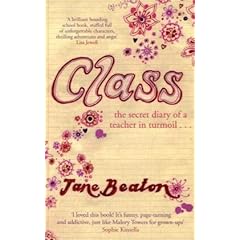
Class: The Secret Diary of a Teacher in Turmoil (Jane Beaton)


--The blurb--
"It's about love lives...

Maggie has been dating Stan for years - safe, comfortable and about as exciting as soggy toast. Can their relationship survive? Especially when Maggie meets David McDonald, her opposite number at the boys boarding school over the hill. Every single girl in the school has a crush on him, but not Maggie ...yet.

It's about school lives...

Two girls. Same form. Simone Kardashian has won a scholarship and is determined to make her parents proud. Fliss Prosser is furious at being so far from home and her friends. As Simone tries desperately to fit in, Fliss tries desperately to get out.

It's about private lives...

Veronica Deveral knows how to manage a school. Routine and discipline are fundamental to her role. But Veronica has a secret that could ruin her career."
from www.amazon.co.uk

--The review--
Would, or do, Scots really say that things 'suck'? In this novel they do, and I'm not sure I really took to it. However, the characters present in the novel are generally its greatest strength - they are vividly painted, not homogeneous, and very human and realistic indeed. There is also, arguably, just the right number of characters for the novel to be suitably both intense and manageable. In a revealing and pertinent title, Jane Beaton addresses class struggle alongside the traditional schooltime tribulations in Class.

While the plot also has its charms, there are also some weaknesses - the end is too abrupt, for instance, and there is definitely a little plagiarism afoot too (methinks the author has been reading a little too much Malory Towers, right down to the headmistress' opening speech to the newbies and the setting of the West Country seaside mansion with its four towers). The Veronica Deveral thread was also a little weak - it wasn't consistently given enough attention throughout the story, so that by the time its denouement was revealed, you didn't actually care enough about the character or the problem. Something else that could have been built up more and had promise was the relationship between Maggie and Simone, subsidiary as it was intended to be. The mystery element, though, was at least relatively taut, keeping the reader guessing until its resolution, and the burgeoning relationship between Maggie and David was well played-out - it is perhaps worth reading the rest of the series (next instalment 2010) for this part of the storyline alone, even if one already suspects that they know how it will end.

Stylistically the novel was too self-consciously old-fashioned in places, which didn't play as well as the modern style that Beaton adopts from the beginning (with lots of name-dropping of brands, such as Topshop, which didn't annoy me as much as it usually does). The old-fashioned elements of style that started to creep in during the novel's second half weakened the notion of the novel as a tale of a modern girls' boarding school, and also highlighted the generally sloppy wrapping up of ideas at the end. There were also some shocking mistakes in my proof copy (e.g. 'pour over' instead of 'pore over' prep) which I hope were resolved in the final edition. The first part of the title - Class - is also an excellent choice given the general demographic of boarding schools and the situations of the characters, but is let down by the subtitle (The Secret Diary of a Teacher in Turmoil), which is not only unnecessary but also inaccurate (given that it is not written in a diary style, but in the third person, and switches frequently between the points of view of different characters).

I am in agreement with one of the Amazon reviewers that this constitutes a fun, nice, lightweight read. However, I do hope that in the next book of the series, we will see a little more of Jane Beaton's personality in the setting and events and a little less of Enid Blyton's.

Thursday, 30 April 2009

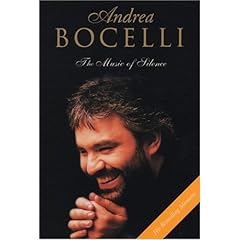
The Music of Silence (Andrea Bocelli)

--The blurb--
"Andrea Bocelli is currently the world's most successful male singer. He has sold an astonishing 60 million albums worldwide and has sung for the Pope and Bill Clinton. His concerts sell out in every continent, and his album Sacred Arias has become the biggest-selling album of all time by a classical vocalist. His single 'Canto Della Terra', was the BBC's official song of Euro 2000. Yet behind this man's extraordinary success lies a story of personal triumph more dramatic than any opera. Andrea Bocelli was blinded at the age of twelve, whilst playing football. Not only did he overcome his sight loss to qualify as a lawyer, but continued to pursue his childhood dream to sing, using Braille musical scores and lyric sheets. He was discovered singing in piano bars by the Italian star Zucchero, before Pavarotti took him under his wing. Bocelli's first CD, Romanza, became the third biggest global hit in 1998, rocketing him to international stardom. Everything he has released since then has either gone Gold or Platinum. His recordings now outsell all of the 'Three Tenors'. Andrea Bocelli: The Music of Silence is Bocelli's true story, told in his own words for the first time. In this frank and charming memoir, Bocelli talks as never before about his blindness(something he has long refused to talk about with the press) the importance of family, and stage fright."
blurb from www.amazon.co.uk

--The review--
The unusual choice to present his life story through an alter ego, Amos Bardi, makes this autobiography a charming and distinctive read, and thankfully Bocelli explains the full details of his choice to the reader in the introduction so that we can proceed with the least of confusion. Written with sophistication and without the help of a ghostwriter, it allows unprecedented insight into Bocelli's life, personality and upbringing, including equally unprecedented frankness regarding the misdemeanours of his youth.

However, parts of this autobiography were far too syrupy. Objection number one is a general point: it appeared at times that Bocelli chose this alter ego/third person passageway so that he could big himself up more than he would have been able to by writing more traditionally, and this egotism became a little grating. Objection number two is more specific - having worked in a nursery, and thus realised that even the smallest child can be 'trained' or prepared to cope with the greatest of changes, I couldn't really sympathise with the great heartbreaking situation of chapter three, when Bocelli's parents leave him at boarding school - but perhaps that's just me. The ending of the autobiography, when Bocelli finally finds fame, was also a little weak and seemed to peter out, but this seems fairly usual in autobiographies where the author's career is not yet over (so there is perhaps no 'natural' conclusion).

The slightly unconventional style may not sit well with everyone, especially since it takes a bit of getting used to, even with the initial explanation. However, it is certainly bound to stick in your head, and allows the polymath underneath the classical crossover star to be deftly revealed.

Friday, 17 April 2009

Le CV de Dieu (Jean-Louis Fournier)

--The blurb--
"Heaven was finished, earth was finished, the animals were finished, and man was finished. God thought that he was done too, and descended into a deep melancholy. He didn't know what to do with himself next. He did a little pottery, kneading a ball of earth, but his heart was no longer in it. He no longer had confidence in himself, he had lost faith. God no longer believed in God. He urgently needed something to do, new projects and big tasks. He therefore decided to seek work, and like everyone else, he has to draft his CV..."
from www.amazon.fr; translation mine

--The review--
We may be on the cusp of Jean-Louis Fournier's work being catapulted further into the public eye. Not to be confused with the more famous Alain-Fournier (author of the acclaimed Le Grand Meaulnes), this M. Fournier is barely known outside of France, with his works at present being only available in French. This could, however, all be about to change, with the esteemed Prix Femina, a literary prize created in 1904, being awarded to his latest offering (Where Are We Going, Dad?) last year. If this work is translated into English, others could soon follow, including the delightful light read God's CV. As well as being quite short, the interview format between God and the director of a company is frequently interrupted by various personality tests filled out by the man himself, as well as (among other things) medical and law papers, and correspondence between God and the Pope.

God is presented much in the way ancient Greek legends portrayed their gods: as an ultimately fallible being not that far away from being human, but having the ability to wield awesome power. This Bruce-Almighty quality is quite likeable and makes the character of God far less irritating than he could have been: as well as displaying modesty and creativity, he also suffers from crises of confidence, leaves things to the last minute, and occasionally even displays streaks of evil that Hitler would be proud of. Some good attempts are made by the author to explain things like why God created disability (variety's the spice of life, innit) and why the good die young, even if these are not always followed through. In the latter scenario, the analogy of a cinema is used: you go in (at the beginning of your life), watch the film (your life plays out) and then you exit the cinema (you die), but this is not entirely successful, as the reason why people die young, or are dragged out of the movie theatre kicking and screaming halfway through the film, is not really addressed or explored properly. However, given the highly fallible God that Fournier has set up for us, chances are this was the intention.

The book is well-written with plenty of humour, and the setup of various documents being used to tell the story is a successful narrative device that other authors, such as Paul Torday, have used since. The length is just about right too, keeping the plot taut and concise. The notions of God, religion, Satan and hell are themes that seem to crop up repeatedly in Fournier's oeuvre, so I would be interested to see his other interpretations of the idea. In God's CV, we are even confronted with the suggestion that God and the devil are one and the same, meaning that this 'light read', then, actually turns out to be considerably dark in places. However, the ending is lighthearted, slightly humorous in a sinister sort of way, and completely appropriate, rounding the book off nicely. In a world of dark times, we need books like this that simultaneously confront and deflect from the world's major concerns through deftly-woven black humour. If the Prix Femina has any clout at all, it is to be hoped that soon all you anglophones will be able to read this too.

Other works by Jean-Louis Fournier
Where Are We Going, Dad?/Où on va, papa? (2008)
Blasted God!/Satané Dieu! (2005)
Little Meaulnes/Le Petit Meaulnes (2003)
I'm Not Going To Hell/J'irai pas en enfer (2001)
The Dark Girl/La Noiraude (1999)
My Dad Never Killed Anyone/Il a jamais tué personne mon papa (1999)
I'll teach you to be polite, little idiot/Je vais t'apprendre la politesse, p'tit con (1998)

Wednesday, 31 December 2008

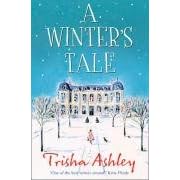
A Winter's Tale (Trisha Ashley)


--The blurb--
"A charming romantic comedy about a hard-up single mum inheriting a stately home - and a host of headaches. The perfect novel for curling up with during the long winter nights. Sophy Winter is not your typical Lady of the Manor. When she unexpectedly inherits Winter's End - a crumbling mansion in the beautiful Lancashire countryside - it seems like all her prayers have been answered. She eagerly swaps life as an impoverished housekeeper in favour of her own team of staff. But Sophy quickly realises the challenge on her hands - the house is decrepit and its eccentric inhabitants are a nightmare. And once it is discovered that Winter's End played host to a young Shakespeare, the entire village of Sticklepond becomes curious about Sophy's plans, especially charming Jack Lewis. But is he really smitten by Sophy, or her newly-acquired cash? Meanwhile, Sophy's gorgeous head gardener Seth is the strong and silent type. But does his passion bloom for anything beyond the horticultural? As Sophy gets to grips with squabbling relatives, collapsing buildings and the ghostly presence of one of her ancestors, she wonders if Winter's End is not so much a gift from the gods as a mixed blessing. ..A charming romantic comedy for fans of Katie Fforde and Jill Mansell - guaranteed to thaw the coldest of hearts!"
blurb from www.amazon.co.uk

--The review--
Given to me as a Christmas gift due to the tenuous Shakespeare connection, I was concerned from the outset that I would not enjoy this piece of obvious 'chick lit' from this author who was unknown to me. However, the inaccuracy of my own prejudice soon combined curiously with the accuracy of a first impression. The main character, Sophy, was unconvincing: her first-person narrative was littered with ill-aimed humour about trying to keep off the extra pounds, which didn't seem to come very naturally in keeping with the rest of the writing, and the idea of the woman who apparently couldn't keep her brain out of her knickers (without even any well-written sex scenes to compensate) was not only irritating but a generally weak and lazy plot device. Ashley also allows the villain of the piece to escape far too easily with little comeuppance, which smacks of the author's impatience to finish the novel, which is never preferable to a desire to finish a piece of work well. However, this feeble characterisation (and the equally dubious characterisation of Seth) thankfully did not preclude engagement with other characters in the novel, such as Alys and Lucy. The novel would have been a far more valuable addition to the chick-lit canon without the frankly silly attempts at romance et al.

This all begs the question of what on earth kept me reading this book to the end. It is indeed comfort food for the brain, with some well-drawn characters and a suitably picturesque setting. However, where Ashley really comes into her own is where the plot is concerned: apart from the villain's escape from justice, the threads of the novel's plot generally tie together well, with thoughtful and yet still accessible links with Shakespeare and his work as a sort of bonus. The running of stately homes is well-researched without enough detail to bore the reader; the set-up, romance aside, nicely combines realism with escapism. It is also, perhaps needless to say, easy to read: vocabulary and syntax meant that I raced through it. Ashley also shows rare glimmers of excellence in her writing skills, such as using 'spectral coral' as a simile, which lit up the otherwise cosy writing.

While my virginal experience with Trisha Ashley's work would have been much improved with the absence of clumsy attempts to 'connect' with the author's alleged audience, this was not an entirely joyless experience - which, I suspect, was the main aim after all.

Other works by Trisha Ashley
Good Husband Material (2000)
Every Woman For Herself (2002)
The Urge to Jump (2002)
Singled Out (2003)
The Generous Gardener (2004)
Sweet Nothings (2007)
Lord Rayven's Revenge (2008)
Sowing Secrets (2008)
Happy Endings (2008)