Showing posts with label john steinbeck. Show all posts

Sunday, 23 March 2014

The Pearl (John Steinbeck)

--The blurb--
"Kino is a desperately poor Mexican-pearl diver. But when he finds 'The Pearl of the World' he believes that his life will be magically transformed. Obsessed by his dreams, Kino is blind to the greed, fear and even violence the pearl arouses in his neighbours - and himself."

--The review--
John Steinbeck is known for the scenic descriptions of desolate yet beauteous landscapes that he portrays. When combined with the moral dilemmas that his characters often face, or the grave situations in which they find themselves, their power is increased. 

This is equally true in The Pearl, where Kino's discovery of a valuable black pearl drives him to the desire to use it to change his family's life for the better. Barren Mexican panoramas are lit up by his love for his family and the simplest pleasures of his life, and just as quickly darkened by the increasing horror of his quest to sell the pearl.

In many ways this is done to great effect: we, the readers, are on Kino's side, urging him on and longing for his success. As mentioned, the descriptions of emotions and the natural world are bewitching, and the short length of The Pearl means that the story's pace is kept taut throughout.

However, it is all dashed to pieces almost from the start by our knowledge that Kino is doomed - if he is able to sell the pearl successfully, it will be an even shorter story than it already is, and as his agony is drawn out, we have the sinking feeling that there is less and less chance of it ending well. This is arguably the novella's weakness: in Of Mice And Men, which is almost as short, there was always a tantalising ambiguity and a chance that the dream could come true. It is clear early on in The Pearl, however, that this is unlikely to be the case.

And yet we read on. Why? This is testament to the power of Steinbeck's storytelling. It's like seeing a film that's based on a book you've already read: you have a clear idea of how it will end, but you want to see how the director will portray it. In that sense, Steinbeck does step into that role of film director, painting clear visions in front of our eyes of Kino's flight from (and, simultaneously, towards) disaster - and it is therefore this magical quality that makes the story indeed a rare pearl. 

Other works by John Steinbeck (selection)
Cup of Gold (1927)
The Red Pony (1933)
Tortilla Flat (1935)

Of Mice and Men (1937)
The Grapes of Wrath (1939)
East of Eden (1952)

Tuesday, 21 July 2009

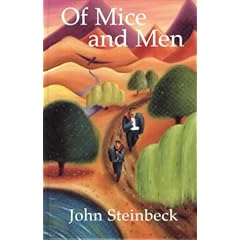
Of Mice and Men (John Steinbeck)

--The blurb--
"“Guys like us, that work on ranches, are the loneliest guys in the world. They got no family. They don’t belong no place ...With us it ain’t like that.We got a future ... because I got you to look after me and you got me to look after you.”

George and Lennie are migrant American labourers –the one alert and protective and the other strong, stupid and potentially dangerous. This is the powerful story of their relationship and their dreams of finding a more stable and less lonely way of life."

--The review--
It is arguably the job of an author to bring to life a world that is previously unknown to their readers, and yet the scene that opens Of Mice and Men is perhaps more universal than this: the paradisiacal setting of American countryside is awash with rich colour and is almost synaesthetic in its ability to make words morph into textures and sounds and breaths of sunny breeze. Steinbeck then goes on, however, to narrow down the experience and fuse the pan-global landscape with the more specific toils and backgrounds of the two main characters.

Starting off very slowly and languorously, Steinbeck allows the reader to savour every word and moment before taking them on a rollercoaster of increasingly serious events whereby George and Lennie are under ever-more serious threats to their jobs, dreams and lives. Steinbeck successfully manages to provoke pathos in the reader towards each of these characters, though for very different reasons, and keeps the plot incredibly tight and concise, which is perhaps the main contributor to its success.

The novel's ending is both finished and unfinished, leaving the reader stunned and with many unanswered questions about the nature of friendship. Is the previously paradisiacal arena now just a personal hell? And does George's final action make him the greatest of enemies or the greatest of friends? In addition to this, the novella raises the issue throughout of how mental illness is, was and should be treated, and it is perhaps Steinbeck's treatment of these timeless themes that reveals the key to the enduring success of his work. It perhaps proves that an author's job is therefore not entirely to bring a different world to their readers, but rather to combine it with themes that are familiar across humanity in order to create a truly great story that echoes down the ages.

Other works by John Steinbeck (selection)
Cup of Gold (1927)
The Red Pony (1933)
Tortilla Flat (1935)
The Grapes of Wrath (1939)
The Pearl (1947)
East of Eden (1952)