Showing posts with label novella. Show all posts

Sunday, 11 April 2010

On Chesil Beach (Ian McEwan)

--The blurb--
"The year is 1962. Florence, the daughter of a successful businessman and an aloof Oxford academic, is a talented musician. She dreams of a career on the concert stage and of the perfect life she will create with Edward, the earnest young history student she met by chance and who unexpectedly wooed and won her heart. Edward grew up in the country on the outskirts of Oxford, where his father, the headmaster of the local school, struggled to keep the household together and his mother, brain-damaged in an accident, drifted in a world of her own. Edward's native intelligence, coupled with a longing to experience the excitement and intellectual fervor of the city, had taken him to University College in London. Falling in love with the accomplished, shy, and sensitive Florence - and having his affections returned with equal intensity - has utterly changed his life. Their marriage, they believe, will bring them happiness and the confidence to fulfill their true destinies. The glowing promise of the future, however, cannot totally mask their worries about the wedding night. Edward, who has had little experience with women, frets about his sexual prowess. Florence's anxieties run deeper: she is overcome by conflicting emotions and a fear of the moment she will surrender herself to her husband in their honeymoon suite."

--The review--
The Swinging Sixties are years that are fondly held in Western consciousness, life being free and revolutionary, where personal independence was gained and old imperial shackles lost. This perception stands in stark contrast to the prim and frigid setting of McEwan's On Chesil Beach, where the quiveringly intense setting perfectly reflects the excitement and nerves of the evening, while allowing us to get to know the characters via the dreamlike leaps through time created by a non-linear narrative. The courtship between Florence and Edwards is gently, fluidly and organically traced, and McEwan's skill shines through in doing this: while simultaneously delighting readers with his eloquent descriptions of the scenery, and building two very realistic and human characters through the story of their relationship, tension is also layered effectively, compelling the reader to continue.

In reading this novel, we perhaps gain a truer insight into the situations of several young people of the 1960s: confined by a lack of education relevant to the real world, and still forced in many ways to conform to parental and societal expectation, there was a very real risk of being trapped for life in an unhappy or unfulfilling relationship due to the stigma associated with separation, divorce, and sex before marriage. The difference in this case is that Florence and Edward do not end up taking that risk, and the reader is left to decide if they made the right choice, and whether their ensuing lives are happy or unhappy.

The ending of this novella is slightly Truffaut-esque, with quick and slightly avantgarde and nostalgic recapitulations of how the characters' lives transpired, and while others might find this conciseness pleasing, others might find it to be more of a let-down. However, the novella's overall result is moving, beautiful, inspiring and slightly tragic, standing testament to McEwan's ongoing talent.

Other works by Ian McEwan
First Love, Last Rites (1975)
In Between The Sheets (1978)
The Cement Garden (1978)
The Comfort of Strangers (1981)
The Child in Time (1987)
The Innocent (1990)
Black Dogs (1992)
Enduring Love (1997)
Amsterdam (1998)
Atonement (2001)
Saturday (2005)
Solar (2010)

Sunday, 20 September 2009

La grammaire est une chanson douce (Erik Orsenna)

--The blurb--
"In Orsenna's witty rumination on words and grammar, 10-year-old Jeanne and her 14-year-old brother, Thomas, are shipwrecked on a strange island where words have become independent. Rendered mute, the siblings visit the Word Market, where one can buy the perfect word for any occasion. They also travel to a town full of independent words that strut around without the need for human beings to utter them. Such word adventures help restore the siblings' power of speech."

--The review--
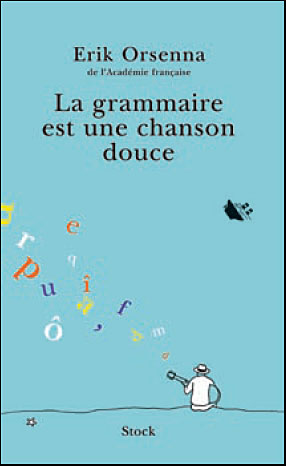
Erik Orsenna is possibly one of the world's few remaining polymaths. He is not only a graduate of the London School of Economics (with a degree in politics, philosophy and economics), but also wrote a book to rival Nick Hornby's 31 Songs (in the form of History of the World in Nine Guitars, with Thierry Arnoult), and is known for writing books with titles that professional pedants die for (as well as Grammar is a Gentle, Sweet Song, he has also written the as-yet-untranslated Les chevaliers du subjonctif). Further to this, there's another reason why his books should be more widely known to adults: the editions of La grammaire... published by the French publisher, Stock, contain sublime illustrations, which are also by the author. Adults sometimes like pictures in their books, too (even if they don't want to admit it).

Happily, the Saint-Exupery-style illustrations are not the only positive aspect of La grammaire.... Orsenna is skilful in his use of child characters, putting him on a par with the more well-known Jostein Gaarder (particularly in relation to Gaarder's Hello? Is There Anybody There?) and with the work that made Antoine de Saint-Exupery so stratospherically famous, Le Petit Prince. Other similarities to these books include Orsenna's fantasy-soaked setting and imaginative style, so it is understandably pleasing to have this Saint-Exupery link confirmed towards the end of the novella, even if the author isn't necessarily someone whose work Orsenna desires to emulate directly.

Orsenna is also wonderfully expressive and didactic, particularly in one passage where he compares constructing a phrase to decorating a Christmas tree: "You start with the naked tree, and then you decorate it to your whims and desires...Pay attention to your phrase: if you burden it with too many garlands and baubles - that is to say adjectives, adverbs and the like - it can collapse too." Whether Orsenna is deliberately didactic is difficult to say, but either way, he is not irritating in this, and he is successful. Overall, the story is well-constructed, its ending is satisfying, and its two main characters, Jeanne and Thomas, are as well-drawn as the other characters that they meet along the way. This is an enchanting hook into Orsenna's work, and, with its cleverness and wit, proves enjoyable for children and for grammar buffs alike.

Other works by Erik Orsenna*
Portrait of the Gulf Stream: In Praise of Currents (2008)
Tidings from the Isle of Flight (2005)
History of the World in Nine Guitars (1999)
André Le Notre: Guardian to the Sun King (1999)
Love and Empire (1993)

*noted here are only the works that have been translated into English; a wider selection is available in French.

Tuesday, 21 July 2009

Of Mice and Men (John Steinbeck)

--The blurb--
"“Guys like us, that work on ranches, are the loneliest guys in the world. They got no family. They don’t belong no place ...With us it ain’t like that.We got a future ... because I got you to look after me and you got me to look after you.”

George and Lennie are migrant American labourers –the one alert and protective and the other strong, stupid and potentially dangerous. This is the powerful story of their relationship and their dreams of finding a more stable and less lonely way of life."

--The review--
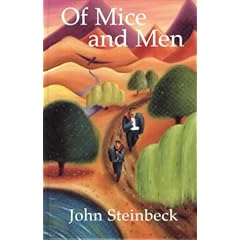
It is arguably the job of an author to bring to life a world that is previously unknown to their readers, and yet the scene that opens Of Mice and Men is perhaps more universal than this: the paradisiacal setting of American countryside is awash with rich colour and is almost synaesthetic in its ability to make words morph into textures and sounds and breaths of sunny breeze. Steinbeck then goes on, however, to narrow down the experience and fuse the pan-global landscape with the more specific toils and backgrounds of the two main characters.

Starting off very slowly and languorously, Steinbeck allows the reader to savour every word and moment before taking them on a rollercoaster of increasingly serious events whereby George and Lennie are under ever-more serious threats to their jobs, dreams and lives. Steinbeck successfully manages to provoke pathos in the reader towards each of these characters, though for very different reasons, and keeps the plot incredibly tight and concise, which is perhaps the main contributor to its success.

The novel's ending is both finished and unfinished, leaving the reader stunned and with many unanswered questions about the nature of friendship. Is the previously paradisiacal arena now just a personal hell? And does George's final action make him the greatest of enemies or the greatest of friends? In addition to this, the novella raises the issue throughout of how mental illness is, was and should be treated, and it is perhaps Steinbeck's treatment of these timeless themes that reveals the key to the enduring success of his work. It perhaps proves that an author's job is therefore not entirely to bring a different world to their readers, but rather to combine it with themes that are familiar across humanity in order to create a truly great story that echoes down the ages.

Other works by John Steinbeck (selection)
Cup of Gold (1927)
The Red Pony (1933)
Tortilla Flat (1935)
The Grapes of Wrath (1939)
The Pearl (1947)
East of Eden (1952)