Showing posts with label science fiction. Show all posts

Saturday, 31 August 2013

Flowers for Algernon (Daniel Keyes)

 --The blurb--
"Charlie Gordon, IQ 68, is a floor sweeper, and the gentle butt of everyone's jokes, until an experiment in the enhancement of human intelligence turns him into a genius. But then Algernon, the mouse whose triumphal experimental transformation preceded his, fades and dies, and Charlie has to face the possibility that his salvation was only temporary."

--The review--
The recent news story about miniature human brains being grown in laboratories has the potential to spark a flurry of debate. The positives and negatives of such developments are equally legion. On the plus side, such in vitro experiments could allow neurological disorders such as autism and schizophrenia to be much better understood, and also enable a reduction in animal experimentation (ever a hot topic). However, on the more sinister side, others may argue that such experiments are the stuff of science fiction: they play God, pose a threat to our moral and ethical codes, and are the beginning of a slippery slope towards experiments that could have catastrophic consequences (such as the growth of fully-sized human brains). But forty-seven years ago, in true dystopian tradition, novelist Daniel Keyes was already predicting some of the disastrous after-effects of tampering with the human brain, in his debut, entitled Flowers For Algernon

The narrator, Charlie, who tells of his experiences epistolary-style through a series of progress reports, seems part-inspired by Lennie Small, the developmentally-delayed protagonist in John Steinbeck's Of Mice And Men (published nearly 30 years before Flowers For Algernon, so already a classic by the time of Keyes' publication), thanks to the two characters' similarly well-meaning, easy-going attitudes, and their limited means of oral and written expression. However, Keyes does not produce a carbon copy of Lennie in Charlie, who is all his own character thanks to his keenness to learn and the unusual nature of the situation in which he has been placed. Despite Charlie's basic literacy, both his personality and the situation are expressed clearly, inspiring immediate affection in the reader. Sympathy is also invoked, as we are able to see aspects of the way people treat Charlie differently to how he views it; this, though, naturally changes as the story progresses.

As well as Charlie's understanding of the world around him, the style in which he writes also develops, with vocabulary choices becoming more sophisticated and spelling and punctuation errors disappearing, indicating his increasing intelligence. Keyes does not always manage this transition between entries smoothly, but this can be forgiven thanks to the largely uncharted nature of the surgery undergone by Charlie - in these circumstances, the notion of rapid or erratic progress is not entirely unrealistic, especially in the context of the unpredictable behaviour and progress already mentioned by Charlie in relation to murine test subject Algernon.

Algernon the mouse is key to the novel in more ways than simply providing an intriguing title. He provides a realistic basis for the surgery carried out on Charlie (scientific tests and new medicines are always carried out on animals before being tested on humans), but also a powerful precursor and foreshadow of Charlie's own fate. Less literally, the mouse - often perceived as modest and insignificant in both life and literature - symbolises the equally vulnerable position occupied not just by Charlie but by the disabled in general, who often find themselves at the mercy of those who are more powerful or simply more numerous. This is perhaps an even more significant symbol given that the disability rights movement and independent living movement were just beginning to get going in the decade in which Flowers For Algernon was published.

It is hardly surprising that the book has never been out of print since its initial publication in 1966. As well as the pathos evoked and the taut narrative arc being worthy of commendation, there is also the fact that the issues addressed by Keyes are as relevant today as they were almost fifty years ago. The novel's ability to alter perspectives on disability rights in a hard-hitting yet accessible style means that it should be read by every man, woman and teen, with Keyes successfully getting across his message that "foresight may be vain", and that "the best laid schemes of mice and men/Go often awry" - and all through a sci-fi-style ode to a man and a mouse.

other works by Daniel Keyes
The Touch (1968)
The Fifth Sally (1980)
The Minds of Billy Milligan (1981)
Unveiling Claudia (1986)
The Milligan Wars (1994)
Until Death (1998)
Algernon, Charlie and I: A Writer's Journey (2000)
The Asylum Prophecies (2009)

Sunday, 13 January 2013

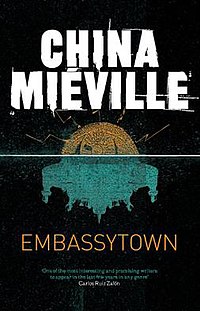
Embassytown (China Miéville)

--The blurb--
"Embassytown: a city of contradictions on the outskirts of the universe. Avice is an immerser, a traveller on the immer, the sea of space and time below the everyday, now returned to her birth planet. Here on Arieka, humans are not the only intelligent life, and Avice has a rare bond with the natives, the enigmatic Hosts - who cannot lie. Only a tiny cadre of unique human Ambassadors can speak Language, and connect the two communities. But an unimaginable new arrival has come to Embassytown. And when this Ambassador speaks, everything changes. Catastrophe looms. Avice knows the only hope is for her to speak directly to the alien Hosts. And that is impossible."

--The review--
Dystopian literature has a strong history, and any newcomer on the scene has a hard nut to crack. However, with positive coverage in several high-quality publications such as the Financial Times, China Miéville's Embassytown, published in 2011, is doing a great deal to bring this writer to the fore: Miéville's reputation has been building up gradually, with his first novel being published in the year 1998. The Guardian even went as far as to aver that Embassytown would be nominated for the Booker Prize. So how far does this novel contend with established dystopian classics such as The Handmaid's Tale, The Time Machine, and Brave New World?

All of the initial signs are promising, with Miéville raising questions from the book's very first moments. What is the embassy of the title? Who are the shiftparents? What is the voidcraft and the Arrival Ball? What is the edge? Confusing yet enthralling, Embassytown is packed with fantastical and charming oddities, such as string septets. Imaginative, rich, and full of possibilities for future rereads, Miéville cleverly combines intriguing new aspects with hints of familiarity: the "thumb-sized vespcams hunting for images to transmit" without doubt carry echoes of the surveillance society in which some people argue that we live today. To begin with, the novel is poetic yet lucid; we are lulled by the author's clever use of alliteration, and simultaneously unsettled by the content. Continued questions make us keep reading; we want to know why communication will be difficult for the principal characters, and what the meanings of Miéville's foreboding neologisms (miab, yawl...) could be. The language of the ambassadors and hosts also proves a masterful creation that ultimately constitutes one of the novel's highlights.

However, as time goes on Miéville fails to build on the aspects of society that we already find familiar. One of the hallmarks of good science fiction is the writer's ability to build on the reader's fear that one day this could be their world; however, Miéville focuses more on the realm of fantasy, and many of the bizarre constructions and the characteristics of the people that make up Embassytown go unexplained. Even though characters and situations are developed, readers are left with too many crucial questions unanswered for these to be fully effective or moving. This is not usually a characteristic of well-written science fiction; it is possible, however, that readers who are better versed in reading a wider range of science fiction will benefit more from Embassytown and be better able to read between the lines.

While the author could have the chance to take his place in the dystopian fiction hall of fame, Embassytown would need far greater clarity for this to occur (which could be resolved if Miéville slackened his writing pace, as he currently seems to publish novels relatively frequently). However, the earlier comment about rereads still stands; the novel is so rich in detail and ambition that it's possible that readers' questions may be answered upon further inspection.

other novels by China Miéville
King Rat (1998)
Perdido Street Station (2000)
The Tain (2002)
The Scar (2002)
Iron Council (2004)
Un Lun Dun (2007)
The City and The City (2009)
Kraken (2010)
Railsea (2012)

Monday, 14 March 2011

And Another Thing (Eoin Colfer)

--The blurb--
"An Englishman's continuing search through space and time for a decent cup of tea . . . 
Arthur Dent's accidental association with that wholly remarkable book, The Hitchhiker's Guide to the Galaxy, has not been entirely without incident. Arthur has traveled the length, breadth, and depth of known, and unknown, space. He has stumbled forward and backward through time. He has been blown up, reassembled, cruelly imprisoned, horribly released, and colorfully insulted more than is strictly necessary. And of course Arthur Dent has comprehensively failed to grasp the meaning of life, the universe, and everything. Arthur has finally made it home to Earth, but that does not mean he has escaped his fate. Arthur's chances of getting his hands on a decent cuppa have evaporated rapidly, along with all the world's oceans. For no sooner has he touched down on the planet Earth than he finds out that it is about to be blown up . . . again."

--The review--
When it comes to novel sequels, whether authorised or unauthorised by the original author's estate, we as readers always feel our hackles raised in suspicion. Pamela Cox's sequels to Enid Blyton's school stories and Gilbert Adair's follow-ups to the Peter Pan series leave me cold just thinking about them, whereas Alexandra Ripley's sequel to Gone With The Wind was, to my mind, a success. But where does Eoin Colfer's attempt to follow in the footsteps of the late great Douglas Adams fall?

When writing a sequel of a series originally started by another person, two types of fidelity are important: fidelity to characters and fidelity to style. Happily, Colfer is loyal on both of these counts while simultaneously putting his own stamp on the enterprise, having characters do things that we would expect of them as the plot is taken in new and hilarious directions. Equally, he adheres faithfully to Adams' near-inimitable sharp wit and non-sequitur humour, carrying the torch with ease for Adams fans everywhere. His prose not only caused me to laugh out loud on several occasions, but also made me forget that it was not Adams himself taking us through the final instalment. Imitating a writer's style to such an impressive degree is a laudable feat that shouldn't be ignored, and was perhaps helped along by Colfer's own humility and awe (of which more is detailed in the book's notes).

In being faithful to the standard set by Adams prior to this, Colfer also pays the respect that is due to the series by carrying through Adams' wishes for a sixth instalment to be written in a style that he would have approved of. While other reviewers have found the story to be "well-written but weak", I did not see any obviously glaring holes - but then again I am not an obsessive fan of the original series, merely enjoying them from time to time rather than scrutinising every available detail.

All in all, a satisfying, valedictory, respectful and downright hilarious conclusion to a much-revered and beloved series.

A selection of other works by Eoin Colfer
The Wish List (2000)
Artemis Fowl series (2001-present)
The Supernaturalist series (2004-present)
Half Moon Investigations (2006)
Airman (2008)
Plugged (2011)

Sunday, 21 February 2010

The Man In The High Castle (Philip K Dick)

--The blurb--
"It is 1962 and the Second World War has been over for seventeen years: people have now had a chance to adjust to the new order. But it's not been easy. The Mediterranean has been drained to make farmland, the population of Africa has virtually been wiped out and America has been divided between the Nazis and the Japanese. In the neutral buffer zone that divides the two superpowers lives the man in the high castle, the author of an underground bestseller, a work of fiction that offers an alternative theory of world history in which the Axis powers didn't win the war. The novel is a rallying cry for all those who dream of overthrowing the occupiers. But could it be more than that? Subtle, complex and beautifully characterized, The Man in the High Castle remains the finest alternative world novel ever written, and a work of profundity and significance."

--The review--
Supposedly a revolutionary novel for the world of science fiction (in terms of taking it away from spaceships and so forth) when it was first published, The Man In The High Castle is considered by many of the late novelist's fans to be among his finest work, even if he is most famous today for the intriguingly titled Do Androids Dream of Electric Sheep?. However, while The Man In The High Castle may well have its legions of loyal Philip K Dick fans behind it, the novel cannot claim the accolade of being the most accessible dystopian novel to grace the bookshelves. While this opinion is possibly attributable to my own stupidity, I found that upon reading the introductory notes after finishing reading the novel, some points had gone completely over my head.

While the novel picked up pace in the second half, it was slow to gather momentum and the characters and situations seemed two-dimensional, despite their basis on previous world history. Equally, the author alternated frequently between settings and relationships, which didn't always make the novel the easiest to follow. On the up side, it was well-written even if it didn't always prove itself to be lucid, one found oneself caring more about what would happen and actually meeting the legendary man in the high castle towards the end, and the ending was more than satisfactory. It is clearly a multi-layered and complex work, which causes it to merit further readings. It is also a clever novel that is ambitious in its scope, though the various criminal activities and gory details that are also elaborated upon within its pages perhaps detract from its dystopian background.

Even though Dick's works deserve further investigation, this novel probably isn't the best one to start with if you're unfamiliar with his output. It's easy to see how his following has been more underground, and how this isn't his most popular or famed novel, losing that accolade to the one about the androids and the sheep. Empathy with the characters was difficult to achieve, but despite this being a common feature of dystopian novels, it may also partly be a reason why readers may ditch this and turn to (say) an Orwell, Huxley or Atwood novel. However, don't give up on it (or on Philip K Dick's work) completely: I suspect that it's the multiple layers that provide long-term rewards rather than instant gratification.

Other works by Philip K Dick
See here

Tuesday, 14 July 2009

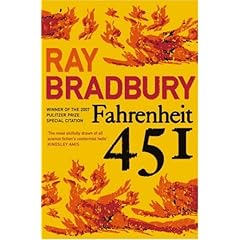
Fahrenheit 451 (Ray Bradbury)

--The blurb--
"In Fahrenheit 451, Ray Bradbury's classic, frightening vision of the future, firemen don't put out fires--they start them in order to burn books. Bradbury's vividly painted society holds up the appearance of happiness as the highest goal--a place where trivial information is good, and knowledge and ideas are bad. Fire Captain Beatty explains it this way, "Give the people contests they win by remembering the words to more popular songs.... Don't give them slippery stuff like philosophy or sociology to tie things up with. That way lies melancholy."
Guy Montag is a book-burning fireman undergoing a crisis of faith. His wife spends all day with her television "family", imploring Montag to work harder so that they can afford a fourth TV wall. Their dull, empty life sharply contrasts with that of his next-door neighbour Clarisse, a young girl thrilled by the ideas in books, and more interested in what she can see in the world around her than in the mindless chatter of the tube. When Clarisse disappears mysteriously, Montag is moved to make some changes, and starts hiding books in his home. Eventually, his wife turns him in, and he must answer the call to burn his secret cache of books. After fleeing to avoid arrest, Montag winds up joining an outlaw band of scholars who keep the contents of books in their heads, waiting for the time society will once again need the wisdom of literature."

--The review--
The canon of dystopian novels is generally distilled in the public consciousness to three novels: George Orwell's 1984, Aldous Huxley's Brave New World, and Margaret Atwood's The Handmaid's Tale. However, there are many worthy others, including the works of HG Wells, and Fahrenheit 451 by Ray Bradbury. Centring on the theme of book burning (a subject familiar to any British history student born after about 1980 due to the prevalence of Nazi Germany in the syllabus), Bradbury takes the image further with a series of what-ifs, making soap operas more interactive and scary, and magnifying the populace that is already constantly plugged into MP3 players by extending this to include it as their source of news as well.

Scarily, the novel was written only in 1953, before the mass paranoia created by the red scare had taken full force, and before MP3 players had even been invented. It is this relevance and sense of prophecy, as with other dystopian novels, that ensures enduring success. Bradbury's style creeps up on you and intensifies as you read, making this a real page-turner. Even the characters that you only meet fleetingly have vivid personalities, meaning that the novel's cast is printed almost indelibly on the reader's consciousness. The plot is tightly sustained and remains accessible while still maintaining some details of complexity, making it not only a book that you'll race to finish, but a book that you want to return to as well. Haunting and enjoyable, and yet imbued with humanity, this is a readable and thought-provoking introduction to Ray Bradbury's work that deserves to be included more ostensibly in the list of must-read dystopian literature.

Other works by Ray Bradbury
The Martian Chronicles (1950)
Dandelion Wine (1957)
Something Wicked This Way Comes (1962)
The Halloween Tree (1972)
Death is a Lonely Business (1985)
A Graveyard for Lunatics (1990)
Green Shadows, White Whale (1992)
From the Dust Returned (2001)
Let's All Kill Constance (2004)
Farewell Summer (2006)