Saturday, 28 April 2012

Helen Keller In Love (Rosie Sultan)

--The blurb--
"Helen Keller has long been a towering figure in the pantheon of world heroines. Yet [...] Rosie Sultan’s debut novel imagines a part of Keller’s life she rarely spoke of or wrote about: the man she once loved. When Helen is in her thirties and Annie Sullivan is diagnosed with tuberculosis, a young man steps in as a private secretary. Peter Fagan opens a new world to Helen, and their sensual interactions—signing and lip-reading with hands and fingers—quickly set in motion a liberating, passionate, and clandestine affair. It’s not long before Helen’s secret is discovered and met with stern disapproval from her family and Annie. As pressure mounts, the lovers plot to elope, and Helen is caught between the expectations of the people who love her and her most intimate desires."

--The review--
It is easy to see what inspires generations of people about Helen Keller: the stoicism, grace, modesty and talent that pervades her writing would be nothing short of remarkable even in someone 'ordinary', let alone in someone living with Keller's disabilities today - and even more so given the limitations in treating someone who was blind and deaf during Keller's lifetime. But naturally this places expectations on someone to say that they are coping well, and so to seize upon a time in Keller's life where she more ostensibly did not cope well is arguably a bold move. But this is what Sultan does in her first novel, Helen Keller In Love, by investigating a passionate love affair that took place between Keller and her private secretary which sadly did not come to the fruition that he allegedly promised her.

The two aspects of this work - history and fiction - are equally intriguing. Historically, Helen Keller In Love is clearly the result of hours and months (if not years) of diligent research by the author. With documentary evidence that this affair occurred, it brings new focus and perspective to Helen Keller's life. For a woman who was at pains to emphasise just how normal her life was, we are suddenly given part of her life which was not 'normal', and brings us to wonder whether it ever could have been. In addition, by highlighting this element of Keller's life, Sultan makes us reconsider the importance of other peripheral figures in history; the chances are that some of them had more impact than we may have previously realised.

The fictional factor is just as crucial, however. Even though there is some documentary evidence of the affair between Keller and Fagan, the author is honest in her endnotes about the fact that some other key documents have since been lost or destroyed. As with all historical writing, this has a significant effect on the end product - and in terms of historical fiction, it affects the degree to which the author is able and willing to put their own stamp on the basic storyline. Sultan's storytelling is believeable, intense and moving, allowing us to feel Helen's joy, pain and frustration across the story's entire trajectory. This also raises many interesting questions for the reader and makes them wonder how Fagan's side of the story would read.

Nevertheless, the result is an unputdownable debut which establishes Rosie Sultan as a blazing new figure on the historical fiction scene (which I'm sure the good people at Viking, who sent me this complimentary copy, will be glad to hear). This romantic yet serious novel, which is indulgent in some places yet minimalist in others, is suitable for any woman who has ever been in love (or lust) - it probably won't appeal much to men due to its highly romantic nature, but that shouldn't inhibit sales too much. Out this week, it comes highly recommended with the approach of summer. 

Monday, 16 April 2012

Midnight in Peking (Paul French)


--The blurb--
"January, 1937: Peking is a heady mix of privilege and scandal, lavish cocktail bars and opium dens, warlords and corruption, rumours and superstition – and the clock is ticking down on all of it. In the exclusive Legation Quarter, the foreign residents wait nervously for the axe to fall.  Japanese troops have already occupied Manchuria and are poised to advance south.  Word has it that Chiang Kai-shek and his shaky government, long since moved to Nanking, are ready to cut a deal with Tokyo and leave Peking to its fate. Each day brings a ratcheting up of tension for Chinese and foreigners alike inside the ancient city walls.  On one of those walls, not far from the nefarious Badlands, is a massive watchtower – haunted, so the locals believe, by fox spirits that prey upon innocent mortals. Then one bitterly cold night, the body of an innocent mortal is dumped there.  It belongs to Pamela Werner, the daughter of a former British consul to China, and when the details of her death become known, people find it hard to credit that any human could treat another in such a fashion.  Even as the Japanese noose on the city tightens, the killing of Pamela transfixes Peking. Seventy-five years after these events, Paul French finally gives the case the resolution it was denied at the time."  

--The review--
Despite not being a fan of crime fiction usually, when I think back on it my interest in popular culture is littered with crime references and the idea of bringing the bad guys to justice: over the years I have been a fan, variously, of shows such as Lewis, Watchdog, and Motorway Cops, as well as books by Ruth Rendell, Susan Swan, Marisha Pessl, and Grahame Greene. 

However (and this is a big however), I cannot stand the sight of blood. This includes the presence of blood in shows where it is obviously fake, like in Casualty. Another thing I can't abide is graphic descriptions of injury. These two things together often preclude me from exploring much of the crime genre in books and on television. Thankfully, though, I can now add Paul French's work to the safe list thanks to Midnight In Peking, which is due for UK paperback release on May 31st 2012.

So what made me, like the mug that I am, say yes to this when offered it by Penguin's lovely PR people? The main draw for me was the historical aspect: knowing shamefully little about history in general despite studying the subject until I was 18 (thanks, British education system!) means that I am now as keen to get my mitts on history books as possible while I work out what I am interested in more precisely. In spite of being a crime novel, Paul French did not disappoint with his colourful yet well-researched depiction of pre-Communist China. Concise yet engaging, his rendition of this time period instantly made me want to find out more.

This is not the only thing that Midnight In Peking has going for it: the author keeps a tight rein on the information, revealing it little by little in a very controlled fashion, while at the same time treating the reader to sumptuous (yet still concise) descriptions of the cityscape. As we read, we genuinely want to know of the fate of the characters and wish for justice to be finally brought to victim Pamela Werner, whose family incredibly never received justice during their lifetime. It is at times frustrating and at other times satisfying to know the outcome. French keeps the graphic descriptions of Pamela's injuries to a minimum and structures the story so that it is easy enough to skip them for those of us who are not that way inclined.

As a whole, then, Chris French has done a great service to us all, not only in drawing attention to this aspect of China's history but also in terms of bringing some form of peace to a family that never previously was able to attain it for their case. Although at times a little more dialogue is wished for, this is a small flaw in an otherwise great historical novel.

Other books by Paul French
North Korea The Paranoid Peninsula: A Troubled History (2005)
Carl Crow: A Tough Old China Hand - The Life, Times and Adventures of an American in Shanghai (2006)
Through the Looking Glass: China Foreign Journalists from Opium War to Mao (2009)
The Old Shanghai A-Z (2010)

Paul French is also the author of blog China Rhyming.

Tuesday, 3 April 2012

Glow (Jessica Maria Tuccelli)

--The blurb--
"In the autumn of 1941, Amelia J. McGee, a young woman of Cherokee and Scotch-Irish descent, and an outspoken pamphleteer for the NAACP, hastily sends her daughter, Ella, alone on a bus home to Georgia in the middle of the night--a desperate measure that proves calamitous when the child encounters two drifters and is left for dead on the side of the road. Ella awakens in the homestead of Willie Mae Cotton, a wise root doctor and former slave, and her partner, Mary-Mary Freeborn, tucked deep in the Takatoka Forest. As Ella heals, the secrets of her lineage are revealed. Shot through with Cherokee lore and hoodoo conjuring, Glow transports us from Washington, D.C., on the brink of World War II to the Blue Ridge frontier of 1836, from the parlors of antebellum manses to the plantation kitchens where girls are raised by women who stand in as mothers. As the land with all its promise and turmoil passes from one generation to the next, Ella's ancestral home turns from safe haven to mayhem and back again."

--The review--
It can seem at times as if humans are very far from the major historical events and eras of times such as the Second World War and America pre-emancipation, and yet when we visit places that were central to events or talk to people who were there, it seems all the closer as we are reminded what havoc people can be capable of. Parallel to this devastating backdrop of America's treatment of Negroes and Native Americans, Jessica Maria Tuccelli also reminds us of the joy that human beings are capable of bringing forth in her debut novel, entitled Glow.

Visiting places like Washington DC and talking to my grandmother reminds me that our history is in fact often very close to us and within terrifying reach. Tuccelli juxtaposes love and fear, marries the realistic with the fantastical, and tallies an immediate sense of danger with descriptions of soaring beauty. Even though aspects of this reminded me of other books I have read - the supernatural elements taking me back to Helen Oyeyemi's The Icarus Girl, and the sense of childish hope destroyed repairing me to works by Joyce Carol Oates and others - this was in no way negative; the author clearly hallmarks her individual style using skilful changes of voice from adult to child and back again, and combining the accessible with the ambitious.

In Glow, some characters are better painted than others, but this is perhaps an inevitable consequence given the sheer numbers of them. The 'glow' of the title is left slightly ambiguous so that readers can colour in the gaps; we are told that the 'glow' refers to the ability to 'see' the souls of the departed, but we are also given the impression that there is more to it than this, without being told exactly what. In a way, it is a shame that Glow is not a longer novel, as more detail is needed in parts and Tuccelli could have easily continued her already strong narrative. The author makes deft use of both Christianity (using Biblical quotations at the beginnings of chapters to remind even the most hardened of atheists of the Bible's lyricism, even if they don't believe in its content) and the occult (by having the souls of the dead haunt their lineage) in a way that adds elegance, depth, and tension.

Even though the racial aspect of the story could have been threaded through the narrative more consistently (in its present form it seems a little awkward - a bit like the novel's title), and even though Barbara Kingsolver's The Poisonwood Bible unites nature, magic and so on with a little more ease, Glow is certainly not without its charms, with its detail and character making it a rich treasure box that can be plundered repeatedly.

Sunday, 1 April 2012

The Perfume Lover: A Personal History of Scent (Denyse Beaulieu)

 --The blurb--
"What if the most beautiful night in your life inspired a fragrance? Denyse Beaulieu is a [...] fragrance writer; it is her world, her love, her life. When she was growing up, perfume was forbidden in her house, spurring a childhood curiosity that went on to become a[...] passion. It is this passion she pursued all the way to Paris, where she now lives, and entered the secretive world of the perfume industry. But little did she know that it would lead her to achieve a fragrance lover’s wildest dream …When Denyse tells a famous perfumer of a [...] night spent in Seville under an orange tree in full blossom, wrapped in the arms of a beautiful young man, the story stirs his imagination and together they create a scent that captures the essence of that night. This is the story of that perfume. As the unique creative collaboration unfolds, the perfume-in-progress conjures intimate memories, leading Beaulieu to make sense of her life through scents. Throughout, she weaves the [...] history of perfumery into her personal journey [...]: the masters and the masterpieces; the myths and the myth-busting, down to the molecular mysteries that weld our flesh to flowers…[...]Your world will never smell the same."

--The review-- 
I always enjoy receiving books for review, but I especially enjoy receiving titles that are relevant to the multiple audiences of my very different blogs (and not only so that I can cross-post the review!), as such books quite frequently offer insights "behind the scenes" of the world we often get only limited glimpses of - in this case, the complex world of perfumery. Beaulieu's privileged position as perfume writer and general expert (she teaches courses on perfume in institutes in London and Paris) means that we are allowed access to this world at last, in a candid yet approachable fashion.

But there is more to it than this. This beautifully-presented edition of The Perfume Lover, which came wrapped in black tissue and pink ribbon, and with a sample of the perfume created by Beaulieu in the book, is a truly interdisciplinary adventure. Not only does Beaulieu effortlessly blend the history of perfume with her own selective biography, she also takes us on a rich journey through religion, art, literature, and etymology. By combining this with perfumers' secrets of the industry and the mechanics of making a perfume, we almost feel like she is doing the latter herself in book form as she mixes all of these 'notes' to make a unified whole.

We are certainly not disappointed by the amount or quality of insider information that Beaulieu gives us: we are let into how far celebrities are really involved in creating the scents bearing their names (answer: it varies!), told which perfumes are favoured by luminaries such as Michael Jackson (answer: Bal à Versailles), and told why you'll never find a bad review of a perfume in a magazine or newspaper (answer: you'll have to read The Perfume Lover to find out). All of this sets us up for an intriguing read - but none of it is the main part of the story.

Throughout the book we are given tantalising views not only of the laboriousness of the perfume-making process (hundreds of formulae can be conducted in the creation of just one perfume, in the hope of hitting on the right combination) but also into the perfume that Denyse herself created, leaving us wondering what the perfume (whose sample is given with the book) will finally be like when we sprinkle it on our skins. When I finally did, I can't pretend it was completely as I had expected, and obviously reactions, likes, and dislikes will vary from person to person. But there is certainly a thrill to be had not only in knowing that you're testing a perfume that's not due out for another 6 months (it will be released by L'Artisan Parfumeur in the autumn), but also that you know the entire story and process behind it, in intimate detail.

This brings us to the only negative that I detected in this book. While Beaulieu is a master of beautiful description and detail, this does at time lead to too much information regarding her own sex life and what I perceive to be her personal levels of promiscuity (do readers really need to know that as a young girl she practised fellatio techniques on ice cream cones?!). Indeed, for someone who is clearly intelligent and talented, this promiscuity is disappointing; while perfume clearly has a sensual aspect, and Beaulieu is not wrong to emphasise this in the book, in some aspects of this she does take it too far for my liking.

This also means that despite her literary talents I am unlikely to read any more of the books that Beaulieu has worked on as a translator. I mention this because as a translator myself I wouldn't ever associate my name with anything I would be ashamed of or was contrary to my morals and interests. People see that a translator is associated with a work and it can influence their views on that person, even if they did not write it. With empty-headed chick lit on offer (mostly in French, but also in English) and a book about sex games and the history of sexuality (available in French and in English) among Beaulieu's translation repertoire, I somehow have the feeling that our interests don't coincide much, and it therefore doesn't endear me to her in terms of what she may put out in future. This is a great shame, as The Perfume Lover itself makes for an enjoyable and fascinating read. I'll therefore be very interested to see what Beaulieu has waiting in the wings for us.

This review has been cross-posted to Bianca's Beauty Blog

Friday, 30 March 2012

The Bottom Billion (Paul Collier)

--The blurb--
"Although nearly five billion of the world's people are beginning to climb from desperate poverty and to benefit from globalization's reach to developing countries, there is a “bottom billion” of the world's poor whose countries, largely immune to the forces of global economy, are falling farther behind and are in danger of falling apart, separating permanently [...] from the rest of the world. [...] Collier identifies and explains the four traps that prevent the homelands of the world's billion poorest people from growing and joining in the benefits of globalization. [...] Collier addresses the fact that conventional aid has been unable to tackle these problems and puts forward a radical new plan of action."

--The review--
Having approached this book on the recommendation of others after finding that teaching a course on development studies may be on the cards as part of my work, it was certainly with trepidation. Even though our household takes The Economist, I mainly only look at it for the articles on books, the arts, languages and education. I never had the chance to study economics in school and am not really inclined towards business, politics, world affairs and the like in general. It's fairly safe to say, then, that I'm not too knowledgeable about such weighty subjects as world poverty. I needed to be introduced, then, to the main problems and potential solutions in a gentle yet accessible way that still hammered home all of the facts in an unemotional way.

Paul Collier's "The Bottom Billion" does all of these things and more. He recognises that the facts themselves are emotive and so is careful to not embellish them further in this regard. Setting out the basic economic concepts behind poverty and giving key statistics, he talks the reader through them patiently without being patronising. Soon even previously completely unfamiliar concepts are clear enough to the reader that they can even explain them to others without difficulty (anyone for my explanation of Dutch disease?). Once the groundwork has been done, we're able to get into the really tough stuff.

This, too, is handled sensitively yet with all the necessary details. Collier doesn't rein in the intensity of any of the examples he gives, whether they are gruesome, terrifying, tragic, or funny-if-they-weren't-based-on-real-events. Gradually a picture is built up of the complexity of the problems faced in the third world, as well as some of the solutions that have been posited in the past. The author assesses the pros and cons of each situation and solution, and suggests his own ideas based on what has and has not worked before. 

Evidently it's not as simple as one relatively slim tome; while Collier's ideas seem realistic, it's equally evident that his research (carried out with the help of several doctoral and post-doctoral researchers) is detailed, time-consumin and even at times frustrating. In light of this, it's remarkable that he has been able to distil his work into such a concise volume. Ultimately, the readability of it combined with the shock factor of the facts means its impact stays with the reader and makes them want to know more. Even though the development studies plans toted at my workplace didn't go through, the benefits of reading Collier's research are immeasurable and long-lasting. Anyone with any awareness of the world around them should look into this book - even if they don't realise that they want, and need, to know more.

Other works by Paul Collier
The Plundered Planet (2011)
Catching Up: What LDCs Can Do and How Others Can Help (2011)
Conflict, Political Accountability and Aid (2010)
Wars, Guns and Votes (2009)
Living Down The Past (1998)
Trade Shocks (1994)
Labour and Poverty in Rural Tanzania (1989)
Labour and Poverty in Kenya (1986)

Research papers by Paul Collier can also be read here.

Sunday, 11 March 2012

This Mobius Strip of Ifs (Mathias Freese)

--The blurb--
"In this [...]collection of [...]essays, Mathias B. Freese jousts with American culture. A mixture of the author's reminiscences, insights, observations, and criticism, the book examines the use and misuse of psychotherapy, childhood trauma, complicated family relationships, his frustration as a teacher, and the enduring value of tenaciously writing through it all. Freese [...]describes the conditioning society imposes upon artists [...Freese writes] about the spiritual teacher, Krishnamurti, poet and novelist, Nikos Kazantzakis, or film giants such as Orson Welles and Buster Keaton, [...] while examining Existentialism, alternative education, and Jewish values. [...]At the core of these essays is the author's struggle to authentically express his unique perspective, to unflinchingly reveal a profound visceral truth, along with a passionate desire to be completely alive and aware."

--The review--
With 2012 being an Olympic year, it seems fitting in this year to have a book released featuring the idea of a Mobius strip as its base (in case you didn't know, an Olympic medal's ribbon is a Mobius strip - a twisted ribbon). Mobius strips have a mysterious quality; they look unusual yet simple from the outset, but when you begin to look at the maths behind them, it's clear that there is so much more about them to be unravelled. It's clear that this notion of something simple, yet complex in its beauty, with so much to be unravelled, has inspired the author greatly - and it's true that this does serve as a useful metaphor for the journey we all go through in our lives, in attempting to interpret ourselves as well as the world around us.

While this kind of philosophical problem-solving is something that can probably never be truly completed by any of us, I'm not sure either that Freese fully achieves his aim in This Mobius Strip of Ifs. Firstly, on a superficial level, the book does not have an entirely professional finish (something that's perhaps symptomatic of its self-published nature): editing is sloppy, the blurb is overly laudatory when it should be purely summative (this, along with the length of it, is the reason for my editing of the blurb in this post) with perhaps one tantalising hook, and it seems strange that his wife should not only write the introduction but also refer to her husband by his/their last name (this is unorthodox, and not in a positive way).

Freese also seems to have plenty of erroneous ideas about professions of which he has experience (namely, teaching), and of which he does not (blogging). His collection of essays was of interest to me primarily as a teacher who also aspires to write full-time, but in spite of my own aspirations it was still disappointing to find that he was so derisive of teaching and teachers, while at the same time not portraying himself in the most positive light. To say outright that "teaching was a waste of [his] time and talent" not only betrays Freese's own arrogance but also indicates his lack of understanding of what the profession can be: in my experience, you can still be autonomous as a teacher (I have had little to no interference in the formulation of my syllabi, which has allowed tremendously satisfying bursts of creativity and freedom) while still adhering to and being receptive to the authority and regime that you agree to follow the day you sign a contract. Despite the freedom I mention above, it is also important to realise that total freedom, except perhaps in our own minds, is an illusion; Freese does not seem to have realised this, and if he hoped to find total freedom through any profession where you sign a contract and work for someone else, he was always bound to be disappointed.

It is equally dangerous to include a chapter lambasting bloggers and the reviews you have been given by them when you are sending that same book out to them for yet more reviews. Reviewers do not have to agree with you in order to be right, and it seems absurd to bite the hand that (at least partly) feeds you. The author is also mistaken about the purpose of blogging; a caveat stating that there are always exceptions does little to pour oil on the troubled waters of this chapter. 

It seems a great shame that the author seems intent on damaging himself in this way, but unfortunately the flaws of this collection do not stop here. Freese comes across as having a superiority complex, even while he states the obvious. He is seemingly deliberately vague at times, perhaps to mask his faults (it is a relief to find that "In First Person" he acknowledges some of them); there is a tone of false self-deprecation in parts; and he seems to be at cross-purposes throughout the collection, preaching rather than partaking in a confidential conversation. His mode of address to the reader - "dear reader" - is annoying, unoriginal and patronising. Thankfully he drops it after about the first quarter of the book - but really, if he were going to copy anyone, why did it have to be someone as high-profile as Bronte? Equally curious is that he claims he does not write for fame or praise and seems keen to emphasis the anonymity of his writing. While I agree with him that everything we write is important for our own self-development, why not then just keep a diary? Why resort to self-publishing something that in all honesty needs a red pen taking to it before it can be truly suitable for publication?

The essays start off well, but quickly deteriorate. They have potential, but are either too dramatic or mawkish to take seriously, need clarifying or refining (Freese often digresses), or are self-indulgent in general, lacking in sensitivity and tact (but perhaps this is a generational thing; the author has fifty years on me). The collection of essays would have been more interesting by far if the writer had focused on his teaching experiences: Teachers Have No Chance is among the strongest essays in the book and contained material I could relate to well. Jefferson is also another essay with greater meaning. The rest, though, require serious tidying up, and Freese could start by removing the hyperbolic, unnecessary, and frankly insulting similes and metaphors that pepper the book in description of his own life: calling your own life a Holocaust and saying your experiences are like being tortured by a Nazi are disrespectful and do a great disservice to survivors of genocide. Blogs such as The Spohrs Are Multiplying explores the emotions relating to bereavement in a much more articulate and sensitive way.

So what are the positive points of this collection? As I believe I mentioned, there are definitely some and it is for this as well that it seems a shame for the author to do damage to himself in this way (why detract so severely from the good points of what you have created, after all?). It may not merit an Olympic gold, but perhaps a bronze can still be salvaged. 

The idea of exploring our imperfections and life's infinite circle of "what ifs" is certainly appealing and is discussed by Freese to a degree. For what Freese lacks in reflective writing, he compensates for more than adequately in his descriptive writing. There is some promising material in his life story (teacher, psychotherapist and writer is, I'm guessing, far from the usual trajectory of most lives, and that's before you even get to the patchwork of his life's loves and losses), even if it would have been better expressed in the form of a third-person narrative. Some essays have many strengths ("On The Holocaust" is possibly the best one for its intelligence and perception) and I believe past and present members of the teaching profession would find Freese's experiences in this regard to be of interest, as well as being something they can identify with themselves.

The author's advice to therapists is equally applicable to many other professions - and, in addition, his enthusiasm for some of his interests is infectious: reading his views on writers as diverse as Freud, Hitchens and Krishnamurti makes me want to go and read their works myself too. Freese is a far better poet than first-person writer and it is my belief that he should explore and exploit this avenue more fully if possible. He recommends a range of interesting books and films towards the end of the collection, which deserve to be investigated by others, even if the list should be formatted as just that - a list - as it doesn't merit a full essay in itself.

My final, and perhaps most important comment, is that the enjoyment of this collection of essays is, in all probability, highly dependent on the reader's nationality and cultural background. I am British, and this essay collection consists of several long outpourings of emotion that do not generally sit well with our traditional stiff-upper-lip approach. It is not something that we are used to, in spite of the massive influx of American self-help literature into British bookshops. It is a collection that would have perhaps appealed more to me in its entirety when I was younger and had only just discovered the self-help genre. Nonetheless, the wide range of topics covered means that I challenge anyone to read this collection and not find one single thing that is relevant to their life. It is a collection that can be picked up by anyone, and from which anyone may gain something - no matter how small.

Other works by Mathias B Freese
The I Tetralogy (2005)
Down to a Sunless Sea (2008)

Monday, 5 March 2012

Stepping out for Fairtrade Fortnight

SPONSORED POST
 Viral video by ebuzzing

It can be hard at times to truly stick to the Fairtrade philosophy all the time: you know you should, but every time you promise to take steps to help small producers over big consumerist conglomerates, it never quite happens. That branch of Waterstones is always so much closer than your local bookshop, or Amazon just seems so much faster and cheaper. To promote the Fairtrade movement, celebrities are going to even greater lengths this Fairtrade Fortnight (27 February to 11 March 2012) to raise awareness, with luminaries including Louisa Lytton, Alistair McGowan and Simon Webb all starring in Youtube videos to encourage others to take steps to go Fairtrade.

Through the ‘Take A Step for Fairtrade’ campaign, the Fairtrade Foundation wants to see more individuals and businesses buying and selling Fairtrade products in the UK, The public are being asked to think about what they can do every day, every week or every month throughout 2012 and take a step to make a difference to the lives of farmers in the developing world who produce the products they buy.
With Fairtrade every step counts. In Malawi, for example, sugar farmers earn an extra $60 for every tonne they sell on Fairtrade terms. As a result, farmers in Chinangwa village have been able to bring clean water and electricity to their homes, afford roofs for their houses and school fees for their children.

The more people that support Fairtrade, the more farmers and workers will be able to improve their lives through the better terms of trade it offers. And there's really no excuse for not knowing about it: as well as buying books from high street retailers that support Fairtrade, such as Oxfam, there's also an array of books on the subject of Fairtrade itself, on sites such as TheFairTradeStore.co.uk and Fairtrade.org.uk. Some of these books are priced as low as £4.99; who says you can't have a bargain just because you're buying Fairtrade? There's even a free ebook, "50 reasons to buy Fairtrade", that's downloadable here.

The Fairtrade Foundation encourages everyone to start their journey at www.fairtrade.org.uk/step, and to check out the rest of the mini-series on the Fairtrade YouTube channel at http://www.youtube.com/user/Fairtradefoundation. You won't regret it!

Monday, 20 February 2012

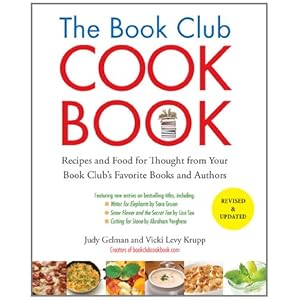
The Book Club Cookbook (Judy Gelman and Vicki Levy Krupp)

--The blurb--
"Whether it's Roman punch with The Age of Innocence, Sabzi Challow (spinach and rice) and lamb with The Kite Runner, or ambrosia with To Kill a Mockingbird, nothing spices up a book club meeting like great eats. Featuring recipes and discussion ideas for one hundred popular club selections, this cookbook guides readers in selecting and preparing culinary masterpieces that blend perfectly with the literary masterpieces their club is reading. This fully revised and updated edition includes a full-colour, sixteen-page photo insert, and new contributions from a host of today's bestselling authors, offering recipes and commentary from: Sara Gruen's Water for Elephants (Oyster Brie Soup), Kathryn Stockett's The Help (Demetrie's Chocolate Pie and Caramel Cake), Jodi Picoult's My Sister's Keeper (Brian Fitzgerald's Firehouse Marinara Sauce), Annie Barrows' The Guernsey Literary and Potato Peel Pie Society (Potato Peel Pie and Non-Occupied Potato Peel Pie) and Chris Cleave's Little Bee (Post-Colonial Pie)."

--The review--
Books and food are possibly more intrinsically linked than most people realise, and it goes further than just enjoying a few snacks while discussing a good book with friends. Even when my sister and I were children, one of our favourite games was to pile up all of the living room pouffes on the sofa so that they almost touched the ceiling, sit on them, and munch on snozzcumber (=cucumber) and sup on frobscottle (read: lemonade) while watching Roald Dahl's The BFG on the small screen. Call us strange children if you will - but naturally this meant that when I was contacted by Penguin asking if I wanted to review this book (which unites two of my major loves of food and books), I couldn't say yes fast enough.

In truth, the list of new books and recipes that appears on this second edition's cover didn't actually appeal to me much. I hadn't heard of half of the books, and of the half I did know of, I hadn't read them. So for a moment I did wonder how far I would be able to relate to the selection of recipes and books chosen. However, I need not have worried: upon opening the pages, I stumbled upon a veritable treasure trove of books and recipes I recognised, as well as books and recipes that I'd never seen before but really wanted to try and to read. 

I started off with an old English classic: Toad-in-the-Hole, from the novel Major Pettigrew's Last Stand. I came away thinking that their Yorkshire pudding mix needed more milk to make it go further, but at the same time I still finished the recipe with a full tummy and a desire to read the book. Other recipes I sampled included a sour cherry pie from The Dive From Clausen's Pier (which I suspect did not benefit from my cheat shortcut modifications; just follow the damn recipe, people), a goat cheese and sun-dried tomato pizza from The Devil Wears Prada (a genius pizza topping that I couldn't believe I'd never tried before, and from a hilarious-sounding book, too), eggplant caponata from Bel Canto (not my favourite book or foodstuff, but my husband loved the dish), and spicy pork, orange, and hoisin wanton cups from Balzac and the Little Chinese Seamstress (which I enjoyed, but would perhaps prefer to make with beef. Now there's an experiment for the future...or not, as the case may be, if my advice on the cherry pie is anything to go by. Listening to my own advice has never been one of my strong points!).

While all of the books mentioned above are modern, the cookbook still contains plenty of recipes from classic novels for the traditional reader, such as To Kill A Mockingbird, The Age of Innocence, Love in the Time of Cholera, and Jane Eyre - all of which I look forward to exploring. The selection, then, and the way it's set up, definitely doesn't disappoint. While the stunning colour photographs could be more spread out throughout the book, rather than just being stuck all together in the middle, this is really my only quibble. I love the input from authors and book groups alike, as well as from the compilers of this book themselves, who are clearly keen readers, and think the idea of an online community that lovers of the cookbook can also enjoy is an inspired idea too.

I truly believe that this collection offers something unique in the world of cookbooks - unless I've been living under a rock for some time, I don't recall seeing any other cookbook like this. As well as being inspired to get the authors' book club cookbook for kids (I'm hoping for some REAL Roald Dahl recipes!), I've also been inspired to do what I suspect was the authors' aim all along: to cook, and to read, and to do both at the same time. Cheers, ladies.

Other works by Judy Gelman & Vicki Levy Krupp
The Kids' Book Club Book (2007)
Table Of Contents (2011)
 

--cross-posted to Ferret Food and Wines--

Sunday, 19 February 2012

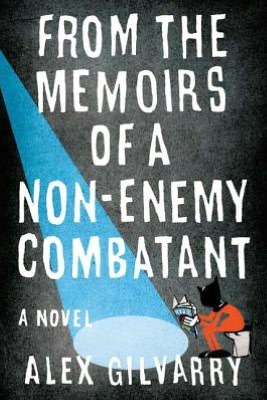
From The Memoirs of a Non-Enemy Combatant (Alex Gilvarry)

--The blurb--
"Boyet Hernandez is a small man with a big American dream when he arrives in New York in 2002, fresh out of design school in Manila. With dubious financing and visions of Fashion Week runways, he sets up shop in a Brooklyn toothpick factory, pursuing his goals with monkish devotion (distractions of a voluptuous undergrad not withstanding). But mere weeks after a high-end retail order promises to catapult his (B)oy label to the big time, there's a knock on the door in the middle of the night: the flamboyant ex-Catholic Boyet is brought to Gitmo, handed a Koran, and locked away indefinitely on suspicion of being linked to a terrorist plot. Now, from his 6' x 8' cell, Boy prepares for the trial of his life with this intimate confession, even as his belief in American justice begins to erode."

--The review--
With the recent passing of 9/11's 10th anniversary, it's only natural that there should be an even greater resurgence of literature on this theme than ever before as the memories of that day are freshened for all. Alex Gilvarry's attempt is a slightly off-the-wall, behind-the-scenes view of the paranoia of post-9/11, this time through the eyes of a so-called terrorist, who Gilvarry wants us to believe is an innocent man, bringing into question our belief and trust in the governments that preside over us.

Part first-person memoir, part third-person biography, it's therefore not dissimilar in this respect to the other hybrid text I read recently, the definitely non-fictional Along The Cherry Lane. While characters in From The Memoirs of a Non-Enemy Combatant are strong, there is another respect in which it differs from Along The Cherry Lane: even though we are presumably supposed to sympathise with and warm to Boyet Hernandez (or Boy, as he is frequently referred to), it is difficult to do this given his sheer naïveté in associating with such clearly dodgy characters. The characters therefore do not appeal to us in the way that they are perhaps intended to, and some (like the Russian models Boy uses for his shows) are apparently supposed to be funny (or at least, I didn't find the novel as amusing as several other readers and reviewers apparently did - but I suppose it's all a matter of taste), but are far too caricatured for us to truly be able to engage with them. If the writer was trying to be satirical, in this respect I don't believe him to have been successful.

However, there is certainly one very intriguing aspect of the style: even though not fully appropriate for a 'confession' (as it's often referred to), factual 'mistakes' made by the clearly very human Boy are corrected by the author/narrator through footnotes, and his trial is also chronicled through the footnotes in the repeated references to articles in various high-profile newspapers on the subject, complete with dates. Even though we know it is not a true story (a quick Google search reveals this; in addition, I was amused to find that there are real people named Boyet Hernandez), this meticulous set-up and attention to detail almost makes us think it could be - and that if this story were true, what other details in the novel could also be true (particularly in relation to the treatment of prisoners and the bureaucracy of the American justice system).

This unusual novel lingers in a strange way, despite its flaws. Is it clever? Yes. Is it witty? To my mind, not really. But if there is one thing that Alex Gilvarry is not, it's an imitator. Having never read any book like this before in its subject matter and style makes me feel like this is an entry onto the scene of a truly intriguing new literary talent.

Saturday, 18 February 2012

Along The Cherry Lane (Richard Sparks)

--The blurb--
"At the height of Milton Okun's career, a critic wrote, "Of all producers, Milton Okun's range is the widest, from Placido Domingo to the Muppets". Conductor for Harry Belafonte, arranger and producer of Peter, Paul and Mary, and the man who brought John Denver to stardom and produced his most loved hits, Okun also founded Cherry Lane Music, publisher of Elvis and Dreamworks, among many other household names. He achieved great success in many different fields - often, as he tells it, almost by accident. And yet he expected to spend his entire working life as a music teacher in New York City public schools. From the Weaves to will.i.am and the Black Eyed Peas, Milton Okun has been a central figure in the continuing story of our musical heritage, his career ranging from the folk revival to the new technological landscapes of the twenty-first century. Along The Cherry Lane is a portrait of a unique career, told in stories by Okun himself and those who have been a part of his remarkable life in music."

--The review--
As a lover of all kinds of music (my iTunes library goes from Aaron Copland and Abba to Yann Tiersen and Yes, stopping via Mozart and Morcheeba), I was keen and curious to read a memoir of someone who'd had the honour of working with Placido Domingo AND the Muppets. In addition, I'm also a huge fan of "behind-the-scenes" type topics (only the other day I was scouring blog entries by those who'd participated in reality TV show Come Dine With Me), so to have the curtain lifted, allowing us to see the tough everyday details of the music industry, was equally appealing. As an aspiring writer, Milt Okun also epitomises what I consider to be the ideal kind of fame: people know who you are and respect you and your work, but don't mob you every time you go to the supermarket. In short, his autobiography, told with the help of his son-in-law Richard Sparks, ticked a lot of boxes.

Furthermore, I was not disappointed by this highly readable oeuvre. While the 'interview' style in which it is written, with its frequent interjections from co-workers and family members, takes some getting used to, it also marks Along The Cherry Lane as a unique form of memoir - rather than being ghostwritten by a desperate hack, Richard Sparks not only knows Okun as a family member but is also sensitive to the industry in which the great man works, having worked himself in TV, theatre, and the writing of lyrics, which combines to create a tautly-told tale of Okun's life.

As well as containing touching anecdotes from his personal life (such as his encounters with former students who remember him fondly, or the moment at the end of the book, when Milt realises that his wife is the one for him through their shared feeling of being underwhelmed by Maria Callas' musical abilities), the interviews are full of stories about the personalities of well-loved stars such as Harry Belafonte, without being gossippy or bitchy. It also brings to light surprises about the industry itself that, on reflection, are not really that surprising (that, for instance, some of his successful acts in fact could not sing that well, or that some singers worm their way into being credited with writing songs, alongside the real songwriters, just to receive more royalties) but help to give us a more honest view nonetheless, in a way that I suspect to be rare in autobiographies by other music moguls (can you see Simon Cowell being this honest about the likes of his Autotuned protégés?).

Even if you had not heard of all of Milton Okun's acts, or are not impressed or intrigued by them once you do know of them (I can't say I'll be checking out the apparently limited Peter, Paul and Mary anytime soon), there will be something in there for you, whether you're an Elvis fan or a Dreamworks aficionado (yes, he has really worked with these big names). But what really gives the book its heart is Milt Okun's modesty - despite his clear success, he feels it is just down to knowing the right people, and being in the right place at the right time, almost more than his manifest talent. The warmth exuded by his family members, artists on his books, and former students is also testament to the impact he has made on others through his patient personality. 

It also can't have been the easiest book to write; to write about someone while they are still alive, and to make an assessment of their career, life and personality, and to do it well, is no mean feat. This is not to mention the hybrid format of something that is not quite biography and not quite autobiography, as well as an interview. But Richard Sparks fulfils his brief more than successfully, and Along The Cherry Lane, by its end, fills its readers with a greater knowledge of and (in some cases) passion for the music industry and its artists than they had at the start - and encourages them to check out even more of Sparks' and Okun's work and achievements.

Other work by Richard Sparks
Diary of a Mad Poker Player (2005)