Showing posts with label self-help. Show all posts

Sunday, 15 December 2013

Chicken Soup for the Soul: Teacher Tales (eds: Canfield, Hansen, Newmark)

--The blurb-- 
"There's always one special teacher or student, and Chicken Soup for the Soul: Teacher Tales regales all educators with its heartfelt, inspiring and humorous stories from inside and outside the classroom. Stories from teachers and students about their favourite memories, lasting lessons and unforgettable moments will uplift and encourage any teacher."

--The review--
Aspiring teachers have plenty of things in mind when they enter the profession or begin their training. Helping young people as their teachers have helped them. Being an inspiration to others. Using the subject they loved to study themselves. Being a reincarnation of Robin Williams' character in Dead Poets' Society. While many of these things are possible, it's worth remembering that just as being a doctor is not like being JD in Scrubs, teaching also carries a lot of realities that don't figure in your dreams, like the seemingly endless administration, the state of near-exhaustion that term-time wreaks upon you, children who can be in their chair one second and drawing on the walls the next, and uncooperative colleagues. All of these things can make it difficult to remember why you're there in the first place.

So when teachers need a bit of a pick-me-up, compendia such as Teacher Tales are much appreciated. Easy to dip into for a quick read even when you're exhausted on your daily commute or just before bed, the stories are droplets of inspiration. Despite the stories' formulaic, at-times mawkish format that's common to all of the Chicken Soup books, the collection contains something for every teacher to relate to, whether they're just starting out, are on the cusp of retirement, are thinking of quitting, or are somewhere in between. The teachers who have written stories for the book are proud to show their human side, whether they've ended up crying after class, have accidentally shown an inappropriate video to their students, or have dealt with a parent, colleague or pupil badly. They reflect on students and teachers who have changed them, whether it's through pedagogy or personality.

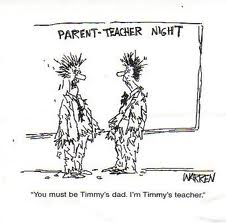
However, it's not all serious: there are cartoons to lift the spirits (like the one below) and stories of buying supplies or gifts for students during one's grocery shopping. All of these morsels of humour and hope are a drip-feed to get teachers through the next day, week, month or year - and that is a valuable thing in what can be a stressful profession.
But ultimately, Teacher Tales makes the reader remember that teaching is more rewarding than stressful. As teachers read this book, they will remember their own embarrassing moments, best students, worst students, field trips, best and worst teachers, assignments from students that they've almost wanted to pin on their own fridge, and in the end, the greatest learning curve they've ever been on.

For a full list of Chicken Soup for the Soul titles, see the official website.
There’s always that one special teacher or student, and Chicken Soup for the Soul: Teacher Tales regales all educators with its heartfelt, inspiring, and humorous stories from inside and outside the classroom. Stories from teachers and students about their favorite memories, lasting lessons, and unforgettable moments will uplift and encourage any teacher. A foreword by Anthony Mullen, 2009 National Teacher of the Year, and stories from all the 2009 State Teachers of the Year. - See more at: http://books.simonandschuster.com/Chicken-Soup-for-the-Soul-Teacher-Tales/Jack-Canfield/9781935096474#sthash.bC8EbLOU.dpuf

Sunday, 1 September 2013

Bookish Bits and Bobs: Writing Down Your Soul

It's been said by several, in one way or another, including by Paul Theroux, that "a day without writing is a wasted day". That could be true in more ways than one: as well as practically being a no-brainer for anyone who wishes to write professionally (even if this is easy to say and less easy to do), it's vital to do so for those who struggle with their feelings and their state of mind, as it could mean the difference between getting through the next day and not.

The form this could take, however, is becoming increasingly varied. While paper diaries themselves are still a popular format when it comes to expressive writing, the rise and rise of blogs, Facebook and Twitter naturally means that venting one's spleen online is also growing in popularity. The crucial difference between these formats is the public nature of the internet, and personal experience shows that this can do harm: keeping an online diary at the age of seventeen, in which I outlined in some detail my crush on my English teacher, meant that I was rumbled when classmates not only found it but then told the member of staff in question. One excuse for this could be that blogging was newer then, and that we as a generation were a little less schooled in keeping our details private when using the web. 

Hannah Smith
So, one could ask, why am I writing all of this down here, now, again in public? Partly because I believe that the subject of protecting oneself online needs to be discussed openly, particularly in schools where no social education classes are given, and particularly in the light of prolific cyberbullying cases such as that of Hannah Smith. Hannah was not writing a diary online - but anyone who chooses to have a presence online (which, in the Western world, is most people) exposes themselves to criticism by others, even without revealing their deepest feelings. 

You'd think that this would be a vote for the traditional paper diary. But even those can be found and read by others - so it's worth remembering that you take a risk the second you commit your feelings to paper. But does that mean diary-writing (or 'journaling', as the Americans irritatingly call it) should be abandoned altogether?

Not at all. One study, conducted in 1986 by Professor Pennebaker, found that encouraging people to write expressively to vent their feelings was better for their mental health than bottling up traumatic experiences. This effect proves timeless, as found in subsequent research. However, research carried out this year in Israel by Professor Barak has uncovered an interesting twist: those who blog about their feelings in a way that is set up to invite comments benefited most from expressive writing compared to those who blogged privately, and those whose blogs were open to readers but closed to comments. This takes diary-writing in the direction of 'group therapy', even if this is carried out remotely when compared to traditional counselling: people are invited to comment and advise, which may lead to them sharing their own experiences, arguably allowing one's most intimate feelings to be directed in a more constructive manner than a private diary.

However, it would be naive to assume that the risks of the internet automatically disappear in this situation, with Professor Barak still advising caution. Anonymity is still possible online, but is growing increasingly difficult to maintain thanks to many websites using Facebook, Google, or OpenID as online 'passports'. Possible anonymity for the writer also means possible anonymity for bullies, and when bullies fear no repercussions, the results can be disastrous, as in the case of Hannah Smith. But these cases are unusual, and that is why they make the news: Professor Barak maintains that of the hundreds of online comments made during their study, only a few were deleted for being abusive - and that the very act of writing one's feelings down remained significantly therapeutic.

So whatever form your diary-writing takes, how can you be sure it will help and that you will get the most out of it? The positive use of writing as therapy will require individuals to vary their techniques in order to find a method that works for them. As a long-term diary-writer myself (1997 to 2005 was probably my most intensive period of it), I can only offer what's worked for me and hope that some of it may work for others:
  • Public or private? Weigh up the benefits and consequences of both options. Publicly-accessible online diaries could attract positive and constructive comments, or negative and abusive ones. Private online diaries can be password-protected, meaning that people who you don't want to see your feelings can stumble on them less easily, while still providing you with therapeutic benefits. Finally, keeping private paper diaries, while less secure, can feel more 'real' thanks to the actual act of writing something down by hand, and later can prove valuable hard evidence of how far you've come if you ever feel a bit shaky again. I've done both and can see the benefits of both - even if I'd now use a different modus operandi to my seventeen-year-old self when proceeding online.
  • Don't just stick with the usual 'Dear Diary' format when writing for therapy. Poems, lists, and drawings (even if you can't draw!) are all equally beneficial when trying to find a way through the muddle of your thoughts.
  • Don't worry about spelling, punctuation, grammar or repetition. And I say that as an English teacher! Diaries aren't a school assignment - they're therapy. And repetition can actually be vital in helping you to sort through your feelings. It's not written to be an entertaining read, but to help you.
  • Write whenever you like. Diaries don't have to be an everyday thing. You may find yourself writing every day (or even multiple times a day) if you are feeling particularly distressed, but there's no rule. Play it by ear and relax.
  • Be patient. As with any therapy, you won't see results overnight. I won't go as far as to say that "time heals all wounds", as we all have aspects of our lives that have made us who we are today and that we won't forget. However, to say that "time is a healer" is closer to the mark, and to come back to one of the major pluses of paper diaries, it is greatly valuable to be able to look back over, say, six months' worth of entries, and to be able to see development and progress in your thought processes.

Friday, 23 August 2013

Great Days At Work (Suzanne Hazelton)


--The blurb--
"Great Days at Work will enable you to become more enthusiastic at work, feel more positive and work more effectively with others. Drawing on the latest insights from positive psychology, and based on hard business results, it outlines the practical day-to-day changes you can make immediately for instant benefit, as well as helping you develop a longer term strategy that means you'll get more out of work. This easily applicable book reveals how to develop an effective perspective on time, embed productive new habits, gain a clear sense of self and build better working relationships. As a result you will make a bigger contribution to your organization, as well as feel more engaged, satisfied and in control of your own work and career. Discover how to have a great day at work, every day!"

--The review--
While growing up, most people have a dream about what they want to do with their lives, and children tend to state adventurous or romantic, generally aspirational and traditional professions that require creativity or bravery as the dream: firemen, astronauts, policemen, teachers, doctors, vets, writers, and artists all tend to feature. A common link between these professions is control, whether it's over other people in an authoritative profession, or over ourselves, whereby creativity allows us to prioritise our personal freedom and control our own destinies. So with those commonly-held childhood dreams in mind, it's understandable that when many of us end up in jobs involving a little more drudgery (sorry to anyone in those professions, but find me a child who wants to be a cold caller, administrator, tollbooth operator...), or just any job that isn't what we'd dreamed of, we may feel like we're losing control or even that some great injustice has been done to us. This logically leads to further negative thoughts, a general sense of despair, and more bad days than good.

Suzanne Hazelton comes to the rescue with Great Days At Work. Rather than being a fluffy version of psychology for dummies, the slim volume is full of surprisingly easy and practical ideas to really create change in our lives. And Hazelton packs a lot in to the 238-page manual, covering everything to checking up on our health to negotiating with others. The tone is friendly and accessible without being patronising, and the content draws on up-to-date research, videos and quizzes, as well as mentioning inspiring figures of today's world that we can all admire, such as Steve Jobs and Andy Murray. 

The only problem with Hazelton's use of these very recent resources is formatting: many of the web addresses she gives are so long as to be unusable, as they will either quickly become outdated or have a high risk of readers typing them into their browsers incorrectly (in this sense, having Great Days At Work as an ebook is more practical). Reducing the links to much shorter ones using URL redirection services is all that's required. Plus, while most of the sources used are reliable, I'm not sure there's any excuse for citing Wikipedia, no matter how occasionally it's done.

Nonetheless, the resources that the author does direct us to are relevant, useful, and easy to use, examining every aspect of our individual approaches to life and work, whether it's quizzing us on spirituality or frequency of physical activity, or encouraging us to watch inspirational lectures. In addition, as personal growth is an ongoing process, there is plenty of food for thought even for people who are already reasonably happy with themselves and their job. 

Hazelton's background in the IT industry means that there is inevitably some focus on this type of business environment. However, the principles of positive psychology involved in this book not only apply to any type of workplace, but also to any stage of one's working life (even though there is a small section on retirement). Further to this, much of what Hazelton advises can apply to virtually any age or life stage too - meaning that as well as using its precepts to help myself have more great days at work, I can also use them as part of my students' social education time in homeroom, so that not only will they be able to manage their lives more effectively now, but also that in future they too will be able to adapt and carry through these same ideas in order to have great days at work themselves.

also by Suzanne Hazelton
Raise Your Game (2012) 

Thursday, 1 August 2013

Chicken Soup For The Soul 20th Anniversary Edition (Canfield, Hansen and Newmark [eds])

--The blurb--
"The twentieth anniversary edition of the original Chicken Soup for the Soul is brimming with even more hope and inspiration - the stories you’ve always loved, plus bonus stories, plus 20 bonus stories from today’s thought leaders. Twenty years later, Chicken Soup for the Soul continues to open the heart and rekindle the spirit. Celebrate the twentieth anniversary with the classic book that inspired millions -- reinvigorated with bonus stories of inspiration! You will find hope and inspiration in these 101 heartwarming stories about counting your blessings, thinking positive, and overcoming challenges."

--The review--
It could be argued that America invented the self-improvement genre as we know it today, especially thanks to pioneers such as Ralph Waldo Emerson (who used the term 'self-help' in his 1841 essay, Compensation), Dale Carnegie (who wrote the ever-successful How To Win Friends And Influence People in 1936) and Napoleon Hill (author of Think And Grow Rich, penned in 1937). Today the industry is worth around $9 billion; and now with around 500 million Chicken Soup for the Soul books now having been sold worldwide, it's fair to say that they are one of the biggest self-help series around. And that's before you even count the revenue made from the brand's forays into other sectors: as just a few examples, you can buy Chicken Soup for the Soul DVDs, board games, greeting cards, puzzle books, dog food (yes, really), and - of course - soup. This all clocked up $2bn in retail sales in just ten years. So now that it's been twenty years since the original Chicken Soup for the Soul book hit the shelves, how does this new collection celebrate? What can it possibly add to a clearly already thriving brand?

Existing fans of the series will already be familiar with several of the stories the anniversary edition contains - but rereading these is like catching up with an old schoolmate and being pleased to see them, rather than being bored by them and feeling like they should just finish up their coffee and leave. New stories have also been added, which fit in seamlessly with the tone and style of the old. As Chicken Soup for the Soul is an international series, it was equally encouraging to see a few UK-based stories added to the collection, rather than the compilation being wholly rooted in the US. With luck, this is something that will continue to improve about the series: while many of its readers are from America, the brand's founders are quick to acknowledge its worldwide readership, so to see more stories from readers from these countries would be more representative.

Stories from great thinkers of our age, such as Deepak Chopra, have also been included in this edition. While it's a good way to recognise the brand's success, it also highlights why the at-times criticized homogeneous style in which the stories are written is in fact used. Even though some readers may be pleased to see writers' individual styles take on a more significant role, as variation in style is always welcome, this new approach is also in fact the anniversary edition's downfall, as not all of the luminaries the editors have chosen are actually able to write clearly and in a way that's meaningful and practical.

However, none of this stops the collection from doing what it ultimately sets out to do: proving that it's still as relevant to readers as it ever was. The stories, even if they are overly saccharine at times, generally continue to surprise, move, and provoke thought. The ever-expanding collection of titles (now numbering over 200) also continues to accompany readers throughout their lives: readers of the teen and kid series ten years ago may now be looking for a book to appeal to their hobby, birthplace, profession, or status as a new parent (hear that, Duchess of Cambridge?). Introducing the series to a new generation of readers is just one of the important roles that the brand has in keeping people positive and inspiring them to overcome new challenges - and those things will never get old.

For a full list of Chicken Soup for the Soul titles, see the official website.

Monday, 14 May 2012

Sweet Tea and Jesus Shoes (Sandra Chastain et al.)

--The blurb--
"Come sit on the porch a spell. Let's talk about times gone by and folks we remember, about slow summer evenings and lightning bugs in a jar. Listen to the music of a creaky swing and hand-cranked ice cream and cicadas chorusing in the sultry night air. Let's talk about how things used to be in the South--and for some of us, they way they still are. Welcome to the world of Sweet Tea and Jesus Shoes, where [...] authors Deborah Smith, Sandra Chastain, Virginia Ellis, Debra Dixon, Donna Ball and Nancy Knight come together for the first time to create this [...] collection of nostalgic tales. Here life's lessons are handed down [...] from eccentric relatives, outrageous pets and unrepentant neighbors, and served up with a generous dollop of that most valued of all Southern commodities: good old fashioned storytelling. From Mississippi to Georgia, from Florida to Tennessee, these daughters of the South will take you on a lush tour of the times and places they know best, each voice as refreshing and inviting as a glass of cold sweet tea on a hot afternoon. So come. Let us take you back. Let us take you home."

--The review--
With the rise and rise of self-help books, and in particular the Chicken Soup for the Soul series in America, it's hardly surprising perhaps that the warm and fuzzy style of the majority of these books should pervade the national consciousness. Upon reading Sweet Tea and Jesus Shoes one is certainly reminded of this popular and successful series thanks to the emotive and confidential style in which these authors write. In spite of the title, the stories are not overly religious and so should not put off anyone who is not this way inclined.

The quality of the stories in this collection - which is the result of a collaboration by six different female authors - does inevitably vary. While some of the stories are overly saccharine for some tastes, there is without doubt more to this compendium than the tradition and trend started by the Chicken Soup series. Certain stories have a real "laugh-out-loud" aspect as well as a spiritual one, as the authors regale us with wacky tales of dotty relatives and slightly deranged pets. The texts are comforting and accessible without any feeling of dumbing down as we are told of situations we can all relate to, set in the slightly muggy heat of America's Deep South: whether it's trying to fit into a family as a new in-law, or trying to host a party that simply must go well, most readers will find something that rings true for them, whether they're reading from Alaska or France, Britain or India.

But alongside its humour, it is the purpose of this compilation that sets it apart from other tomes of its ilk. While many self-help books seek mainly to inspire (with any other side effects being secondary, accidental or peripheral) this collection not only motivates and touches us with heart-warming and amusing stories, but also, in equal measure, sets out to give us a true sense of place (and, furthermore, achieves this aim). In reading these tales, the reader is transported through the trials, tribulations, thrills and spills of other families just like theirs, and equally to the warm, friendly and tropical atmosphere of the South (giving me severe Florida-itis in the process; it's been now five years since I was last there). 

Simultaneously nostalgic and refreshing as promised, anybody wanting a dose of escapism, realism, humour and inspiration all in one book will surely find what they are seeking here.

Works by the same authors

Sunday, 11 March 2012

This Mobius Strip of Ifs (Mathias Freese)

--The blurb--
"In this [...]collection of [...]essays, Mathias B. Freese jousts with American culture. A mixture of the author's reminiscences, insights, observations, and criticism, the book examines the use and misuse of psychotherapy, childhood trauma, complicated family relationships, his frustration as a teacher, and the enduring value of tenaciously writing through it all. Freese [...]describes the conditioning society imposes upon artists [...Freese writes] about the spiritual teacher, Krishnamurti, poet and novelist, Nikos Kazantzakis, or film giants such as Orson Welles and Buster Keaton, [...] while examining Existentialism, alternative education, and Jewish values. [...]At the core of these essays is the author's struggle to authentically express his unique perspective, to unflinchingly reveal a profound visceral truth, along with a passionate desire to be completely alive and aware."

--The review--
With 2012 being an Olympic year, it seems fitting in this year to have a book released featuring the idea of a Mobius strip as its base (in case you didn't know, an Olympic medal's ribbon is a Mobius strip - a twisted ribbon). Mobius strips have a mysterious quality; they look unusual yet simple from the outset, but when you begin to look at the maths behind them, it's clear that there is so much more about them to be unravelled. It's clear that this notion of something simple, yet complex in its beauty, with so much to be unravelled, has inspired the author greatly - and it's true that this does serve as a useful metaphor for the journey we all go through in our lives, in attempting to interpret ourselves as well as the world around us.

While this kind of philosophical problem-solving is something that can probably never be truly completed by any of us, I'm not sure either that Freese fully achieves his aim in This Mobius Strip of Ifs. Firstly, on a superficial level, the book does not have an entirely professional finish (something that's perhaps symptomatic of its self-published nature): editing is sloppy, the blurb is overly laudatory when it should be purely summative (this, along with the length of it, is the reason for my editing of the blurb in this post) with perhaps one tantalising hook, and it seems strange that his wife should not only write the introduction but also refer to her husband by his/their last name (this is unorthodox, and not in a positive way).

Freese also seems to have plenty of erroneous ideas about professions of which he has experience (namely, teaching), and of which he does not (blogging). His collection of essays was of interest to me primarily as a teacher who also aspires to write full-time, but in spite of my own aspirations it was still disappointing to find that he was so derisive of teaching and teachers, while at the same time not portraying himself in the most positive light. To say outright that "teaching was a waste of [his] time and talent" not only betrays Freese's own arrogance but also indicates his lack of understanding of what the profession can be: in my experience, you can still be autonomous as a teacher (I have had little to no interference in the formulation of my syllabi, which has allowed tremendously satisfying bursts of creativity and freedom) while still adhering to and being receptive to the authority and regime that you agree to follow the day you sign a contract. Despite the freedom I mention above, it is also important to realise that total freedom, except perhaps in our own minds, is an illusion; Freese does not seem to have realised this, and if he hoped to find total freedom through any profession where you sign a contract and work for someone else, he was always bound to be disappointed.

It is equally dangerous to include a chapter lambasting bloggers and the reviews you have been given by them when you are sending that same book out to them for yet more reviews. Reviewers do not have to agree with you in order to be right, and it seems absurd to bite the hand that (at least partly) feeds you. The author is also mistaken about the purpose of blogging; a caveat stating that there are always exceptions does little to pour oil on the troubled waters of this chapter. 

It seems a great shame that the author seems intent on damaging himself in this way, but unfortunately the flaws of this collection do not stop here. Freese comes across as having a superiority complex, even while he states the obvious. He is seemingly deliberately vague at times, perhaps to mask his faults (it is a relief to find that "In First Person" he acknowledges some of them); there is a tone of false self-deprecation in parts; and he seems to be at cross-purposes throughout the collection, preaching rather than partaking in a confidential conversation. His mode of address to the reader - "dear reader" - is annoying, unoriginal and patronising. Thankfully he drops it after about the first quarter of the book - but really, if he were going to copy anyone, why did it have to be someone as high-profile as Bronte? Equally curious is that he claims he does not write for fame or praise and seems keen to emphasis the anonymity of his writing. While I agree with him that everything we write is important for our own self-development, why not then just keep a diary? Why resort to self-publishing something that in all honesty needs a red pen taking to it before it can be truly suitable for publication?

The essays start off well, but quickly deteriorate. They have potential, but are either too dramatic or mawkish to take seriously, need clarifying or refining (Freese often digresses), or are self-indulgent in general, lacking in sensitivity and tact (but perhaps this is a generational thing; the author has fifty years on me). The collection of essays would have been more interesting by far if the writer had focused on his teaching experiences: Teachers Have No Chance is among the strongest essays in the book and contained material I could relate to well. Jefferson is also another essay with greater meaning. The rest, though, require serious tidying up, and Freese could start by removing the hyperbolic, unnecessary, and frankly insulting similes and metaphors that pepper the book in description of his own life: calling your own life a Holocaust and saying your experiences are like being tortured by a Nazi are disrespectful and do a great disservice to survivors of genocide. Blogs such as The Spohrs Are Multiplying explores the emotions relating to bereavement in a much more articulate and sensitive way.

So what are the positive points of this collection? As I believe I mentioned, there are definitely some and it is for this as well that it seems a shame for the author to do damage to himself in this way (why detract so severely from the good points of what you have created, after all?). It may not merit an Olympic gold, but perhaps a bronze can still be salvaged. 

The idea of exploring our imperfections and life's infinite circle of "what ifs" is certainly appealing and is discussed by Freese to a degree. For what Freese lacks in reflective writing, he compensates for more than adequately in his descriptive writing. There is some promising material in his life story (teacher, psychotherapist and writer is, I'm guessing, far from the usual trajectory of most lives, and that's before you even get to the patchwork of his life's loves and losses), even if it would have been better expressed in the form of a third-person narrative. Some essays have many strengths ("On The Holocaust" is possibly the best one for its intelligence and perception) and I believe past and present members of the teaching profession would find Freese's experiences in this regard to be of interest, as well as being something they can identify with themselves.

The author's advice to therapists is equally applicable to many other professions - and, in addition, his enthusiasm for some of his interests is infectious: reading his views on writers as diverse as Freud, Hitchens and Krishnamurti makes me want to go and read their works myself too. Freese is a far better poet than first-person writer and it is my belief that he should explore and exploit this avenue more fully if possible. He recommends a range of interesting books and films towards the end of the collection, which deserve to be investigated by others, even if the list should be formatted as just that - a list - as it doesn't merit a full essay in itself.

My final, and perhaps most important comment, is that the enjoyment of this collection of essays is, in all probability, highly dependent on the reader's nationality and cultural background. I am British, and this essay collection consists of several long outpourings of emotion that do not generally sit well with our traditional stiff-upper-lip approach. It is not something that we are used to, in spite of the massive influx of American self-help literature into British bookshops. It is a collection that would have perhaps appealed more to me in its entirety when I was younger and had only just discovered the self-help genre. Nonetheless, the wide range of topics covered means that I challenge anyone to read this collection and not find one single thing that is relevant to their life. It is a collection that can be picked up by anyone, and from which anyone may gain something - no matter how small.

Other works by Mathias B Freese
The I Tetralogy (2005)
Down to a Sunless Sea (2008)

Thursday, 1 September 2011

The Alchemist (Paulo Coelho)

--The blurb--
"Santiago is an Andalusian shepherd boy who dreams of travelling the world in search of a worldly treasure as fabulous as any ever found. From his home in Spain he journeys to the markets of Tangiers, and from there into the Egyptian desert, where a fateful encounter with the alchemist awaits him."

--The review--
Disconcertingly, despite having had both an English and a French copy of The Alchemist on my bookshelf for a number of years, I could not actually remember if I had read this story before or not. The reason for this is perhaps as follows: upon (re)reading it, I found that Coelho's poetic strengths as found in Eleven Minutes are not as obvious here. The author's strengths are in setting and detail, and then, to an extent, character, rather than in plot - the whole of The Alchemist just seems a bit thin, and takes on the manner of a children's story, rather than being in the style of a spiritual book for adults. While that's a good thing, in a way, if it makes the story more accessible to a wider range of people, it could have easily done with extra padding and extension.

The Alchemist is ultimately a sweet and sentimental fairytale that lacks concrete relevance to our own lives - in the end, it contains nothing that we can apply directly. More development, as mentioned, is certainly required overall, especially when it comes to explanations of some of Coelho's concepts, such as The Soul of the World. The story does contain some pleasing and thoughtful maxims, but it does perhaps depend on the reader as to whether they are happier with this than with something more directly advisory. This is perhaps exemplified by the fact that after the number of five-star ratings for this book on Amazon (184), the next highest number of ratings is actually in the one-star category (where there are 62).

It is fitting that the protagonist ends up back where he started, and this endows the book with a satisfying and cyclical appeal. Ironically, even though this is Coelho's best-selling work, I did not find it to be the best of his oeuvre; go elsewhere for something more inspiring and less woolly. 

Other works by Paulo Coelho
The Manifest of Krig-Ha (1974)
Theatre of Education (1974)
Hell Archives (1982)
Practical Manual of Vampirism (1986)
The Pilgrimage (1987)
Brida (1990)
The Greatest Gift (1991)
The Valkyries (1992)
Maktub (1994)
By the River Piedra I Sat Down And Wept (1994)
The Fifth Mountain (1996)
Love Letters From A Prophet (1997)
The Manual of the Warrior of Light (1997)
Veronika Decides To Die (1998)
Essential Words (1998)
The Devil and Miss Prym (2000)
Fathers, Sons and Grandsons (2001)
Eleven Minutes (2003)
And On The Seventh Day (2004)
The Genie and the Roses (2004)
Journeys (2004)
The Zahir (2005)
Revived Paths (2005)
Like The Flowing River (2006)
The Witch of Portobello (2006)
Life: Selected Quotations (2007)
The Winner Stands Alone (2008)
The Aleph (2011)