Showing posts with label teenage fiction. Show all posts

Thursday, 5 December 2013

The Perks of Being a Wallflower (Stephen Chbosky)

--The blurb--
"The Perks of Being a Wallflower is a story about what it’s like to travel that strange course through the uncharted territory of high school. The world of first dates, family dramas, and new friends. Of sex, drugs, and The Rocky Horror Picture Show. Of those wild and poignant roller-coaster days known as growing up."

--The review--
In order to simultaneously reassure teens that others out there feel as they do, and reassure themselves that they still remember how it feels to be there, several writers have chased adolescent angst through the media of novels and film, from American Pie to Adrian Mole. The worldwide success of Stephen Chbosky's The Perks of Being a Wallflower, which has been published in 31 languages, has added to this arsenal and yet also raised expectations. So, perhaps contrary to its 'wallflower' title, how does it fit in to this canon? And is the hyperbole surrounding it justified?

As a newcomer to the genre, Perks fits in perfectly - even if it lacks the humour of classic teen angst protagonist Adrian Mole. It combines trivial events with more serious incidents, has a somewhat quirky narrator go through the standard teenage experience of obtaining a driver's licence and engage in the clichéd rebellion of beginning to smoke cigarettes, and juxtaposes sex and drugs with the value of true friendships and relationships. It opens up issues that young people may otherwise feel afraid to discuss and is poignant and superficial by equal turns. It makes for compulsive reading as the reader waits to see how protagonist Charlie develops and gains in confidence, and compels one to root for him as he loses his friends, is put upon by siblings, and experiments as he searches for his true self. These are things that teenagers everywhere are doing, meaning that Perks offers a universality that justifies the hype. Despite the book's clearly American setting, Chbosky's depiction of this (even arguably slightly unhinged) teenage narrator evidently appeals to young people worldwide, which transcends the specifics of the United States laws and school system.

These qualities even transcend the book's major negatives. Due to all of the above, the Aunt Helen plotline is greatly superfluous. Teenagers don't need an excuse for their screwed-upness: it's just par for the course when it comes to adolescence. By adding a subconscious motive for Charlie's behaviour, Chbosky elevates Charlie's teenage quest for identity and acceptance to something more serious (and even clinical) than it needs to be. Furthermore, the 'wallflower' of the title seems contradictory to Charlie's personality and behaviour. While he is more introverted than extroverted and experiences dips of unpopularity, on the whole he is presented as living a rather wilder and more rebellious lifestyle involving underage smoking, drinking, and drug consumption, attending and enjoying all-night parties, participation in random Rocky Horror performances, and hanging out with students two or three years older than himself (incidentally, this represents one of Chbosky's weaknesses: the tendency to portray the teens in the story as older than they really are in terms of aspects of their behaviour). None of this screams 'wallflower' to people who expect wallflowers to not only be so unpopular as to rarely/never be invited to parties, but also people who dislike them on the rare occasions that they do have a chance to go.

Nonetheless, it is not unreasonable to assume that because of Charlie's clear blossoming before our eyes, and the elements with which many teens will be able to identify (even if they are genuine wallflowers), Perks will remain part of the 'adolescent angst' canon, alongside such classics as Catcher in the Rye, The Fault in our Stars, and yes - even Adrian Mole.

Sunday, 17 November 2013

A Little Love Song (Michelle Magorian)

--The blurb--
"It is the summer of 1943 and war continues to rage. For Rose and her sister Diana, it’s a time of independence and self-discovery as they find first loves. But when Rose unearths a love story from another war, she realises that wartime intensifies emotions, and maybe she isn’t in love with Derry as she first thought she was. Rose is about to discover a secret that will change everything..."

--The review--
With the centenary of World War One's beginning now less than twelve months away at the time of writing, it can at times be difficult to believe that something that still seems so close, in that it affected the lives of many of our grandparents, is yet so far back in the past. Michelle Magorian's 1991 novel A Little Love Song helps to revive certain aspects of how life was for young people at this time - pivotal not only for being in the synapse between childhood and adulthood, but also pivotal due to taking an important place in a changing world.

This wartime setting is typical of Magorian's novels, and here it plays a background rather than mainstream role, while still not being without significance: as a result of the difficulties of the mid-war period, young people are reflected in the novel as more independent, down-to-earth and capable. Even when confronted with challenges, Magorian's characters are still prepared to rise to these and to do their best, even when they are finding these moments tough. Even if this is not an accurate reflection of how adolescents actually were during the early 1940s, this depiction serves not only to give the book's teenage audience an example of good character, but also to inspire readers to admire the characters' resilience.   

Equally, though, there is much in A Little Love Song to resonate with today's readers - not just in terms of burgeoning independence and sexual awakening, but also in terms of feelings of hopelessness and inadequacy, which are perennially adolescent problems. Magorian is a master at building up sympathy and revulsion in equal measure: in our heads, we rebuke characters for being silly, recoil at arrogant and misogynist behaviour, relate to their feelings, and rejoice in their triumphs. The pace at which this is done is carefully constructed and concise, and we will the characters to cope and to move towards the outcomes that we hope for. 

All of this shows just why Michelle Magorian has been one of the most successful children's writers of the past forty years, thanks to her reach not only across present generations but also her ability to extend a hand into the hearts of the past.

other works by Michelle Magorian
Goodnight Mister Tom (1981)

Back Home (1984)

Waiting for My Shorts to Dry (1989) 
Who's Going to Take Care of Me? (1990) 
Orange Paw Marks (1991)   
In Deep Water (1992) 
Jump (1992) 
A Cuckoo in the Nest (1994) 
A Spoonful of Jam (1998) 
Be Yourself (2003) 
Just Henry (2008)

Tuesday, 5 July 2011

Holes (Louis Sachar)

--The blurb--
"Stanley Yelnats is sentenced to dig holes at Camp Green Lake detention centre for stealing a pair of trainers. Stanley's quest to discover what he is digging for leads to danger and adventure and to a confrontation with his family's past."

--The review--
The absurd premise of the theft of a pair of trainers - not to mention the mysterious holes that Stanley and his fellow "campers" are forced to dig at what must be the worst camp ever - serve as an intriguing narrative hook before you've even turned back the cover. Expectations are therefore high, and yet Sachar manages to fulfil them through the story of the possibly the unluckiest literary hero in history. 

The story's modern anti-hero, Stanley Yelnats, and his various co-campers, paint a slightly 'emo' and sardonic picture that still remains humorous, and which in conjunction with the wacky events that follow, help to turn teenage readers onto the quirkier side of literature while still keeping real aspects of the characters that readers can relate to, in much the same way as Paula Danziger's books do. As well as the zany "what-ifs" that Stanley's situation generates, the narrative is cut through by tales of his family's past, as well as those of notorious outlaws and of the old lake's infamous and mysterious past. Initially these seem disconnected and we wonder where the author is going with this, but it is not long before he ties them up in superb and deft style. All of these narrative threads have the common aim, too, of Stanley eventually being able to better himself, meaning that the novella is not only a journey of justice and family history but Stanley's personal journey of self-esteem and self-confidence. 

And by putting it like that, I've just made it sound a lot more American and schmaltzy than it actually is. In fact, it is gutsy and daring, with the characters proving imperfect but nonetheless likeable, rendered even more so by the classic young-adult-fiction trick of pitting the put-upon children against evil and malevolent adults (a turn employed by Roald Dahl, among other eminent children's authors). In triumphing against them, particularly when set against the earlier grim backdrop of the story's setting, we too feel Stanley's new-found sense of self-belief and ambition. We are convinced of his spirit and tenacity to a far greater degree than at the start of the book, when he seems to really be at the bottom of the pile. 

As a result, it seems very appropriate for the author to tell us at the end of the book that 'we have to fill in the holes ourselves' and that perhaps not all of what Stanley is digging for is fully related in Holes. It is from this that we also learn about ourselves as we read, and it is perhaps because of this that we feel so heartened to discover that Holes is followed up by two further volumes.

Other works by Louis Sachar
Sideways Stories from Wayside School series (5 titles; 1978-1995)
Marvin Redpost series (8 titles; 1992-2000)
Stanley Yelnats' Survival Guide to Camp Green Lake (2003; second in the Holes series)
Small Steps (2006; third in the Holes series)
Johnny's in the Basement (1981)
Someday Angeline (1983)
Sixth Grade Secrets (1987)
There's a Boy in the Girls' Bathroom (1988)
The Boy Who Lost His Face (1989)
Dogs Don't Tell Jokes (1991)
Monkey Soup (1992)
The Cardturner (2010)

Sunday, 27 December 2009

The Thief Lord (Cornelia Funke)

--The blurb--
"Winter has come early to Venice. Two orphaned children are on the run, hiding among the crumbling canals and misty alleyways of the city. Befriended by a gang of street children and their mysterious leader, the Thief Lord, they shelter in an old, disused cinema. On their trail is a bungling detective, obsessed with disguises and the health of his pet tortoises. But a greater threat to the boys' new-found freedom is something from a forgotten past - a beautiful magical treasure with the power to spin time itself."

--The review--
www.amazon.com 's description of this novel invites you to "imagine a Dickens novel with a Venetian setting" in order to get a sense of The Thief Lord, and this is both an intriguing and accurate description, even though any feelings of trepidation and/or cynicism experienced upon starting to read are certainly understandable. It is, after all, just a kids' book. However, this particular kids' book exceeds expectations: the characters are realistically sketched, the writing is sublime, descriptive, vivid and accessible, and these things combined with the unique plot and setting make this a riveting read (and, for adults, a quick one too).

Funke's Italian is also accurate and used to good effect, without seeming pretentious or precluding understanding (though she does also include a glossary in the back of the book in order to be extra helpful); the vocabulary used is also suitably stretching without being offputting. However, in contrast, there are some careless clangers dropped in English that were obviously not picked up by Funke's editors. This is easily compensated for, though, by the fact of pace being kept tight and chapters being kept short, which facilitates reading even without the virtues of Funke's skilful imagery and characterisation. The cast of characters is varied but small, and each has their role to play in the storyline. They come and go like shadows, but all loose ends are tied up by the novel's end (and with quite remarkable cleverness at that - not just in the field of children's literature, but generally).

Better than this, though, is that almost Roald Dahl-style, every character gets their just desserts. Upon closing the book, there are no more questions left to be asked; the reader is assured that Fate has had its way and that justice is appropriately dispensed. We no longer wonder what will happen to the novel's main characters, but we do wonder what is next for Cornelia Funke, as more of her work sets sail for the harbour of children's literature that is set to echo down the ages.

Other works by Cornelia Funke
Inkheart (2003)*
Dragon Rider (2004)
Inkspell (2005)*
When Santa Fell To Earth (2006)
Ghosthunters and the Incredibly Revolting Ghost (2006)¨
Ghosthunters and the Gruesome Invincible Lightning Ghost (2006)¨
Igraine The Brave (2007)
Ghosthunters and the Totally Moldy Baroness (2007)¨
Ghosthunters and the Muddy Monster of Doom (2007)¨
Inkdeath (2008)*

*part of the Inkworld trilogy
¨part of the Ghosthunters series

Wednesday, 25 November 2009

Choir Boy (Charlie Anders)

--The blurb--
"Twelve-year-old choirboy Berry wants nothing more than to remain a choirboy, surrounded by perfect notes, as opposed to his imperfect, quarreling parents. Choral music and the prospect of divinity thrill him. Desperate to keep his voice from changing, he tries to injure himself, and then convinces a clinic to give him testosterone-inhibiting drugs. The hormone pills keep Berry's voice from deepening but also cause him to grow breasts. Suddenly Berry faces a world of unexpected gender issues that push him into a universe far more complex than anything he has experienced. A fantastical coming-of-age story, Choir Boy combines off-kilter humor and its own brand of modern day magic in a rollicking, bittersweet story about growing up different."

--The review--
The ambiguously-named Berry is the centre of this unusual coming-of-age story, where the focus shifts from music and growing up to altogether more sobering issues. Anders clearly knows her stuff when it comes to the music, displaying an impressive breadth of knowledge and appreciation thereof; and, as the book goes on, the denouement becomes so realistic that readers get the impression that Anders also knows a fair amount about many of the other topics raised in the novel. A few morsels of research quickly reveal that this is indeed the case: Anders, like her main character, identifies as a male to female transgendered person. Writing what you know, then, certainly applies here.

The way in which this novel's plot evolves is intriguing and suitably gradual: Berry goes from wanting to stay in a boy-like state merely in order to preserve his beautiful singing voice, but this simple desire accumulates further depth as he realises that in order to stay female-like in terms of his voice, this to an extent involves 'playing the game' a bit (so that the medical professionals will continue to give him the medication that he needs to achieve this, he also needs to play the role of a woman in terms of dressing in female clothing, although the breasts accorded to him by the medication are helpful in this regard too). The novel therefore centres decreasingly around music and more on questions of gender and identity, and where the transsexual and transgendered really belong. Should they use male or female toilets? Should they wear male or female clothes? And should Berry be allowed to remain in the boys' choir that he has always been part of, or will he be made to join the girls' choir instead?

The feeling that Anders knows what she is talking about and the realism with which she expresses this leads the reader to feel a great sense of understanding and empathy towards Berry and others like him. But this is not to say that the book is a hippy love-fest: rest assured, the changes that Berry undergoes, both physically and emotionally, wreak extreme trauma and argument between him and those he cares for. His semi-girlfriend, Lisa, provides a welcome force of balance in amongst all this confusion and angst. Additionally, some of the scenes in the novel are horrifying: with Berry's revulsion towards becoming a man comes some graphic scenes of self-mutilation. This is not for the faint-hearted and Anders jumps in with this relatively early in the book, making one's first encounter with her work a real baptism of fire.

Anders is already a famous face in the science fiction community due to her writing output elsewhere. However, her arresting prose in this fiction debut puts her up there with writers such as Chris Cleave as a significant talent of the past decade, and I have a feeling that we'll be hearing a lot more from her as the years roll on.

Other works by Charlie Anders
The Lazy Crossdresser (2002)
She's Such A Geek: Women Write About Science, Technology, and Other Nerdy Stuff (2006; with Annalee Newitz)

Thursday, 19 March 2009

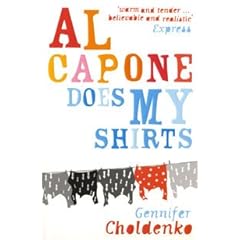
Al Capone Does My Shirts (Gennifer Choldenko)

--The blurb--
"When Moose Flanagan and his family move home, yet again, and become residents of the famous prison island Alcatraz, things get interesting. First of all, they share the island with a few other families and a lot of pretty heavy-duty criminals including Al Capone. And secondly, Moose's sister is starting a new school, which everyone hopes will help her become more integrated with those around her. When Moose comes up with some pretty cunning money-making schemes based on his famous co-residents, he does not count on his sister becoming inadvertently involved. This is a charming, funny and utterly enchanting book that skilfully and delicately weaves a humorous tale with some important issues."
blurb from http://www.amazon.co.uk/

--The review--
Having heard about this one during my own visit to Alcatraz in early 2007, it had been on my mental list of books to read since catching sight of the unconventional title. It is aimed at teens and pre-teens aged 11-14, and so perhaps unsurprisingly I whizzed through it in a night, and as this perhaps reveals, it was worth it.

Painting realistic adolescents and children is often a challenge for adult authors, but Choldenko did a sterling job: Moose was stroppy, both with and without good reason, and macho, but also protective, contemplative, and slightly shy. This trend continued with all of the characters, from the neurotic mother to the hardworking and more laid-back father. Natalie took a little getting used to, primarily due to her speech patterns, but I've worked enough with children on the autistic spectrum to know that once you have met one autistic child, you certainly haven't met them all, so I ultimately felt able to buy into this.

More could have been said about the layout of the island, as just putting a photo in the front of the book and labelling it seems a bit of a cop-out. However, generally speaking you could imagine the surroundings perfectly adequately, from the poky apartment to the San Francisco school. The scheme on which the book is centred is ingenious, and it is rendered even more striking by the emotional backdrop of Moose's family, against which it is set. The end is both happy and chilling even if somewhat improbable (in fact, its improbability almost makes it better), and the author's endnote is helpful, informative, upbeat and personal in equal measure.

While the settings and action of the book could not be further from what we as readers know and from what the author herself knows, Choldenko clearly made this her own, investing personal emotion in it as well as deep historical research, which results in a personal, amusing and historically interesting story. Despite being a children's author, Choldenko should be on the 'one to watch' list of many adults too, and I just hope that the follow-up to this, due later this year, is not a total let-down in comparison.

Other works by Gennifer Choldenko
Al Capone Shines My Shoes (released Sept 2009)
If A Tree Falls At Lunch Period (April 2009)
Notes from a Liar and Her Dog (2003)