Showing posts with label satire. Show all posts

Wednesday, 7 August 2013

Thank You, Jeeves! (PG Wodehouse)

 --The blurb--
 "The valet Jeeves resigns over Bertie's dedicated but somewhat untuneful playing of the banjo. In high dudgeon, Bertie disappears to the country as a guest of his chum Chuffy - only to find his peace shattered by the arrival of his ex-fiancee Pauline Stoker, her formidable father and the eminent loony-doctor Sir Roderick Glossop."

--The review--
As with any other country, stereotypes about Britain abound: afternoon tea. Strawberries and cream. The Queen. Wimbledon. Oxbridge. Butlers. Posh accents. Red buses and telephone boxes. Public schoolboys. The English breakfast. Black cabs. Country estates. And so on. It would be absurd to suggest that Brits indulge in all of these things every day - but equally, most stereotypes arise from the grain of truth that lurks within them. Thank You, Jeeves!- the first full-length novel in PG Wodehouse's Jeeves series - exploits many of these stereotypes to their fullest in the form of a light-hearted romp that becomes more and more farcical at every turn.

The farce is at times difficult to believe, with the events immediately preceding the ending, in particular, seeming rushed, and thrown together purely to bring the novel to a close, rather than providing intrinsic value themselves. However, it's worth remembering at this point the function of farce: the objective of the events is to place characters in untoward situations, and to observe their reactions as they unfold. While the events can be funny, it is the characters who serve even further as the object of the comedy: they are merely pawns in the writer's game, and thus a source of entertainment for us. To this end, Wodehouse deploys the characters and events extremely well.

Furthermore, there are other sources of pleasure in Thank You, Jeeves! beyond the characters' antics. Politically incorrect plot twists, archaic turns of phrase and the sheer extravagance of the setup just involved in having a butler provides plenty of nostalgia for Brits - even if that is a throwback to a time that never really existed. For foreign readers, it gives them a chance to indulge in the classic British stereotypes - even if they know that these stereotypes are not completely true representations of Brits and British life as it is today. Equally, it's possible that those same stereotypes had a cathartic purpose for Wodehouse, who in reality spent most of his life in other countries. Did the deployment of these stereotypes help to remind him of, and even construct for him, an exaggerated version of his homeland? 

To this end, one can wonder if the author intended the events and characters in Thank You, Jeeves! to be sincere or satirical. Given Wodehouse's public-school background and wealthy parents, it's entirely possible that he would have encountered people like these - hence, perhaps, the sharply-drawn characters. However, these same characteristics, and their roots in stereotype, can seem satirical to others - and this, too, is a source of humour, alongside the acerbic one-liners and fast-paced dialogue. The happy ending that Wodehouse produces, which links neatly with the apparently non-sequitur beginning, rounds off the narrative arc beautifully, and concludes this amusing and stress-free read. Off the back of this first Jeeves novel, the entire collection is to be recommended for light relief all year round - and not just in the summer when we all have more time to read - naturally alongside a pot of tea.

other works by PG Wodehouse
A full list of PG Wodehouse's works can be found on Wikipedia. The Jeeves canon consists of 35 short stories and 11 novels.

Monday, 5 August 2013

The Marriage Plot (Jeffrey Eugenides)

 --The blurb--
"Brown University, 1982. Madeleine Hanna, dutiful English student and incurable romantic, is writing her thesis on Jane Austen and George Eliot – authors of the great marriage plots. As Madeleine studies the age-old motivations of the human heart, real life, in the form of two very different men, intervenes. Leonard Bankhead, brilliant scientist and charismatic loner, attracts Madeleine with an intensity that she seems powerless to resist. Meanwhile her old friend Mitchell Grammaticus, a theology student searching for some kind of truth in life, is certain of at least one thing – that he and Madeleine are destined to be together. But as all three leave college, they will have to figure out how they want their own marriage plot to end."

--The review--
Satire of the university campus is common, particularly in the novels of David Lodge. However, in The Marriage Plot, Jeffrey Eugenides brings the notion of the college satire to an American stage, featuring just about every student stereotype going: the romantic literature student, the depressive outsider, the hippy, and the wealthy helicopterish parents. However, cramming the story with these clichéd characters is not the story's downfall but in fact the recipe for its success, with the reader being left to dangle tantalisingly to discover the true meaning of the novel's title only towards the end of the tale.

Eugenides' slow-burning method of writing novels pays off in this latest title, published in 2011, with every detail being so carefully crafted that it is virtually impossible to find fault. It also provides something totally different to his previous works: the campus tragicomedy contrasts neatly with the horror of The Virgin Suicides and the morbidly fascinating sociological study that is Middlesex, proving that the writer is not just a one-trick pony but a wide-ranging perfectionist.

One thing that remains present across the spectrum of Eugenides' novels, however, is his typically caustic wit, combined here with the classic first-world drama of the problems of mostly privileged youths. Gently mocking of English studies and the type of students and faculty members that one tends to find at university, it's 'funny because it's true' and proves immanently readable. Incongruous motifs contribute positively to the comedy, meaning that the female protagonist's occasionally incomprehensible behaviour is, by and large, forgivable.

The development of Madeleine's love for Leonard is at times slow and unrealistic, but by the end of the novel, the detailed description of Leonard's condition makes us more understanding, and we are completely convinced by their relationship. In describing their union, too, Eugenides possibly gently satirises the unsuitable relationships that frequently evolve in the type of novels that Madeleine enjoys studying, and thus makes a subtle ongoing joke about certain aspects of literature itself - and hence, too, his own construction of the Leonard - Madeleine - Mitchell love triangle (not to mention the Mitchell - Larry - Claire subplot, or the romantic troubles experienced by Madeleine's sister Ally).

In short, Eugenides' latest tome is a success, with a happy ending tinged with melancholy still managing to leave the reader satisfied. It also leaves the door wide open for a sequel, but one suspects that this is not Eugenides' style. His ability to make us truly empathise with aspects of his characters' situations makes for what can be an intense experience, and for that reason, it makes sense to close the door on them completely, in order to allow their impact on readers to fully resonate. His collection of short stories is strongly-awaited, particularly to see what new angle and approach he will come up with next. 

other works by Jeffrey Eugenides
The Virgin Suicides (1993)
Middlesex (2002)

Sunday, 2 June 2013

The Tragedy of Fidel Castro (Joao Cerqueira)

 --The blurb--
"When God receives a request from Fátima to help prevent a war between Fidel Castro and JFK, he asks his son, Jesus, to return to Earth and diffuse the conflict. On his island, Fidel Castro faces protests on the streets and realizes that he is about to be overthrown. Alone, surrounded, and aware that the end is fast approaching, he plays his last card. Meanwhile, Christ arrives on Earth and teams up with Fátima, who is convinced she can create a miracle to avoid the final battle between JFK and Fidel Castro and save the world as we know it."

--The review-- 
As the world becomes less religious and more irreverent, literature reflecting this attitude has become increasingly common, with Joao Cerqueira's novella, The Tragedy of Fidel Castro, fitting neatly into this category. However, there is no danger of Cerqueira being subversive for the sake of it; his mischievous and tongue-in-cheek style of writing is innovative and all his own, blending the mild blasphemy of Jean-Louis Fournier (author of God's CV) with the outright mockery of Joseph Heller (as manifested in his classic Catch-22). Cerqueira makes us think hard straight away thanks to his Chomsky-like strategy (informing us glibly that the Fidel Castro, JFK, Jesus and God characters bear no relation whatsoever to the real historical figures), making it difficult - in a fun way - for the reader to separate cultural associations from the words used.

While occasionally a little convoluted, and with more direct speech being a potentially positive addition, Cerqueira is by turns wryly funny, deeply ironic, and a provider of hugely effective descriptions and richly layered yet accessible metaphors. Equally, Cerqueira's focus on situations and events rather than on character development is a further masterstroke, making individuals seem like pawns at the plot's mercy. These aspects all combine to make The Tragedy of Fidel Castro highly competitive with the very best satires in its blackly humorous portrayal of a sobering reality.

In addition to this, Cerqueira owes another debt to Joseph Heller - his patchwork approach means that we cut between scenes rapidly and cannot always see immediately how they fit together. However, this is not necessarily something to take badly (whereas the author's intermittently patronising footnotes are). Ultimately, the story's iconoclastic and mildly atheistic standpoint makes the story deftly layered, making it merit rereads by all satire-lovers.

other works by Joao Cerqueira
Devil's Observations (2010)
Blame It On Too Much Freedom (2007)
Art and Literature in the Spanish Civil War (2005)

Sunday, 26 May 2013

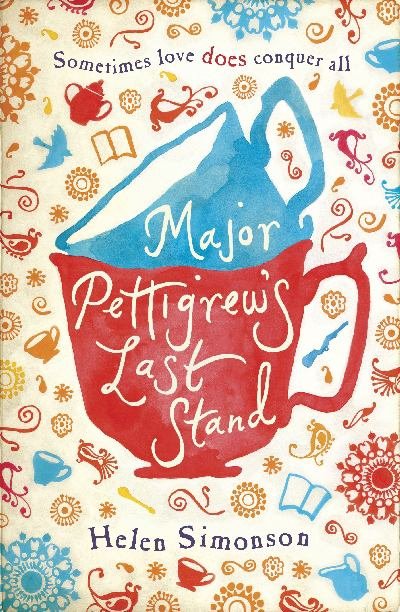
Major Pettigrew's Last Stand (Helen Simonson)

--The blurb--
"Major Ernest Pettigrew is perfectly content to lead a quiet life in the sleepy village of Edgecombe St Mary, away from the meddling of the locals and his overbearing son. But when his brother dies, the Major finds himself seeking companionship with the village shopkeeper, Mrs Ali. Drawn together by a love of books and the loss of their partners, they are soon forced to contend with irate relatives and gossiping villagers. The perfect gentleman, but the most unlikely hero, the Major must ask himself what matters most: family obligation, tradition or love?"

--The review--
Despite the various threats of pollution, globalization and urbanization, the quaint English village does still exist, and as such continues to hold a special place in the hearts of many - even expats who have long been away from this environment, such as the author of Major Pettigrew's Last Stand, Helen Simonson, who has lived in the United States for many years and chose the fictional village of Edgecombe St Mary as the setting for her début. However, while the setting is crucial to the gentle satire of Middle England's at times narrow-minded yet well-meaning attitudes, it is not the main focus of this excellent first novel - it is the pathos, humanity and humour of the characters involved that truly drive the plot forward.

Pettigrew himself narrowly avoids the cliché of the old English gentleman thanks to his dry, sprightly, and extremely British sense of humour. The characters around him are equally fleshed out in slightly clichéd yet very human ways, and the characteristically British reticence with which many of them act only adds to the novel's charm. This, combined with dashes of daring at appropriate moments, is what keeps the reader turning the pages, rather than the novel's clear end point, towards which Major Pettigrew and Mrs Ali are hurtling at speed.

However, novels are about more than just getting from point A to point B. As Edward Monkton's Zen Dog aptly puts it:
As readers, we more or less already know how Major Pettigrew's Last Stand will end; what we are interested in is how Helen Simonson will take us there as all of the story's various minutiae are played out and resolved. The rich cast of characters means that Simonson is able to take us, to varying degrees, on their individual journeys in tandem with the two protagonists, allowing everything to tie up (but not too neatly). 

Why this story's odyssey is the major's "last" stand is never quite clear; while perhaps a reference to his advanced age, it's not as if he's on the brink of death (so those seeking a happy ending need not worry about this possibility). However, this concern is secondary in the face of the novel's strengths: love swells against all obstacles, and it proves a comedy in the very best sense of the word. As many other readers have pointed out, it follows gracefully and wittily in the footsteps of many of English literature's greatest comedians, including Shakespeare and Jane Austen, thanks to its skilful use of wordplay, blisteringly dry humour, and the tracking of lovers' escapades. The perfect gift for expats who secretly still miss England, fans will be delighted to hear that a second novel by Simonson is already in the works.

Friday, 27 July 2012

Diary of a Nobody (George and Weedon Grossmith)

--The blurb--
"Mr Pooter's diary is a faithful record of the daily grind in respectable suburbia and the city office. It tells of his constant war against insolent tradesmen and impudent junior clerks, his incomprehensible son Lupin, and his over-whelming feeling that the biggest joke is on him."

--The review-- 
Many twenty-first century comedians take delight in poking fun at the average Joe: stand-up artist Bill Bailey, for example, uses one delightful couple, Clive and Beryl Pocock, as the exaggerated epitome of Mr and Mrs Average (who enjoy shopping at Asda and are overwhelmed by pipe cleaners and tea breaks). Some even make it the basis of their entire comedic oeuvre, with Sue Townsend satirising your run-of-the-mill geeky teen in the Adrian Mole series and Ricky Gervais emphasising his main character David Brent's over-inflated sense of self-importance in The Office. 

But these modern comedians weren't the first by any means to latch on to this concept, and while the idea likely goes back many thousands of years to the times of ancient Greek and Roman comedy, another excellent example can be found in the annals of nineteenth-century literature, in the form of George and Weedon Grossmith's Diary of a Nobody, which was originally serialised in satirical paper Punch with illustrations by Weedon. It seems that the brothers' talents for endless, as when they weren't penning this comic novel, they were busy in other comic avenues: George in working closely with musical comedy writers Gilbert and Sullivan, and Weedon performing as a comic actor.

This history of comic experience and expertise is apparent in the tightly-executed and humour-filled Diary of a Nobody. The 1892 epistolary novel focuses on the activity of Charles Pooter and his family, and we are soon drawn in to the minutiae of their day-to-day lives and Pooter's preoccupation with his social standing - without being so drawn in that we are unable to laugh. A careful balance is struck between predictability (we know when Lupin comes back home to live that it will all go horribly wrong) and keeping the reader in the dark (just what is Lupin hiding?), although arguably not all issues raised are satisfactorily resolved or explained.

The plot of the novel is well-controlled by its authors, and by just sticking to a few characters and giving them strong personalities (the execrable Cummings and Gowing, the flamboyant Lupin, the simpering Carrie, the embarrassing Daisy, and the dignified Mr Perkupp), the writers ensure a memorable read. They are also occasionally self-referential, with Pooter seeming baffled by his son's interest in the song "See Me Dance The Polka" - a song in fact written by George Grossmith himself. At the end of the novel, the door is left wide open for another sequel whereby hilarity could easily ensue; lamentably, the Grossmith brothers never did write a follow-up to Diary of a Nobody. Nonetheless, it is easy to see why so many film and stage adaptations of this work have been made over the years, and why so many modern comedians have been - and will continue to be - inspired by this seminal work of classic comedy.

Other works by George Grossmith
A Society Clown (Reminiscences) (1888) 
Piano and I: Further Reminiscences (1910)

Other work by Weedon Grossmith
From Studio to Stage (1913)

Saturday, 2 January 2010

The Blessing (Nancy Mitford)

--The blurb--
"After the war, English rose Grace joins her dashing aristocratic husband, Charles-Edouard, in France. She is out of her depth among the elegant French women and when she discovers her husband's tendency to lust after pretty girls, it seems that all is over - until her son Sigismond steps in..."

--The review--
It is surprising to discover that Nancy Mitford was born in 1904, just as the reign of Queen Victoria had come to a close, died in 1973, and wrote The Blessing in 1951. The surprise arises from the sheer modernity of the humour and situations with which we are presented in the forms of Grace, Charles-Edouard, Sigi, Nanny, and all their friends and family. Even having a nanny is not as dated as you might imagine, with several upper-class Parisian children still having 'nounous' today to collect them from school and look after them until their parents reappear.

As well as the characters being luminously described, with sharp dialogue and well-drawn features, the plot is taut and the mischief of Sigi enlivens the novel. The modernity and relevance of the novel is striking, although perhaps not all parts of this may be picked up on for those unfamiliar with Paris and its surrounding area: the pictures of expatriate social life could just as easily have been written today, with the mentions of British brands such as Tiptree adding to this in a positive way rather than detracting from the passages' effectiveness.

Mitford is perfectly able to keep readers on their toes as regards the storyline: in one way we know Sigi should get his comeuppance, but in another way we almost don't really want him to. The eventual reconciliation between Charles-Edouard and Grace is realistic, and the humour throughout is subtle and well-sustained (though again, some of it may pass non-expatriates by). The novella is light, but tremendously well-written and witty; it is a welcome introduction to one of the underrated classic authors of our age, and almost guaranteed to hook any reader who takes the bait.

Other works by Nancy Mitford
Highland Fling (1931)
Christmas Pudding (1932)
Wigs on the Green (1935)
Pigeon Pie (1940)
The Pursuit of Love (1945)
Love in a Cold Climate (1949)
Madame de Pompadour (1954)
Voltaire in Love (1957)
Don't Tell Alfred (1960)
The Water Beetle (1962)
The Sun King (1966)
Frederick the Great (1970)

Wednesday, 27 May 2009

The Rules of Attraction (Bret Easton Ellis)

-The blurb--
"In "The Rules of Attraction", Bret Easton Ellis trains his incisive gaze on the kids at self-consciously bohemian Camden College, a small, affluent liberal-arts college in New England at the height of the Reagan 80s. He treats their sexual posturings and agonies with a mixture of acrid hilarity and compassion while exposing the moral vacuum at the centre of their lives. Racing from Thirsty Thursday Happy Hours to Dressed To Get Screwed parties to drinks at The Edge of the World, this is a poignant take on the death of romance."
from www.amazon.co.uk

--The review--
The growing popularity in the UK of TV programme Skins perhaps indicates how far young people's perceptions of social interaction, and particularly relationships and romance, are shifting and have shifted. However, the writers of Skins were not the first to go there, for before them was Bret Easton Ellis, whose novel The Rules of Attraction was released in 1987 (and subsequently made into a film in 2002). He too portrays a colder, more ruthless face to teenage relationships, dispensing with the lovey dovey and focusing instead on what some might deem an unrealistic version of university life, comprising little other than sex, drugs, and changing degree courses.

And yet I liked it more than Skins; I liked it more than Alan Hollinghurst's Booker Prize-winning The Line of Beauty, which, to be honest, was more of the same (go to a party...do some coke...have some sex...do some more coke...oh, wait, there's another party over there...); and this definitely appealed to me more than Ellis' arguably most famous work, American Psycho (which, given its gratuitous displays of violence, I am unlikely to ever read, seeing as even the merest hint of blood on Casualty makes me reach for a bucket). What gave the novel its compelling aspect was not initially clear; it was difficult to relate to the two-dimensional characters and at times I couldn't help feeling that I was, in fact, just reading a script for an episode of that show.

However, at some point something changed; read it less literally and as more of a satire, and the purpose of the novel becomes much more apparent. There are some really human, tender moments (I preferred the characters at these moments to when they're just randomly sleeping around), there are some killer one-liners that make the novel really acerbic and funny, and the novel is cleverly cyclical, being structured in such a way that the novel's beginning sentence follows on almost seamlessly from its final line. Equally clever is how the novel's title is shown to us, without it actually being explicitly mentioned: Ellis arguably uses the novel to state that there are in fact no rules of attraction at all.

While this wasn't the best novel I've ever read in terms of subject matter, it paints a snapshot of time culturally as well as satirising human relationships in a really skilful way, and has served as an initial hook onto Ellis' writing style (which, admittedly, does take a little getting used to). Next up for me, perhaps, will be Glamorama, which should at least have the advantage of dealing with a world with which I am slightly more familiar. Ellis is an unusual writer who deserves to be known for more than just American Psycho; described as being a writer who is sympathetic to the fate of his own 'lost generation' in a way that only Fitzgerald was about his, the sequel to Less Than Zero, due out next year, is surely justly awaited by his devotees.

Other works by Bret Easton Ellis
Imperial Bedrooms (sequel to Less Than Zero; due May 2010)
Lunar Park (2005)
Glamorama (1998)
The Informers (a collection of linked short stories; 1994)
American Psycho (1991)
Less Than Zero (1985)

Sunday, 11 January 2009

Le Dossier: How To Survive The English (translated by Sarah Long)


--The blurb--
"In this robust, insightful and hitherto only privately available handbook, Parisian wife and mother Hortense de Monplaisir shares with us the secrets of her survival amongst the English. Exiled to London for the sake of her husband’s career, pioneer, Hortense delves into the many aspects of la perfide Albion that have long puzzled its closest neighbour and oldest enemy. No one and nothing is safe from Hortense’s penetrating eye as she discusses a diverse range of topics from the inability of the English to speak their mind, their bizarre love of rituals such as the stag party and the country fete and their passion for long muddy walks, to their obsession with World War II, estate agents and incomprehensible fondness for the traditional English pantomime. The result is a double-edged comedy: here are the foibles of the English, seen through the jaundiced gaze of a sophisticated Parisienne. Hortense’s confident interpretations of some of our best-loved national habits (jam with meat, anyone?) will only confirm our long-held view that the French are, indeed, very different.”
blurb from http://richards-world2.the-world-in-focus.com/

--The review--
Le Dossier, narrated by Hortense de Monplaisir and translated by an Englishwoman, Sarah Long, simultaneously allows Brits to do what they do best on two counts: make fun of themselves, and make fun of the French. Hortense de Monplaisir is in fact a fictional narrator invented by Sarah Long, the 'translator', an Englishwoman who lived in Paris for ten years. It is clear from the outset that Hortense is intended to embody only a very specific Parisian demographic (the rich trophy wife), and not all French people. Long's pointed inclusion of specific detail, such as the location to which Hortense has been expatriated and her references to her regular visit to the coiffeur, makes this evident quickly. Long also assumes the persona of a French woman well, and the 'French accent' with which her character speaks rings loudly throughout the narration almost from the beginning. She makes several very accurate observations about the French as well as about the English, doing this as well implicitly as she does explicitly, and all aspects of both English and French life are well covered and tautly compared.

The positive reaction that I had to this piece of double-edged satire therefore made my perusal of Amazon's comment page very surprising: a disproportionate number of people seemed to find this novel lacking in humour, insulting, or both. The only people who felt this way clearly didn't 'get' the novel's concept, and for this to happen, in my mind, you have to be a few sandwiches short of a picnic. Hortense is crafted to the pinnacle of extremity in her actions, reactions, and thoughts, and while some of these things are representative of the French as a nation (hypochondria, anyone?), she is deliberately designed as a caricature, and as a piece of satirical comedy, the novel comes off very smoothly. It is in no way intended as a serious piece of literature, and bearing this in mind greatly aids the reader's general enjoyment.

Le Dossier combines stereotypes with wit and humour beautifully, and equally mixes disrespect and respect for both cultures. Some of the points Long makes about English culture are particularly salient, and since Le Dossier is satirical and she therefore may not mean them, it does provoke the question of why Long, who lived in Paris for ten years, returned to England; furthermore, instead of adhering to one comment on the book's cover, which assures readers that this book will change their minds if they ever decide that idyllically renovating a French château is a good idea, Le Dossier is perhaps more likely to send the English running towards France faster than ever before, for the novel is as blunt about England's faults as it is about France's. The only weakness in the novel is some slightly shoddy editing: missing footnotes, for instance, and a couple of ill-aimed accents (e.g. château being written chateâu).

Sarah Long reveals herself in the 'about the translator' section, saying 'Madame de Monplaisir, c'est moi!' I kindly instruct anyone who still misses the point of this novel after reading that preface to read the novel over again. It is a rare gem in being both amusing and true, and it is to be hoped that this will propel Ms Long and her work into the limelight, where they both deserve to belong.

Other works by Sarah Long
And What Do You Do?
The Next Best Thing