Showing posts with label history. Show all posts

Saturday, 10 August 2013

The Rest Is Noise (Alex Ross)

 --The blurb--
"The Rest Is Noise is a sweeping musical history from pre-war Vienna to the Velvet Underground. In this comprehensive tour, Alex Ross, music critic for the 'New Yorker', explores the people and places that shaped musical development: Adams to Zweig, Brahms to Bjork, pre-First World War Vienna to 'Nixon in China'. Winner of the Guardian First Book Award, this portrait of an exceptional era weaves together art, politics and cultural history to show how twentieth-century classical music was both a symptom and a source of immense social change."

--The review--
When it comes to works of art, the critical world is frequently split between the separate values of intrinsic and extrinsic reading. Just how vital are the contexts of an artist's personal life and the historical and political scenes in which they grew up to interpretation of their work? Alex Ross' The Rest Is Noise is a firm supporter of extrinsic interpretation, but combines both beautifully to add pace, engagement and a multitude of colours to an already interesting cultural mosaic.

Ross treads the fine line between academics and accessibility largely with skill, although some readers may feel lost by the more detailed discussions relating to key signatures and so on. On the other hand, people whose interest is such that they're reading such an in-depth book on the subject will likely already have a good grasp of the meanings of technical terms (even if 'knowing meanings' and 'listening, identifying and analysing' are two very different skills). The interdisciplinary nature of Ross' work is also appealing, with topics as diverse as Stalin, Disney, and John Donne being discussed. The author handles the jumps between topics and countries well, with the possible exception of dwelling too much on Britten (a whole chapter on one composer seems excessive, especially when a good proportion of it was devoted to a long-winded synopsis of Peter Grimes). However, the tome is mostly inspiring and urges us to listen: even though the chapters appear long, these are happily split into smaller chunks.

As the length of the book suggests, Ross covers an impressive range of music. One could argue that the depth of examples given is so great that The Rest Is Noise would be better as an audiobook: a soundtrack list is provided at the end of the book, but to listen and read simultaneously is not always practical, whereas an audiobook could interject with excerpts or even full works appropriately. Despite the limitations of the book's format, though, Ross does an excellent job of proving the present-day relevance of various twentieth-century works, including several by Kurt Weill (think Pirate Jenny and Mack The Knife), and the significance of a number of little-known artists from this century (such as Marian Anderson). Through this historical approach, Ross shows us the value of interpreting music extrinsically, even if at times he delivers his opinions in a manner that dresses them up as fact (which can add expertise and authority, but also takes a text into risky territory).

Contemporary observations from other musical spheres also increase the relevance of classical music to fans of other forms of music, or to those who know little about the classical genre. Comparing Copland's Fanfare For The Common Man to Queen's We Will Rock You in terms of rhythm and melody is an astute remark, and on further inspection, readers will find such comparisons wherever they look in the world of music: Puccini's Humming Chorus compares closely melodically to Les Misérables' Bring Him Home, for example.

In light of such insightful assertions, then, the occasional sloppiness in terms of formatting is disappointing. Part Three of the book, which encompasses the years 1945-2000, also seems to cover far too great a passage of time compared to the previous parts, which made more sense in their division (effectively World War Two and the years preceding this conflict). The book's glossary also only seems to be available online, which is a shame: an extensive glossary and cycle of fifths in the paper edition would be most helpful. Syntax is clumsy at times, too, and Ross occasionally generalises or makes ill-considered statements (for example, dubbing the BBC the finest purveyor of classical radio programming in the world, without considering other stations such as Italy's Rai Radio Tre, which plays complete works without adverts). However, none of this detracts too significantly from Ross' apparent belief that music cannot achieve complete autonomy from the society around it, and the convincingness with which he backs this up - naturally composers are not only influenced by and are part of their culture, but also influence what comes after them.

This arena of influence is largely described by Ross as being heavily centred around Europe and America, and it seems difficult to believe that there was really nothing musically significant going on in Australia, Asia and so on during the twentieth century. The closest the author comes to this is mentioning traditional music fro the Andes, Bali, India and Japan in relation to Messaien in Chapter 13. Film music also gets a look-in here, although it (and musicals) arguably deserve more airtime. The link between contemporary and classical is cleverly reinforced in Chapter 14, with Ross highlighting the Beatles' admiration for Stockhausen, Stravinsky's influence on Charlie Parker, and Coltrane's love of Bartok. Naturally, though, we all have different notions of importance and it would have been impossible for Ross to include every even remotely influential figure in The Rest Is Noise: although it doesn't stop the reader from feeling that a few have been unjustly left out, such as Ludovico Einaudi and Joe Hisaishi, who have both been hugely popular since the 1980s. Equally, the impact of the Cultural Revolution on China's ability to have real influence could have been given more attention.

So what is the 'noise' and the 'rest' of Ross' title? Several possibilities can be inferred. What some listeners may consider 'noise' is often used to show off composers' and performers' virtuosity as part of quite lyrical works, rather than acting ostensibly and primarily as a source of pleasure. Composers, as 'invisible' men, often had to become visible (i.e., they had to make some noise), as their future depended on it. Even conversation (also 'noise') has lyrical and musical qualities thanks to phonetics, and conversation can take the form of opposition, which too could seem like 'noise', with the controversy of some classical music at the time of its release perhaps being perceived as 'noise' compared to 'approved' music. Classical music can also be deliberately and literally noise, with Ross pointing out not just the most famous example of John Cage's 4'33", but also the lesser-known examples of Imaginary Landscape #4 (also by Cage) and Cinq Etudes de Bruits (by Pierre Schaeffer). Conversely, classical music could be thought of as something pure and to be revered, with 'the rest' being 'noise' (although the positive links Ross makes between classical, folk, film and rock music make this a more tenuous hypothesis). Finally, all that is going on around composers historically and politically is noise, and as Ross is keen to point out, such noise is influential.

Ross also considers the influence of all this 'noise' in the twenty-first century, depicting a mixed future for the art, although perhaps without fully considering the impact of crossover music (through groups such as All Angels) and publications (such as the Classic FM magazine). Nevertheless, the breadth of his work means that virtually everyone will find something they're familiar with, whether it's the Velvet Underground, David Bowie, Missy Elliott, Public Enemy, Philip Glass, or Michael Nyman. This all-encompassing influence of classical music is nicely summed up by Ross, who simultaneously recognises the role of composition today by way of conclusion, neatly demonstrating its continued relevance in our "decentered culture". And with the formation of history and culture as active and vital today as they ever were, it's crucial that composers continue to tell that story for future generations. With luck, Ross will continue to do the same through his writings.

other works by Alex Ross
Listen To This (2011)

Thursday, 8 August 2013

Islamophilia (Douglas Murray)

--The blurb--
"As the country tries to make sense of the slaughter of British soldier Lee Rigby on the streets of London, Douglas Murray delivers an analysis in Islamophilia of how many prominent individuals have, at some point chosen to abandon any hope or wish to criticize Islam. Instead, they have decided to profess some degree of irrational or misguided love for it and make strategic cultural efforts to rewrite history and promote Islam." 
(adapted from Amazon.co.uk)

--The review--
In the wake of the September 11th attacks and others, the rise and rise of Islamophobia has been simultaneously understandable and yet preventable, with it arguably never being right to tar all members of a particular group with the same brush. However, Douglas Murray argues in Islamophilia that too many public figures have gone too far the other way in an attempt to avoid being accused of being 'Islamophobic'. In this short yet well-researched and succinctly-argued ebook, he makes a convincing and thought-provoking case.

This is supplemented well by links to videos and newspaper articles online thanks to the virtues of the ebook format. However, one wonders what will happen if these links become outdated or the publisher ever wants to release the book as a paperback: such supplementary materials are not so easily linked to in this latter case and their availability, as mentioned, can be transient. However, in the current format there's no denying that these sources are helpful (although they are perhaps best read on an iPad or Kindle Fire rather than on a traditional black-and-white ebook reader with a small screen). The sources, too, are well-chosen and complement Murray's argument well.

However, while Murray is frequently convincing, he is also at times borderline aggressive in making his points and is prone to generalization, which may alienate his readers rather than rally them round. Nonetheless, his caustically witty exposé is clever enough to engage and to inspire critical thought, as he brings to the fore examples to support his theory that have hitherto remained largely off the public radar.

The main criticism of this readable treatise is that Murray offers no real solution to the problem of Islamophilia. His conclusion seems rushed and trite, with no practical offering in terms of how readers or public figures ought to be moving forward in the midst of the cultural unrest being experienced in the UK. People feel ill at ease with both Islamophobia and Islamophilia - and quite rightly so. However, just saying the equivalent of "calm down, guys" and "we need to find a middle ground" is insufficient by way of a resolution. This proved a disappointing end to an otherwise intelligent book, and while Murray's other books are worthy of consideration if his methodical and humorous approach is anything to go by, one has to hope that in exploring neoconservatism and the Saville Inquiry, he comes to more pragmatic conclusions than in Islamophilia.

other works by Douglas Murray
Neoconservatism: Why We Need It (2012)
Bloody Sunday: Truth, Lies, and the Saville Inquiry (2011)

Tuesday, 11 June 2013

Incomplete and Utter History of Classical Music (Stephen Fry and Tim Lihoreau)

--The blurb--
"In his Incomplete & Utter History of Classical Music, Stephen Fry presents a potted and [...] rambling 700-year history of classical music and the world as we know it. Along this musical journey he casually throws in references to pretty much whatever takes his fancy, from the Mongol invasion of Russia and Mr Khan (Genghis to his friends), the founding of the MCC, the Black Death (which once again became the new black in England), to the heady revolutionary atmosphere of Mozart's Don Giovanni and the deep doo-doo that Louis XVI got into (or 'du-du' as the French would say).
It's all here - Ambrose and early English plainsong, Bach, Mozart (beloved of mobile phones everywhere), Beethoven, Debussy, Wagner (the old romantic), right up to the present day."

--The review--
"Stephen Fry...national treasure...", opens a certain Weebl video. And certainly very few could argue with that. Beloved by many, he frequently graces our television screens, not least as part of legendary comedies Blackadder and Jeeves and Wooster, as well as (more recently) on intellectual TV pop quizzes such as QI and Never Mind The Buzzcocks. He also regularly graces the nation's bookshelves thanks to his autobiographies and books on poetry. In 2004, he released his Incomplete and Utter History of Classical Music in partnership with Tim Lihoreau, a musician who works closely with radio station Classic FM. Although the book is ghostwritten by Lihoreau, Fry's inimitable style and humour comes through strongly, and the idiosyncratic and at times paradoxical nature of this is also encapsulated in the book's title, which combines modesty and deliberately gross exaggeration in equal measure.

This Lihoreau-Fry lovechild has many merits, presenting the history of classical music in a concise and accessible manner. As Fry rightly points out on multiple occasions in the tome, there's nothing wrong with accessibility. So what if someone only knows Grieg's Hall Of The Mountain King from the Alton Towers advert? It's better than not knowing it at all. However, one could also argue that it's a little like reading Harry Potter or Twilight: great if you're reading, but not so great if you never move on to anything else. One of the many joys of classical music (and indeed almost any music) is the seemingly endless scope for the analysis of different interpretations, and just as many of us have multiple copies of Cry Me A River, Summertime, Blackbird or Somewhere Over The Rainbow kicking around, we fulfil different needs by having several recordings of, say, Handel's Giulio Cesare, and infinitely exploring its various nuances and emphases. This is something that is little mentioned (if at all) by the Fry-Lihoreau team - but then again, this book is only billed as being an introduction to classical music.

The introduction is eased all the more by Fry's signature sense of humour, which of course has been a key element in marketing this book to draw his fans in. Be that as it may, though, some might consider that Fry's particular brand of humour rests significantly on tone of voice and comic timing, making this book better as a radio series (which is, incidentally, how it originated) or even as a television series (we are still waiting). Nevertheless, this is not to say that the pages never raise a chuckle, and they are packed with brilliantly British puns throughout, referring to everything from Jim'll Fix It (perhaps not so politically correct in these times, but never mind) to The Beano. The authors also do cover a vast period of history in a relatively short space without skimping on detail, but some of this space is meaningless filler (which would arguably be cut out for TV or radio) and some of the space is devoted disproportionately to the composers that Fry just happens to like best (but then again, I would say that, as I'm a devotee of Ancient Greek music and will always feel that it deserves more attention).

To end such an ambitious project was always going to be awkward, and Fry's observations towards the end of the book (that the focus has shifted more towards artists and reality TV now than towards composers themselves, and that film music is perhaps the new classical music) are perfectly salient, leaving the reader with plenty to contemplate. While he has tried to end the book on a contemporary note, the danger of this was always that his conclusion would date quickly - some of the groups he mentions, such as Amici Forever, who were busily popularizing classical music at the time of the book's publication nearly ten years ago, have already disbanded. Future edits should probably take account of this by offering up a more general conclusion, perhaps without mentioning specific names unless their place in history is safely assured (mentioning Pavarotti, for instance, is probably not too big a risk). Ultimately, though, despite these pernickety criticisms, a totally unscientific experiment perhaps proves that the book has achieved its aim of popular appeal: when offered up to a class of twenty fifteen-year-olds for free, alongside an autobiography of Bagpuss' creator and two CS Lewis books, this was the only one to be snatched up instantly.

other works by Stephen Fry
The Liar (1992)
Paperweight (1992)
The Hippopotamus (1994)
Making History (1996)
Moab is my Washpot (1997)
The Stars' Tennis Balls (2000)
Rescuing The Spectacled Bear (2002)
The Ode Less Travelled (2005)
Stephen Fry in America (2008)
The Fry Chronicles (2010) 

Sunday, 2 June 2013

The Tragedy of Fidel Castro (Joao Cerqueira)

 --The blurb--
"When God receives a request from Fátima to help prevent a war between Fidel Castro and JFK, he asks his son, Jesus, to return to Earth and diffuse the conflict. On his island, Fidel Castro faces protests on the streets and realizes that he is about to be overthrown. Alone, surrounded, and aware that the end is fast approaching, he plays his last card. Meanwhile, Christ arrives on Earth and teams up with Fátima, who is convinced she can create a miracle to avoid the final battle between JFK and Fidel Castro and save the world as we know it."

--The review-- 
As the world becomes less religious and more irreverent, literature reflecting this attitude has become increasingly common, with Joao Cerqueira's novella, The Tragedy of Fidel Castro, fitting neatly into this category. However, there is no danger of Cerqueira being subversive for the sake of it; his mischievous and tongue-in-cheek style of writing is innovative and all his own, blending the mild blasphemy of Jean-Louis Fournier (author of God's CV) with the outright mockery of Joseph Heller (as manifested in his classic Catch-22). Cerqueira makes us think hard straight away thanks to his Chomsky-like strategy (informing us glibly that the Fidel Castro, JFK, Jesus and God characters bear no relation whatsoever to the real historical figures), making it difficult - in a fun way - for the reader to separate cultural associations from the words used.

While occasionally a little convoluted, and with more direct speech being a potentially positive addition, Cerqueira is by turns wryly funny, deeply ironic, and a provider of hugely effective descriptions and richly layered yet accessible metaphors. Equally, Cerqueira's focus on situations and events rather than on character development is a further masterstroke, making individuals seem like pawns at the plot's mercy. These aspects all combine to make The Tragedy of Fidel Castro highly competitive with the very best satires in its blackly humorous portrayal of a sobering reality.

In addition to this, Cerqueira owes another debt to Joseph Heller - his patchwork approach means that we cut between scenes rapidly and cannot always see immediately how they fit together. However, this is not necessarily something to take badly (whereas the author's intermittently patronising footnotes are). Ultimately, the story's iconoclastic and mildly atheistic standpoint makes the story deftly layered, making it merit rereads by all satire-lovers.

other works by Joao Cerqueira
Devil's Observations (2010)
Blame It On Too Much Freedom (2007)
Art and Literature in the Spanish Civil War (2005)

Sunday, 11 November 2012

Delirium: The Politics of Sex in America (Nancy L Cohen)

 
--The blurb--
"The 2012 election was supposed to be about the economy, but over the last few months it turned into a debate about sex and women’s rights. In Delirium, Cohen takes us on a [...] journey through the confounding and mysterious episodes of [...] recent politics to explain how we and why we got to this place. Along the way she explores such topics as why Bill Clinton was impeached over a private sexual affair; how George W. Bush won the presidency by stealth; why Hillary lost to Obama; why John McCain chose Sarah Palin to be his running mate; and what the 2012 presidential contest tells us about America today. She exposes the surprising role of right-wing women in undermining women’s rights, as well as explains how liberal men were complicit in letting it happen. Cohen uncovers the hidden history of an orchestrated, well-financed, ideologically powered shadow movement to turn back the clock on matters of gender equality and sexual freedom and how it has played a leading role in fueling America’s political wars. Delirium tells the story of this shadow movement and how we can restore common sense and sanity in our nation’s politics."

--The review-- 
As previously mentioned on this blog, Tudor history and American history are given arguably disproportionate importance in Britain's history curriculum, meaning that 18-year-olds often leave school with knowledge of little else in spite of having studied history until the moment of their leaving. However, this emphasis does not mean that everything about American history is covered - and it is clear from Nancy L Cohen's latest book, Delirium, that even those who think they know plenty about American history have only scratched the surface.

Delirium is the title, and madness in various guises is certainly what readers get an alarming insight into throughout this history of the sexual counterrevolution in American politics. In describing how different views on sex and gender in the United States have affected the nation, Cohen is both wide-ranging and detailed, covering topics such as birth control, marriage, and homosexuals in the military. Equally, she keeps the text engaging and readable, condensing what has clearly been long and complex research into accessible chapters without dumbing down. 

The fact that Delirium was written in the midst of the recently-terminated 2012 presidential campaign may mean that this version of the text ages quickly. However, with President Barack Obama having won a second term for the Democrats just days ago, this also leaves the door wide open for future editions and revisions. Full of interesting and little-known facts, Delirium is also concise and well-explained, with plenty of fascinating and largely relevant diversions (although occasionally goes so complicatedly off-topic that the original aim seems distant). 

Some necessary background is given, but at the same time, Cohen does assume that her audience is American and fails to define some key terms from the outset, which would make a glossary handy. However, the author makes up for this with her meticulous research and citations elsewhere in the text, and continually proves herself to be intelligently tolerant and aware of difficulties. Cohen contextualises the issues at hand in a highly distilled manner and gives the reader plenty of food for thought thanks to various jaw-dropping moments and the notion that religion has so much to do with this as to almost be worth a book in itself.

Delirium was an ambitious project, and Cohen has every right to be proud of her achievement. She has spanned a vast time period with dignity, clarity, and concision, and the reader can be left in no doubt of her expert standing. Her other books are certainly worth seeking out, and Delirium itself definitely merits rereads.  

other works by Nancy L Cohen
The Reconstruction of American Liberalism 1865-1914 (2002) 
The 1990s: A Social History of the United States (2009)

Sunday, 9 September 2012

The Way of the Tumbrils (John Elliot)

--The blurb--
"In The Way of the Tumbrils, a dozen of the most turbulent and tragic episodes of the French revolution are recounted. Part history, part guide book, The Way of the Tumbrils is a story of men and women fighting desperately to avoid the scaffold."

--The review--
When today's tourists see the darker side of Paris, including iPhone theft, a permanent trail of dog faeces, and the constant whiff in the air of surliness and cigarette smoke, it can be easy to forget the city's rich history and cast of memorable characters. Thankfully, John Elliot, in what is sadly his only book, is able to bring the whole fabulous story back to life in The Way of the Tumbrils. The writer is, by his own description, not really a writer at all, but just an ex-railwayman with an interest in his subject. However, these humble origins have begotten a text of greatness, which would make a superb gift for all history buffs and Paris fans.

The tumbril, or tumbrel, was a two-wheeled cart often used at the time of the Revolution to transport goods and people. The reason for the tumbrils in Elliot's story, and indeed in its title, is predictably sinister and completely appropriate to the author's highly visual and sensory retelling of this time in history.

Accessible and well-written, The Way of the Tumbrils mixes first-, second- and third-person, which contradicts all the stylists and goes against all the rules, and yet somehow works. Humorous stories arise from Elliot's lack of grasp of French, which seems even funnier given his level of interest in the country's history. However, other scenes indicate that the writer has a higher command of the language than he gives himself credit for. The overall result is a lively account of the bravery and treachery that pervades French history, and the fact that The Way of the Tumbrils only covers the Revolution is almost painful - Elliot is so engaging that a complete history of France would have been extremely desirable.

In spite of the book being published in 1958, the routes set out by Elliot are still easily navigable today - although the inclusion of maps, at least in the e-book edition (the print editions perhaps have them) would have been even more helpful in this regard. There are also other formatting problems with the digital version: some accents and letters are missing or erroneous, and some images and captions are split across several pages. For this reason, the print version is recommended. The accompanying pictures, though, generally are reproduced beautifully.

While the Bastille chapter lacks the same pace and humour as the rest of the book, the writer manages to keep the reader's attention throughout. Although a certain amount of knowledge is presupposed, this does not preclude understanding and may prompt the reader to find out more. Combining history, geography and tourism, The Way of the Tumbrils also considers questions of ethics: its at times emotive and highly descriptive nature may even go as far as to cause some readers to reconsider their views of the death penalty.

If the object of history books is to enable the reader to imagine what it was like to be present at significant times in the past, Elliot certainly achieves this with The Way of the Tumbrils - and remarkably so considering his lack of status as a professional historian. Thanks to his work, many could even be ready to forgive Paris its mounds of mégots, and tour the place of the past today.

Saturday, 18 August 2012

At Home: A Short History of Private Life (Bill Bryson)

--The blurb--
"Bill Bryson and his family live in a Victorian parsonage in a part of England where nothing of any great significance has happened since the Romans decamped. Yet one day, he began to consider how very little he knew about the ordinary things of life as he found it in that comfortable home. To remedy this, he formed the idea of journeying about his house from room to room to “write a history of the world without leaving home.” The bathroom provides the occasion for a history of hygiene; the bedroom, sex, death, and sleep; the kitchen, nutrition and the spice trade; and so on, as Bryson shows how each has fig­ured in the evolution of private life. Whatever happens in the world, he demonstrates, ends up in our house, in the paint and the pipes and the pillows and every item of furniture."

--The review--
Bill Bryson's amusing travelogues are known even to those who have never picked up one of his books. Focusing chiefly on his homeland of America, and his adopted homeland of Britain, several of his works have been adapted for television and there are even plans afoot for a film version of his 1998 work A Walk in the Woods. His prominence over almost twenty-five years, and ability to straddle the genres of travel, history, biography, memoir, language and science as almost nobody else does has assured his comfortable position as a household name. His latest opus, At Home: A Short History of Private Life, which was published in 2010, continues in the author's tradition of trying to eagerly dash through as many topics as possible, in this case in an attempt to illustrate how it is what we do in our day-to-day lives, rather than what battles, monarchs and laws do, that in fact makes history. 

Always engaging, and only occasionally patronising, At Home is intriguingly structured around the layout of Bryson's home, a former refectory in Norfolk. Laying aside the fact that it is practically criminal to a book-lover to have a library and not use it (which Bryson cheerfully admits, which almost makes him seem ungrateful for the large and apparently beautiful home that he has at a time when many young people will probably never become homeowners, let alone have the luxury of a library for their delectation), Bryson more than compensates for this transgression through his compendium of fascinating and eminently quotable facts and stories. His chosen structure (linking the anecdotes with each room in his house) is successful for the most part, although perhaps inevitably - given the scope of the work - is stronger in some places than others. The stories connected with the attic and the cellar, for instance, appear to have little to do with these rooms - and this would have surely been an ideal opportunity to start on when British people started to drink wine and beer and perhaps keep it in their homes before taking it seriously as a hobby. Unfortunately, it's a chance that Bryson apparently missed - but in spite of this, it's a remarkable achievement to keep up the reader's interest in quite such a sustained way, given At Home's length.

While for the most part incredibly readable, the author does seem to have an aversion to semi-colons, which would make some of his longer sentences far easier to read if they had been included. It's difficult to say whether this is a deficiency on Bryson's own part, or just sloppy editing - although if he does have a specific vendetta against this humble punctuation mark then there's probably an explanation tucked away in one of his language books. 

One of the elements which does contribute to the book's readability - and this applies across much of Bryson's canon, as mentioned in my introduction - is the fact that he does focus in At Home, for the most part, on British and American history. This is understandable given his own background, and he does well to pull in stories from around the world at appropriate moments too. Ultimately, despite At Home's 'stab in the dark' approach, it is this unifying principle, as well as the book's mostly successful underlying premise (with an additional focus on the year of his home's construction - 1851), which adds structure, form, and a real conclusion to this history book. Far more interesting than other populist historians such as Stephen Clarke, Bryson remains accessible in the face of the depth of research undertaken and the sheer finesse involved in selecting information from more than 500 works and incorporating the most vital tidbits into a single book (although cynics may suspect that he has an army of willing interns/minions to assist him in this monumental task). For this, in spite of any errors he makes, his place in Britain's (and America's) literary canon, as well as his honorary doctorate from St Andrew's University, is well-deserved.

A full list of works by Bill Bryson can be found here.

Monday, 16 April 2012

Midnight in Peking (Paul French)


--The blurb--
"January, 1937: Peking is a heady mix of privilege and scandal, lavish cocktail bars and opium dens, warlords and corruption, rumours and superstition – and the clock is ticking down on all of it. In the exclusive Legation Quarter, the foreign residents wait nervously for the axe to fall.  Japanese troops have already occupied Manchuria and are poised to advance south.  Word has it that Chiang Kai-shek and his shaky government, long since moved to Nanking, are ready to cut a deal with Tokyo and leave Peking to its fate. Each day brings a ratcheting up of tension for Chinese and foreigners alike inside the ancient city walls.  On one of those walls, not far from the nefarious Badlands, is a massive watchtower – haunted, so the locals believe, by fox spirits that prey upon innocent mortals. Then one bitterly cold night, the body of an innocent mortal is dumped there.  It belongs to Pamela Werner, the daughter of a former British consul to China, and when the details of her death become known, people find it hard to credit that any human could treat another in such a fashion.  Even as the Japanese noose on the city tightens, the killing of Pamela transfixes Peking. Seventy-five years after these events, Paul French finally gives the case the resolution it was denied at the time."  

--The review--
Despite not being a fan of crime fiction usually, when I think back on it my interest in popular culture is littered with crime references and the idea of bringing the bad guys to justice: over the years I have been a fan, variously, of shows such as Lewis, Watchdog, and Motorway Cops, as well as books by Ruth Rendell, Susan Swan, Marisha Pessl, and Grahame Greene. 

However (and this is a big however), I cannot stand the sight of blood. This includes the presence of blood in shows where it is obviously fake, like in Casualty. Another thing I can't abide is graphic descriptions of injury. These two things together often preclude me from exploring much of the crime genre in books and on television. Thankfully, though, I can now add Paul French's work to the safe list thanks to Midnight In Peking, which is due for UK paperback release on May 31st 2012.

So what made me, like the mug that I am, say yes to this when offered it by Penguin's lovely PR people? The main draw for me was the historical aspect: knowing shamefully little about history in general despite studying the subject until I was 18 (thanks, British education system!) means that I am now as keen to get my mitts on history books as possible while I work out what I am interested in more precisely. In spite of being a crime novel, Paul French did not disappoint with his colourful yet well-researched depiction of pre-Communist China. Concise yet engaging, his rendition of this time period instantly made me want to find out more.

This is not the only thing that Midnight In Peking has going for it: the author keeps a tight rein on the information, revealing it little by little in a very controlled fashion, while at the same time treating the reader to sumptuous (yet still concise) descriptions of the cityscape. As we read, we genuinely want to know of the fate of the characters and wish for justice to be finally brought to victim Pamela Werner, whose family incredibly never received justice during their lifetime. It is at times frustrating and at other times satisfying to know the outcome. French keeps the graphic descriptions of Pamela's injuries to a minimum and structures the story so that it is easy enough to skip them for those of us who are not that way inclined.

As a whole, then, Chris French has done a great service to us all, not only in drawing attention to this aspect of China's history but also in terms of bringing some form of peace to a family that never previously was able to attain it for their case. Although at times a little more dialogue is wished for, this is a small flaw in an otherwise great historical novel.

Other books by Paul French
North Korea The Paranoid Peninsula: A Troubled History (2005)
Carl Crow: A Tough Old China Hand - The Life, Times and Adventures of an American in Shanghai (2006)
Through the Looking Glass: China Foreign Journalists from Opium War to Mao (2009)
The Old Shanghai A-Z (2010)

Paul French is also the author of blog China Rhyming.

Sunday, 1 April 2012

The Perfume Lover: A Personal History of Scent (Denyse Beaulieu)

 --The blurb--
"What if the most beautiful night in your life inspired a fragrance? Denyse Beaulieu is a [...] fragrance writer; it is her world, her love, her life. When she was growing up, perfume was forbidden in her house, spurring a childhood curiosity that went on to become a[...] passion. It is this passion she pursued all the way to Paris, where she now lives, and entered the secretive world of the perfume industry. But little did she know that it would lead her to achieve a fragrance lover’s wildest dream …When Denyse tells a famous perfumer of a [...] night spent in Seville under an orange tree in full blossom, wrapped in the arms of a beautiful young man, the story stirs his imagination and together they create a scent that captures the essence of that night. This is the story of that perfume. As the unique creative collaboration unfolds, the perfume-in-progress conjures intimate memories, leading Beaulieu to make sense of her life through scents. Throughout, she weaves the [...] history of perfumery into her personal journey [...]: the masters and the masterpieces; the myths and the myth-busting, down to the molecular mysteries that weld our flesh to flowers…[...]Your world will never smell the same."

--The review-- 
I always enjoy receiving books for review, but I especially enjoy receiving titles that are relevant to the multiple audiences of my very different blogs (and not only so that I can cross-post the review!), as such books quite frequently offer insights "behind the scenes" of the world we often get only limited glimpses of - in this case, the complex world of perfumery. Beaulieu's privileged position as perfume writer and general expert (she teaches courses on perfume in institutes in London and Paris) means that we are allowed access to this world at last, in a candid yet approachable fashion.

But there is more to it than this. This beautifully-presented edition of The Perfume Lover, which came wrapped in black tissue and pink ribbon, and with a sample of the perfume created by Beaulieu in the book, is a truly interdisciplinary adventure. Not only does Beaulieu effortlessly blend the history of perfume with her own selective biography, she also takes us on a rich journey through religion, art, literature, and etymology. By combining this with perfumers' secrets of the industry and the mechanics of making a perfume, we almost feel like she is doing the latter herself in book form as she mixes all of these 'notes' to make a unified whole.

We are certainly not disappointed by the amount or quality of insider information that Beaulieu gives us: we are let into how far celebrities are really involved in creating the scents bearing their names (answer: it varies!), told which perfumes are favoured by luminaries such as Michael Jackson (answer: Bal à Versailles), and told why you'll never find a bad review of a perfume in a magazine or newspaper (answer: you'll have to read The Perfume Lover to find out). All of this sets us up for an intriguing read - but none of it is the main part of the story.

Throughout the book we are given tantalising views not only of the laboriousness of the perfume-making process (hundreds of formulae can be conducted in the creation of just one perfume, in the hope of hitting on the right combination) but also into the perfume that Denyse herself created, leaving us wondering what the perfume (whose sample is given with the book) will finally be like when we sprinkle it on our skins. When I finally did, I can't pretend it was completely as I had expected, and obviously reactions, likes, and dislikes will vary from person to person. But there is certainly a thrill to be had not only in knowing that you're testing a perfume that's not due out for another 6 months (it will be released by L'Artisan Parfumeur in the autumn), but also that you know the entire story and process behind it, in intimate detail.

This brings us to the only negative that I detected in this book. While Beaulieu is a master of beautiful description and detail, this does at time lead to too much information regarding her own sex life and what I perceive to be her personal levels of promiscuity (do readers really need to know that as a young girl she practised fellatio techniques on ice cream cones?!). Indeed, for someone who is clearly intelligent and talented, this promiscuity is disappointing; while perfume clearly has a sensual aspect, and Beaulieu is not wrong to emphasise this in the book, in some aspects of this she does take it too far for my liking.

This also means that despite her literary talents I am unlikely to read any more of the books that Beaulieu has worked on as a translator. I mention this because as a translator myself I wouldn't ever associate my name with anything I would be ashamed of or was contrary to my morals and interests. People see that a translator is associated with a work and it can influence their views on that person, even if they did not write it. With empty-headed chick lit on offer (mostly in French, but also in English) and a book about sex games and the history of sexuality (available in French and in English) among Beaulieu's translation repertoire, I somehow have the feeling that our interests don't coincide much, and it therefore doesn't endear me to her in terms of what she may put out in future. This is a great shame, as The Perfume Lover itself makes for an enjoyable and fascinating read. I'll therefore be very interested to see what Beaulieu has waiting in the wings for us.

This review has been cross-posted to Bianca's Beauty Blog

Sunday, 20 November 2011

Lunch Bucket Paradise (Fred Setterberg)

--The blurb--
"Here are the postwar dreams of a working-class California suburb, and the struggles[...]of those who came of age in that time and place[...] Fred Setterberg evokes that time when cake mixes, washer-drier combos, and a patch of lawn could inspire hope of even better things to come."

--The review--
Fred Setterberg's Lunch Bucket Paradise promises a vibrant picture of burgeoning America in its baby boom years. While this is achieved to a degree by the writer's occasionally eloquent prose and precise descriptions, as well as the way in which he brings his parents to life for the reader ('classic American characters', it's true, to quote some of the accolades on the back of the book), for the most part the novel was little more than a disjointed and dissatisfying read. This was exacerbated by a lack of resolution and the novel being inexplicably chopped into two different parts (one consisted of the main narrative, while another seemed to be made up of a rambling pseudo-political commentary), leading to a feeling of total disconnection from the book's original purpose. A greater sense of streamlining and focus would therefore appear to be required.

In many ways I was reminded while reading of the work of Doc Togden (although Setterberg's work is certainly better formatted as well as being better expressed in places). This is not a compliment; while we all have the story of our lives, it does not mean that all of our stories are worth telling. I was disappointed to find that Setterberg's work consisted mainly of swearing and discussion of sex and violence, which may appeal to ex-rugby players who miss the banter of the locker room, but did not appeal to me. The occasional moments of luminosity in description or character were not enough, for me, to save the novel as a whole.

I had also been hoping for a few more universal aspects of this novel which more of us would be able to relate to. Perhaps American baby-boomers can find things in here that they recognise on a personal level; as a British female born in 1980s England, I couldn't - not even in the loosest of ways. I now have no idea what to do with this review copy that the publisher so kindly sent me; perhaps I'll leave it lying around at work and see if an American baby-boomer picks it up.

Sunday, 4 September 2011

The Visible World (Mark Slouka)

--The blurb--
"The unnamed narrator of The Visible World, the American-born son of Czech immigrants living in New York, grows up in an atmosphere haunted by fragments of a past he cannot understand. Nowhere is this more true than in regard to his mother, Ivana, a spontaneous, passionate woman moving ever closer to genuine despair. As an adult, the narrator travels to Prague, hoping to learn about a love affair between his then young mother and a member of the Czech Resistance named Tomas, an affair whose untimely end, he senses, lays behind Ivana's unhappiness. Ultimately unable to complete his knowledge of the past, he imagines the two lovers as participants in one of the more dramatic moments of the war: the actual assassination of a high-ranking Nazi official."

--The review--
Having spotted that this was recommended by the Richard and Judy Book Club (praised as their Best Read of the Year), I picked it up with confidence, knowing the Madeley/Finnigan duo to be responsible for the meteoric rise of such literary successes as Notes on a Scandal, Brick Lane, and Starter For Ten. Strangely, I had not heard of this particular recommended read; by the end I knew why.

There are errors right from the start in the respect that the narrator, by telling the story in the first person, ends up giving the reader information that he could not possibly have had access to; telling the story in the third person would have therefore been far more appropriate and far less distracting. It also decreases our trust in the narrator and causes our attention to wander (a problem with another book that I've had recently - but more of that another day). Other elements, which are not necessarily errors but perhaps just personal preferences or observations, can also be criticised: the author is precise in emotion and detail but not in plot or character. Overall, he is just far too vague, to the point of it preventing us from fully understanding the story.

Having read Edmund de Waal's excellent history-biography-memoir hybrid recently, the bar had already been set rather high. It did not help that Slouka had apparently been trying to do something similar to de Waal but failed due to a lack of straightforwardness. The comparisons on the back of the book to Ondaatje and Kundera therefore begin to seem completely over-complimentary, unjustified, and overly generous. This is a shame, as it is a potentially rich and promising story that is ruined by shoddy writing skills.

By the time we get to the climax, we no longer care, due in part to its slowness in coming. There are some moments of eloquence that really resonate - but for the most part, the author skirts around the story and makes us wonder what he did to Richard and Judy to make them dispense such a laudable accolade. It is a little worrying, to say the least, that barely a week after reading it I have forgotten the vast majority of it. We get the feeling, ultimately, that the author used this work as a chance to exorcise his own personal demons relating to his family, with little thought for the readers themselves.

Strangely, in spite of all this, The Visible World seems to have scored highly on Amazon, as have his other novels and non-fiction works. It is stranger still, then, that despite good reviews and the prize bestowed on him by the great morning sofa, the author is still apparently relatively obscure, not even apparently meriting an entry on Wikipedia (and I had seriously never even heard his name before reading The Visible World - let alone those of any of his books). Does this mean that the writer's work is just interminably bad? Or is it that the only thing that's bad is the luck he's had? After all, you can be a good author who is just unrecognised - and God's Fool, his fiction debut, does not seem entirely without its charms. But for its sheer forgettability alone, I think that in general I'll be giving his work a wide berth.

Other works by Mark Slouka
The War of the Worlds: Cyberspace and the High-Tech Assault on Reality (1997)
Essentialism (1999)
God's Fool (2008)
Lost Lake (2008)
Real Life (2010)
Essays from the Nick of Time: Reflections and Refutations (2010)

Wednesday, 31 August 2011

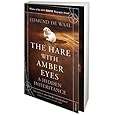
The Hare With Amber Eyes: A Hidden Inheritance (Edmund de Waal)

--The blurb--
"264 wood and ivory carvings, none of them larger than a matchbox: potter Edmund de Waal was entranced when he first encountered the collection in the Tokyo apartment of his great uncle Iggie. Later, when Edmund inherited the ‘netsuke’, they unlocked a story far larger than he could ever have imagined…"

--The review--
Moved to read this tome for its mentions of Proust (due to working through the big guy's opus as we speak - last volume now!), I was left upon finishing with a sense and knowledge of so much more. Edmund de Waal's work received an award for biography, but it is not quite a memoir - it is more than this. Having received recommendations of the book from my mother and sister, and gone on to enjoy it myself, proves via our different spectra of abilities and interests that it is readable, accessible, and interesting to very many. The author therefore does what many in the past have failed to do by bringing history and art history to the masses, binding these interests together perfectly with political and personal histories.

Skilled and sensitive, The Hare With Amber Eyes is driven by the sheer dedication of its author, and the depth of research that has gone into it is of clearly phenomenal levels. Images are used carefully to gently enhance enjoyment, rather than bombarding the reader, and the concision of the prose is equally commendable. The choice of the hare in the title is perhaps not necessarily apparent (after all, there are 264 netsuke to choose from, so why pick that one?), but this does not seem to matter. The book is also a travel book, in that it compels you to want to visit the places described - Odessa, Paris, Vienna and other locations are brought to life with vivacity and tenacity.

That the main themes in the book should be the nature of memory, storytelling and oral tradition (not AURAL, I'm afraid, Edmund), art, the making of things, and passing things down make it no surprise that the story's principal message should be that it's how you tell the story that matters - it's no good simply having these objects without knowing where they have come from, and certainly in the hands of a lesser author the story itself may have become devalued by being passed down to us as a readers in an inferior manner. It is perhaps here that the choice of a hare with amber eyes comes into significance - the use of amber as a way to preserve something old within something new exemplifies the purpose of the writer's story, which he states is to encase the story in something new for his children.

The inheritance referred to on the cover of the book is naturally not only the physical inheritance of the netsuke but the legacy of the family history, and it is told in such a way as to be pleasantly cyclical. Further strengths include the honesty, detail and humour with which family members are portrayed, and the accessibility with which various complex issues are approached. Familiarities such as Impressionism and Nazi Europe are made new for us, and de Waal's arguably overambitious scope is approached and fulfilled with deftness and modesty. 

De Waal's mastery of all aspects of storytelling is what makes this true tale what it is; a rich fiction, but in the most positive possible way. Determined and moving without being slushy, it is practically perfect in every way - absorbing, intellectual, down-to-earth, humorous, and written with real feeling.

Friday, 20 May 2011

Our Street: East End Life In The Second World War (Gilda O'Neill)

--The blurb--
"Our Street is the perfect companion to Gilda O'Neill's bestselling My East End. This book focuses on the lives of Londoners in the East End during the Second World War. Showing the concerns, hopes and fears of these so-called 'ordinary people' Our Street illustrates these times by looking at the every day rituals which marked the patterns of daily life during WWII. It is an important book and also an affectionate record of an often fondly remembered, more communal, way of life that has all but disappeared."

--The review--
As a 1990s kid, it's understandable that I and some of my academic interests should be a product of the restrictions of the UK education system at this time. One of these interests stems from my study of history; in spite of many years of study, the Second World War is one of only a few periods that I know much about and which continues to hold my interest, as well as that of a significant proportion of the British public. Thanks to the ageing combattant and non-combattant survivors of the war, and the younger generation who have had the war's history thrust upon them, WWII-related books and products continue to thrive in today's market.

The aforementioned survivors naturally want to tell the stories of their experiences, and Gilda O'Neill is one of these people, having inhabited the East End of London during the war period. However, Our Street tells relatively little about her own experiences, consisting of a patchwork of testimonials from others, which are of readable lengths and captivate the reader immediately with tidbits of tales which make our jaws drop due to the complete improbability of their occurrence today. This awareness of incidents that are totally outside our span of experience as younger readers also triggers the sobering thought of how different the world will be when we are of pensionable age to the 1990s world we inhabited as children.

For the older generation, in spite of the horrifying experiences that some of the interviewees have gone through, a sense of nostalgia and feeling of the 'Dunkirk spirit' is reawakened, and this aspect of community and strength and familial ties is equally palpable to younger readers. O'Neill ties together the testimonies reasonably successfully, although at times it feels a little forced. The flavour of the East End is equally alive, distributed with vigour through the use of dialect and descriptions of the cityscape and housing estates, and readability is enhanced by the splitting of the book into themed chapters such as evacuation and food. This also enables a 'pick and mix' approach, as it is therefore unnecessary to read the book in chronological order.

To assume the dual role of author and editor, as Gilda O'Neill has done in this book, is surely no easy task, and while she arguably does not completely succeed, the result is still an accessible tome that appeals to those that were there just as much as to those who were not. Her passion for her own personal past and for the history of her past in general is clear, and incites the reader to seek out more of her books - fictional as well as non-fictional.

Other works by Gilda O'Neill
The Cockney Girl (1993)
Whitechapel Girl (1994)
Dream On (1998)
The Lights of London (1999)
The Bells of Bow (1999)
My East End: Memories of Life in Cockney London (2000)
Playing Around (2000)
Just Around The Corner (2001)
Getting There (2002)
The Sins of their Fathers (2003)
Make Us Traitors (2004)
Of Woman Born (2005)
Lost Voices: Memories of a Vanished Way of Life (2006)
The Good Old Days: Crime, Murder and Mayhem in Victorian London (2006)
East End Tales (2008)
Rough Justice (2008)
Secrets of the Heart (2008)

Monday, 1 March 2010

La Chine Classique (Ivan P Kamenarovic)

--The blurb--
"China is coming to us: prestigious texts are now available in translation, plays introduce us to Chinese legend and history, and feng shui has arrived in Europe. But what do we know about the civilisation which has created these? Classical China comes to life through even the culture's most modern rituals. To know it badly would be to travel blindly where there is so much to see."

--The review--
Part of the "Guides to Civilisations" series, this examination of ancient China (extending from the Han dynasty - 200 BCE - to the Tang dynasty - 907 CE) joins a host of equally attractive works on places and peoples as diverse as the Siamese, the Venetians and the Khmers, to the Quebecois, Etruscans and Nabateans. However, China stands out from this collection as being a country with an especially fraught history, which remains still comparatively traumatic even in modern times. In helping readers to understand how China's ancient roots affect the country today, then, one could argue that Kamenarovic's work is characterised by trepidation and challenge.

He has, though, faced the challenge head on, making it his speciality, both in terms of his work as a researcher at the Sorbonne and in terms of also marketing this work to interested members of the public. In his mission, several different cultures collide bizarrely, and this is perhaps part of the appeal of this academic's work, with a man of Russian heritage partly seeking to unite the world by writing in French about China (even though the world's scholars cannot be united by his oeuvre, since his works are unavailable in English). The author says that the approach China's awesome history and mentality, great humility is required, and this is something that is well-reflected in this respectful and considered history book.

The work is comprehensive in its scope, covering the Chinese world and the Chinese being in several clearly divided chapters, and approaching all aspects of Chinese life, from ancient Chinese economics and politics, to Chinese arts and feng shui. This sheer range of topics may make the extended essay seem daunting, but it is easy enough to select the chapters that are of most interest. Equally, while Kamenarovic can offer insights into a typically Chinese outlook on life, and how this thread extends from ancient life to where we are today, these links are not always explicitly made, and it is admittedly better when he does, especially for those who are new to Chinese culture and history. Those looking for more direct insights into today's China may in some ways be better off looking elsewhere.

Nevertheless, the work is helpfully formatted, is not over-long, and carries plenty in the way of helpful illustrations and charts - and all without being patronising. The flip side of this, however, is that readers are sometimes assumed to be more knowledgeable than they actually are - so while this book may prove a helpful reference volume, one may perhaps profit from its knowledge best when it is accompanied by other books, too, from a range of authors covering even more aspects of China's lineage.

Other works by Ivan P Kamenarovic
Arts and letters in Chinese history (1999)
Conflict: Chinese and Western perceptions (2001)
To act and be passive in China and the West: the inactive sage and the man of action (2005)
Journey of a Chinese man of letters (2008)

Wednesday, 10 February 2010

The Story of God (Robert Winston)

--The blurb--
"From a leading voice in the debate on genetic engineering comes a look at the contemporary relationship of science and religion. It begins with the primitive worship of our early ancestors, and concludes with a vivid portrait of faith in the modern world."

--The review--
Sir Robert Winston is, one could say, the biggest scientific household name in Britain today, alongside his potential arch nemesis, Richard Dawkins. This existing status of popularity should have made it easy to reach out to the people of Britain via mainstream writing, and to a degree, this ambitious interdisciplinary project is a successful one, binding together sociology, history, religion, science and psychology in one concise volume. Winston also does not set out to deliberately rebuff his famous colleague's ideas on religion, although he does address these once, and in a respectful manner.

The chapters are set out in roughly chronological order (though Lord Winston does jump around a bit in places where it's appropriate) and are further broken down into readably-sized chunks, with subtitles to further focus ideas. This is good in itself, but its effectiveness is lamentably reduced by a simple issue of formatting: by not including the chapter names and the name of the individual section that you're reading at the time at the top of each page, it can be all too easy to lose the thread of thought. This is a shame given how easily fixable it is.

The scope of The Story of God is of epic proportions and the amount of research and thought that has clearly gone into it should not be underestimated. However, there are a few weaknesses, mostly relating to various nuances of Christianity, though whether this springs from Winston's own Jewish faith, or from gaps in his research, or from missing leaps of logic, or something else, is unclear. Firstly, at some stage Winston describes Christianity as a religion where personal goodness is key. While this is correct to an extent, it is not a wholly appropriate moniker for a belief system where faith rather than works is touted as the entry card into Paradise (i.e. that it doesn't matter how good you are; only belief that Jesus is Lord etc will get you in! see Ephesians 2:8,9). However, this is a complex issue, and Winston perhaps could have explored the nuances of this further, by referring to the Bible passages that are often used in this debate (Romans 3:28, 5:1, Galatians 3:24, James 2:24, as well as the Ephesians passage mentioned before).

The second issue regarding Christianity as pointed out by Lord Winston is equally complex. He refers to the church and the state being separate when talking of the United States, when this is clearly untrue. While the author does briefly address the fact of the Pledge of Allegiance being recited in American schools, the point is missed on two levels: one is that the Pledge does mention God, which would not be permitted in a truly secular schooling system, and the other is that Lord Winston compares this to the recitation of the Lord's prayer in Christian schools in the UK, which I'm not even sure to be the case any longer. In any case, even if in British Christian schools the Lord's prayer is still recited, this certainly does not apply in all British state schools, as it does for the Pledge of Allegiance, which is recited mandatorially in all American public schools. The US is certainly far from being secular and is arguably a religious state in all but name (what are the odds of a citizen subscribing to any other faith apart from Christianity, or a citizen proclaiming themselves to be atheist, ascending to the American presidency?).*

However, to be fair to Lord Winston, these are fairly detailed and complex Christian battlegrounds and are perhaps more suited to another book, especially given that The Story of God is already fairly Judeo-Christian centric, dealing mainly with Islam, Christianity and Judaism. Other religions are mentioned (from the Aztecs and Ancient Greeks, to Hinduism, Buddhism and Sikhism, through to cults and splinter religions such as Wicca and Reverend Moon's Unification Church), but only on a cursory level. While initially this seems unjust, it is in fact a relevant proportion given the relative numbers of people devoted to the vast number of religious beliefs existing in today's world. Terrorism is also dealt with maturely and commonly held misconceptions are settled.

Other issues that are not addressed are interpretation, story vs truth (at times Winston does not back up some of what the Bible talks about with any historicity), and the power of rhetoric (which at times is surely crucial to a religion's momentum and success). Nevertheless, despite these possible shortcomings, what is produced is impressive in its scope, with Winston remaining intelligent and accessible in his writing without being patronising. Anyone who has only ever seen this famous polymath express his ideas on television should be urged towards his books; if they are all like this one, they are rewarding and educational reads that leave readers wanting to know even more.

(*This document is a fairly interesting one for those wanting to know more about religion in American public schools.)

Other works by Robert Winston
Human Instinct (2003)
The Human Mind (2004)
What Makes Me Me (2005)^
Human (2005)^
Body (2005)^
A Child Against All Odds (2006)
It's Elementary (2007)^
Evolution Revolution (2009)^
Bad Ideas: A History of Our Inventions (2010)

^for children

Monday, 20 July 2009

Tears of Darkness: The Story of the Bataan Death March and Its Aftermath (Michael & Elizabeth Norman)

--The blurb--
"For the first four months of 1942, U.S., Filipino, and Japanese soldiers fought what was America’s first major land battle of World War II, the battle for the tiny Philippine peninsula of Bataan. It ended with the surrender of 76,000 Filipinos and Americans, the single largest defeat in American military history. The defeat, though, was only the beginning, as Michael and Elizabeth M. Norman make dramatically clear in this powerfully original book. From then until the Japanese surrendered in August 1945, the prisoners of war suffered an ordeal of unparalleled cruelty and savagery: forty-one months of captivity, starvation rations, dehydration, hard labor, deadly disease, and torture—far from the machinations of General Douglas MacArthur. The Normans bring to the story remarkable feats of reportage and literary empathy. Their protagonist, Ben Steele, is a figure out of Hemingway: a young cowboy turned sketch artist from Montana who joined the army to see the world. Juxtaposed against Steele’s story and the sobering tale of the Death March and its aftermath is the story of a number of Japanese soldiers. The result is an altogether new and original World War II book: it exposes the myths of military heroism as shallow and inadequate; it makes clear, with great literary and human power, that war causes suffering for people on all sides."

--The review--
As time, resources, diversions and worries seem to hurtle at lightning speed towards an ever-changing future, it is perhaps evident that in the kerfuffle to keep up with what's new, some old memories may be forgotten. Thanks to this book, however, the Bataan Death March is one of those events that now won't be. Michael and Elizabeth Norman weave reportage and history with extraordinary skill, and their interest in and passion for their subject constantly shines through. It is grotesque in its description of the soldiers' treatment, injuries and disease, but this is utterly necessary to convey the full horror of the experience, and it goes a long way to making the reader genuinely care for the fates of the servicemen.

However, the focus is not, as one might expect, on making the Americans look like heroes against the demon Japanese. The Japanese are equally well-represented as genuine human beings and the chronicling of these events makes it clear that this is a world suffering, an indiscriminate suffering, borne equally by Filipinos and British as much as by Americans and Japanese. Woven with this is the more detailed story of Ben Steele, a survivor (albeit just barely) of the death march who is still alive today. This is an eventually successful strategy, though it takes some time to pick up speed; interestingly, you only feel to begin that he is the main character when flashbacks to his pre-war life on the Montana prairie start to decrease. This can perhaps be attributed to the novel's occasionally 'piecemeal' feeling, whereby the listing of events with little detail (especially in the runup to the Bataan surrender) can start to make your eyes go a little fuzzy and can make your mind start to wander. The jumping between characters also takes time to get used to, but ultimately enhances the book.

Beyond this, there were just two other areas that struck me as requiring improvement. One was the authors' apparent inability to use prepositions such as 'with' and 'that'; inclusion of these particles would have clarified many of their sentences, making them more fluid. This is also applicable to the couple's use of colons and semi-colons (or, rather, the lack of them). As a Brit, I also took issue with the rather American and sloppy title, "Tears of Darkness". It is explained very clearly at the start of the book that this is a translation of the Japanese word 'anrui', which means exactly this, but surely it would have been more original, and indeed more appropriate, to give the book's title as "Anrui", rather than the more generic one that was eventually chosen? Nevertheless, these are superficial concerns that did not stop me from being moved by the book and finding it a significant read. It shamed me that despite my lengthy studies of World War Two between the ages of 14 and 18, I had not come across these events before. Michael and Elizabeth Norman successfully illuminate and humanise a hidden area of history, and bring to light the many forgotten soldiers who lost their lives in the struggle. We should remember them.

Other works by Elizabeth M Norman
Women at War: The Story of Fifty Military Nurses Who Served in Vietnam (1990)
We Band of Angels: The Untold Story of American Nurses Trapped on Bataan by the Japanese (2000)