Showing posts with label france. Show all posts

Sunday, 14 July 2013

Bookish Bits and Bobs: Vive les livres

It's recently been reported that the French consumption of ebooks has gone up by 2% between 2011 and 2013...making a total of a mere 3% of book sales. This compares to around 22% consumption in the US and around 10% consumption in the UK. So why are French readers not interested?

Trying to get a connection? Good luck with that
One theory that has been posited is that the French are less enthusiastic about gadgetry in general, meaning that ebook uptake was always bound to be slow. Only about 1% of the adult population of France is said to own an ereader, while this figure is more like 26% in the US. This of course doesn't account for tablet ownership, but even if we look at this, it too is lower (10% of the French adult population owns one, compared to 34% in the US). These statistics are perhaps surprising to those who spend most of their time around Paris, where ebook readers, tablets and smartphones abound. However, travel just a couple of hours south and it's clear that such gadgetry is a novelty, with ereader users getting strange looks in public as they are such a rare sight. In some very rural areas, connectivity is also still limited to non-existent, which will limit uptake.

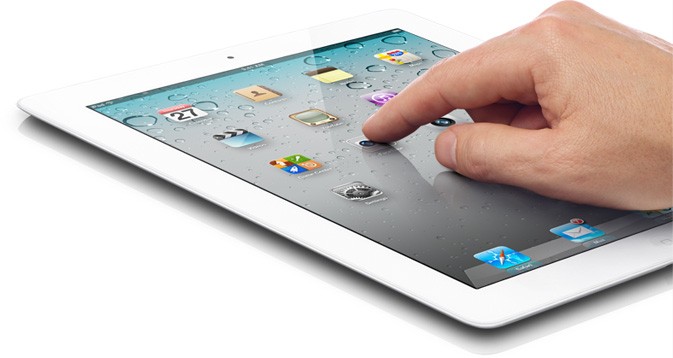
It's also worth bearing in mind that salaries in the US are higher than in France. According to the BBC, the average American works for $3,263 a month, while the average French person earns $2,886 - and while differences in the cost of living can partly justify this gap in salary, it would not be true to say that everyday living costs are always lower in France. (Long-distance train travel and food are just two of the things that spring to mind as being cheaper in the US.) Prices of these gadgets are also comparatively lower. Not many people in France (outside the capital, of course) have the spare €400 required for the 16GB iPad 2 - whereas people in the US, with higher average salaries, are able to snag one for $400 (about €300 at today's exchange rate). But this can't be all there is to it. Why aren't the French interested in this technology, or in reading ebooks in general?

The French version of Big Brother
At the risk of sounding deliberately polemic, it could be observed that the French are just slow on the uptake in general when it comes to new trends, and that they also just have different tastes (and that this is, indeed, part of the country's charm). For instance, celebrity gossip and reality TV does exist in France, but to nowhere near the same degree of popularity as in the US or UK. They are also more parochial in their food tastes, preferring to continue exploring the cuisine of their own country (or even just region) rather than branching out and cooking dishes from many different countries. This naturally stretches into technology and more specifically into education and technology. Smartboards in French state schools? You have to be joking.

The front-facing, chalk-and-talk French system
Why is education important in this debate? It's not that all schools in the UK and US are now teaching exclusively from e-textbooks and dancing around bonfires of their old paper copies (although there are of course reasons why this wouldn't be such a terrible thing), as compared to France, where students are still made to copy out chalked notes from the blackboard (erm, in some places...see right!). While a lack of technology in French schools is partly linked to the country's slow uptake of e-readers and so on (given that children and adults arguably haven't been shown the benefits to any advanced degree), it also links back to the fact that French education is still very traditional indeed. It's probably roughly where Britain was back in the eighties or maybe even the seventies. "Special needs" go largely unaddressed; little account is taken of students' differing learning styles (kinetic, aesthetic and so on); rote learning is highly prized; arts, sports and even sciences take a back seat in primary schools, while most of the learning time is spent on literacy and numeracy; and learning is overall very book-based, with focus on individual rather than group learning. 

Perhaps this sounds harsh and a French student who's left the system recently (or is still in it) will soon come along to debunk this. But it seems doubtful. One of the strengths (and weaknesses) of the French education system is its lack of overall change across the years, and this would explain the lack of technological assimilation in French schools. The "if it ain't broke, don't fix it" philosophy prevails. Why would students need ebook readers or smartboards? Textbooks and blackboards work just as well. In 2010, only 66% of French teachers claimed to have used technology in their classroom in the last 12 months, compared to 96% of UK teachers. The teachers in France cited reasons for this which included potential disruption to the class, difficulties in installing the technology, and doubting the technology's pedagogical efficacy. All of this amounts to an attitude and ethos whereby physical books are highly prized by French children and adults. Combined with the income levels and gadget prices mentioned above, this makes them more likely to use paper books than electronic ones.

Bookshop, rue de la Convention, Paris
The same pattern pervades the French book market. Having spent their education with the value of physical books being reinforced, the French are keen to continue prizing this, with the prices of paper books being highly protected so that authors are paid properly. High book prices have driven consumers in other countries to flock to online sellers, but as well as cherishing paper books and the academic institution of the country's authors, the French also like to uphold the livelihood of independent booksellers, which is partly driven by anti-capitalist sentiments as well as a sense of intellectual honour. This all means that in France, large online companies (and suppliers of ebooks) cannot win over independent (or at least physical) retailers - at least for now. 

A smartboard being used in a French state school
One can therefore conclude that far too many factors are still too strongly at play in favour of paper books for the French to even consider converting seriously to ebooks. So could this ever change? The French have already started stealing Britain's TV shows (creating their own versions of Money Drop and Come Dine With Me, to name but a few), even if some of these were programmes that Britain decided it didn't want anymore way back in the eighties (such as Family Fortunes); will they therefore be following the UK and US suit in the near future? Back in 2010, when the above data was initially released, then-education minister Luc Chatel announced a €60m investment in school technology, and in October 2011, telecoms company Orange worked with the French government to establish a promising pilot scheme in schools. Called the Tablette Elève Nomade project, 300 Samsung Android tablets were provided to six schools across three French districts, and it went so well that the initial one-year trial was extended to last a further year. Teachers noted several positive changes, including easier motivation of disaffected learners, easier differentiation, increased team work and bonding among students, and increased parental involvement. 

Maccy D's, French-style...a sign of progress?
All of this indicates that in the right environment and with appropriate support, parents, students and teachers are all receptive to the use of new technology. As children who were born into a world where smartphones and at-home web access are normal begin to grow up, it's possible that the new young population (who, if current trends continue, are more likely to live in a shoebox of a studio flat than a roomy detached house) will be keener to read digitally (even if only to save space). Perhaps only then will ebook sales increase. France is slower to pick up on trends - but it often gets there eventually. For better or for worse, celebrity magazines such as Voici! are gaining in popularity in France, Amazon is well-used (even though discounts are nowhere near as large thanks to laws protecting authors), and even McDonalds (you'd think the arch enemy of the French) does well throughout the country. Ebook sales are likely to do this too in the end, with likelihood perhaps being increased with the decline of traditional physical bookstores such as the Fnac. However, somehow it seems less probable that France will ever stop loving books in general. Vive les livres indeed.

Sunday, 9 September 2012

The Way of the Tumbrils (John Elliot)

--The blurb--
"In The Way of the Tumbrils, a dozen of the most turbulent and tragic episodes of the French revolution are recounted. Part history, part guide book, The Way of the Tumbrils is a story of men and women fighting desperately to avoid the scaffold."

--The review--
When today's tourists see the darker side of Paris, including iPhone theft, a permanent trail of dog faeces, and the constant whiff in the air of surliness and cigarette smoke, it can be easy to forget the city's rich history and cast of memorable characters. Thankfully, John Elliot, in what is sadly his only book, is able to bring the whole fabulous story back to life in The Way of the Tumbrils. The writer is, by his own description, not really a writer at all, but just an ex-railwayman with an interest in his subject. However, these humble origins have begotten a text of greatness, which would make a superb gift for all history buffs and Paris fans.

The tumbril, or tumbrel, was a two-wheeled cart often used at the time of the Revolution to transport goods and people. The reason for the tumbrils in Elliot's story, and indeed in its title, is predictably sinister and completely appropriate to the author's highly visual and sensory retelling of this time in history.

Accessible and well-written, The Way of the Tumbrils mixes first-, second- and third-person, which contradicts all the stylists and goes against all the rules, and yet somehow works. Humorous stories arise from Elliot's lack of grasp of French, which seems even funnier given his level of interest in the country's history. However, other scenes indicate that the writer has a higher command of the language than he gives himself credit for. The overall result is a lively account of the bravery and treachery that pervades French history, and the fact that The Way of the Tumbrils only covers the Revolution is almost painful - Elliot is so engaging that a complete history of France would have been extremely desirable.

In spite of the book being published in 1958, the routes set out by Elliot are still easily navigable today - although the inclusion of maps, at least in the e-book edition (the print editions perhaps have them) would have been even more helpful in this regard. There are also other formatting problems with the digital version: some accents and letters are missing or erroneous, and some images and captions are split across several pages. For this reason, the print version is recommended. The accompanying pictures, though, generally are reproduced beautifully.

While the Bastille chapter lacks the same pace and humour as the rest of the book, the writer manages to keep the reader's attention throughout. Although a certain amount of knowledge is presupposed, this does not preclude understanding and may prompt the reader to find out more. Combining history, geography and tourism, The Way of the Tumbrils also considers questions of ethics: its at times emotive and highly descriptive nature may even go as far as to cause some readers to reconsider their views of the death penalty.

If the object of history books is to enable the reader to imagine what it was like to be present at significant times in the past, Elliot certainly achieves this with The Way of the Tumbrils - and remarkably so considering his lack of status as a professional historian. Thanks to his work, many could even be ready to forgive Paris its mounds of mégots, and tour the place of the past today.

Sunday, 13 May 2012

Bookish Bits and Bobs: Writing Your Life

I have always been a fan of autobiography as a genre, and luckily so is my husband. As a young teen I would read autobiographies of my favourite pop stars, while today I am more likely to read autobiographies of my favourite writers and broadcasters. These sit on the bookshelf alongside Jean-Marc's choices (often autobiographies written by political figures like Charles de Gaulle). 

So with this being a source of entertainment consistently from teenagedom to adulthood, it hardly seems surprising that I was immediately drawn to the exhibition on autobiography being held at the Louis Vuitton Espace Culturel in Paris' 16th arrondissement. It's just lamentable that I only heard of it a week before it was due to close, meaning repeat visits are unlikely to be possible.

It seems bizarre that while the Louis Vuitton shop on the Champs Elysées teems with Chinese and Japanese visitors, who queue in droves outside the door of the flagship store, the Espace Culturel, which is immediately adjacent to it on the Rue de Bassano, is practically deserted. There are some visitors, but still plenty of space and quiet for you to explore the exhibits, which prove to be an entirely positive and fruitful experience.

The venue itself is spacious and clean-looking, with its white walls and surfaces allowing exhibits to just pop out at you. This is complemented by the panoramic view of Paris to be gained from its tall windows (seriously, don't ever pay to go up the Eiffel Tower when you can get views like this for free) and contrasted by the lift ride up to the exhibit space, which is an exhibit in itself - with your ride taking place in total darkness, the artist behind the exhibit wants to encourage riders to explore their senses differently.

As well as it being free to enter the Espace Culturel, another perk of this exhibition was the sumptuously-illustrated and bound catalogue, also free, which gave details of the artists and their work as you went round, and doubled as a satisfying souvenir. But the whole thing is more than worth paying for, with high quality artworks in a variety of different media providing something for everyone. The number of ways in which the artists have chosen to "write their lives" is incredibly far-reaching: aspects of life and experience are captured through wood sculpture, books, film, photography, watercolour, comic books, and more. 

But perhaps more to the point, the reasons why they have chosen to do this do a lot to make visitors think about what it truly means to be 'us', and what we gain - or do not gain - from exploring our lives' twists and turns. For some artists, such as David B, the aim is clearly catharsis, helping them to work through life events such as the illness of a relative. For others, such as Fiona Tan, the autobiography (an hour-long film entitled May You Live In Interesting Times) is a cruise through their family, lives, and history, in an attempt to find out who she really is (which, you understand, can be difficult when you're half Chinese, half Australian, have lived in Indonesia, and now live and work primarily in the Netherlands). This also raised important questions of identity for us: we are a bi-cultural couple (I am English, he is French) who have both lived in each other's countries and plan on possibly going to live in a third one in a few years' time (Belgium). As a teacher in an international school, I also frequently come across what are known in the industry as "third culture kids": children and young people who are caught between the culture of their parents, the culture of the place in which they live (at that particular moment: some stay for less than a year before moving on) and the culture of the expatriate and international school lifestyle. Now that's some autobiography.

Lucy Wadham is someone else who, although she hasn't written an autobiography, has explored this conundrum through the sociological (and, OK, semi-autobiographical) tome The Secret Life Of France, where she discusses not only her own difficult adaptation to French culture and how this has affected her life but also the voyage of discovery travelled by her children in getting to grips with their Britishness (being raised in France, even by an English mother, has understandably made them very French). 

This is less addressed in the Autobiographies exhibition, though, than pivotal moments that the featured artists feel have shaped their lives: Ernesto Sartori, for instance, illustrates a supernatural experience that he had while still a child through the medium of sculpture, and Frédéric Pajak focuses on a gift of a Tintin album and how this helped him to deal with the death of his father. Others are more gradual (as the reading room of autobiographies in the exhibition space also attests), systematic and analytical in their approach, such as On Kawara, who marks each day of his life so far with a dot on a calendar that has a tiny square for every single day for 100 years. This is colour-coded too, with a yellow dot representing an ordinary day, a blue dot showing a day where he produced one work of art, and a red dot indicating a day where he produced more than one.

The forms of autobiography, then, are clearly as varied in their form and purpose as the spectrum of human life and experience itself. But don't take my word for it: if you're passing through the French capital this week, don't hesitate to go and visit the Espace Culturel. Or, at the very least, view the video trailer of the expo here. And when you've done that, you'll find me watching the story of Roald Dahl's life and work that's still available on ITV Player.

The Autobiographies exhibition at the Espace Culturel (60 rue de Bassano, Paris) runs until May 20th.

Monday, 21 March 2011

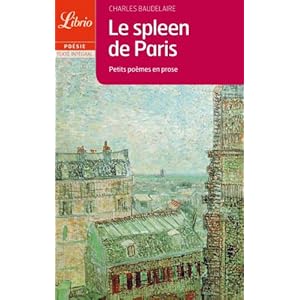
Le Spleen de Paris (Charles Baudelaire)

--The blurb--
"Set in a modern, urban Paris, the prose pieces in Paris Spleen constitute a further exploration of the terrain Baudelaire had covered in his verse masterpiece, "The Flowers of Evil": the city and its squalor and inequalities, the pressures of time and mortality, and the liberation provided by the sensual delights of intoxication, art and women."

--The review--
Marketed as a series of prose poems - a format which I ordinarily adore - I was looking forward to my first taste of one of France's most famous authors. Split into several relatively short sections, it has readability on its side not only in these terms but also in terms of the fact that funnily enough these "prose poems" did not seem to be especially poetic by the standards of modern day prose poems; to me they just seemed like pieces of very good yet accessible descriptive writing, which in itself was not unenjoyable.

Reading this in the original was a difficult experience due to the at times strange sentence constructions that pervaded it; however, in translations this may have been eradicated. This was exacerbated by the fact that several of the prose poems just weren't that memorable, seeming to repeat the same themes over and over again, particularly stating the theme - still common in France today - that the French, even the upper class ones with the greatest security of money and home, feel duty bound to sympathise with the poor for fear that they could too end up in their position (even when this is not in the least bit likely). 

The two segments worth reading, however, are the haunting "The Eyes of the Poor", which most effectively describes the plight of the impoverished, and "The Rope", which is a frankly terrifying tale which has a hint of the Henry James about it. These perhaps most fully exemplify the literary meaning of 'spleen' as used in this collection's title, meaning 'an unexplained melancholy or disgust'. Learning that Edgar Allan Poe was one of Baudelaire's influences comes as no surprise, particularly after reading "The Rope", and it perhaps also fulfils the criterion of there being something for everyone contained within Paris Spleen, as the work spans horror-type stories and morality tales as well as debauchery and beautiful descriptions; in this respect it is not dissimilar to Boccaccio's Decameron - although, of course, in a much shorter and more distilled form.

While the different segments do at times seem to merge together, this work is certainly not without its richness and merit, even though it seems to be much maligned by UK readers (with only one review of the book existing on Amazon UK). However, I certainly found it for the most part to be a more analytical experience, rather than the continuous rushes and gushes of emotion described by American reviewers online. Nevertheless, I would not abandon hope in the works of Baudelaire, and I look forward to investigating even more of them.

 Other works by Charles Baudelaire (selected)
The Flowers of Evil (1857)
Artificial Paradises (1860)

Saturday, 26 February 2011

Puligny-Montrachet: Journal of a Village in Burgundy (Simon Loftus)


--The blurb--
"The 1992 Wine Merchant of the Year describes one year in the life of a small wine-making village in Burgundy, discussing its ancient rivalries and political intrigues, its residents, and the rhythms of the agricultural year."

--The review--
There are plenty of expatriate enthusiasts sending missives from France who are more than ready to line our bookshelves and convince us that by the time we have got to the last page, we will be wine connoisseurs of the first order or ready to do up a derelict château in the middle of nowhere. Simon Loftus, however, is not one of these illusionists, presenting us with a down-to-earth and illusion-free account which is somehow still enchanting. This is even in spite of the fact that in the thirty or so years that have elapsed since the book's publication, some elements of the village life he describes may have changed a little.

Packed full of fascinating facts (including that Puligny-Montrachet has no underground cellars due to the water table causing them to flood should they be dug below ground), Loftus manages to engage his audience without patronising us by flying too low or losing us in technical jargon by flying too high. The production of the wine is fabulously intertwined with tales of the villages' inhabitants, which are enhanced even further by individual interview snippets conducted by Loftus. As if this were not enough, we are also treated visually with photographs, although in a more modern (perhaps hardback) edition there may be even more of a wow-factor with colour photographs (those in the paperback edition are black and white, although this also adds to the journal's more rustic feel).

The journal format also allows the story of the year's wine season to flow, building atmosphere and intimacy with success. It has been said that Loftus' book is not only the best story of French wine-making but also the best story of France in general, and this is certainly a convincing assessment - Loftus takes us all by the hand and leads us to meet the people, the village, the businesses, the landscapes, the produce, the language and the atmosphere with authenticity and vigour. Rich in detail, it also calls us back to reread the account again and again. While it may not convince readers that spending a summer of back-breaking physical labour in the form of harvesting grapes is the best idea, the journal is not here to sell us an untainted dream; Loftus leaves us with no false impressions of how difficult this work and this life can be. We are tourists, but of the best kind, as we are guided by perhaps one of the most honest accounts that there is, by a wine expert who also seems to be very much one of us.

Other works by Simon Loftus
A Pike In The Basement: Tales of a Hungry Traveller (2004)
Red Wines of Bordeaux (1988)
White Wines of Burgundy (with Jasper Morris; 1988)
Anatomy of the Wine Trade: Ade's Sardines and Other Stories (1987)

Sunday, 5 December 2010

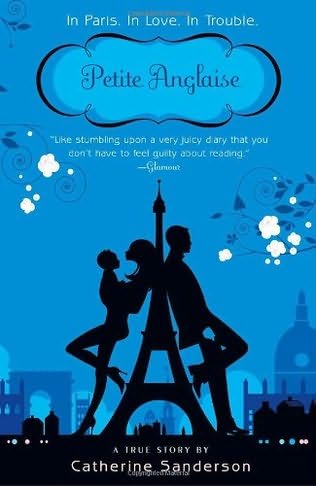
Petite Anglaise (Catherine Sanderson)


--The blurb--
"Living in Paris with her partner, the workaholic Mr Frog, and their adorable toddler, Tadpole, Catherine decides to alleviate the boredom of her metro-boulot-dodo routine by starting a blog under the name of Petite Anglaise. Writing with disarming honesty about Paris life, about the confines of her hollow relationship with Mr Frog and about the wonder and pain that comes with being a mother, she finds a new purpose to her day. As Petite Anglaise, Catherine regains her confidence and makes virtual friends, including one charismatic and single Englishman who lives in Brittany, James. And after meeting James one evening in a bar, Catherine feels she has regained her ability to fall in love, too."

--The review--
As with Catherine Sanderson's fictionalised effort, French Kissing, I was expecting feelings of satisfaction and derision in equal measure following my reading of Petite Anglaise. Happily, this was more on the side of entertainment this time. Sanderson continues to demonstrate her canny ability to seize on tiny details that really do accurately portray daily Parisian life, and the way she writes veers between schmaltziness and sheer beauty in equal measure, making this a very comforting and accessible read.

There were plenty of ways in which I felt totally unable to empathise with Catherine. It certainly confirmed for me the feeling of absolute disgust which permeates me even contemplating the logistics and deceit of an affair, and from me the cherry tomato incident elicited no sympathy (just why would you even consider giving your child something which, when left completely whole, could so easily cause them to choke, and then be so surprised and annoyed when they throw them all up all over you?). However, there were many more ways in which I could empathise: she eloquently expresses the feeling of only living alongside French people, rather than living as part of them and being part of their landscape. Her writing reassured me that this can take many years to establish, and that not having a social life or (m)any friends at this stage of my life in France is not abnormal. Although I could not feel familiarity with her success as a blogger (given my quite frequent feeling when blogging that I am just shooting these words into a cyberspace equivalent of a black hole), I did not feel jealous either. Sanderson's familiar style invites you to take a seat beside her and enjoy the ride.
Consequently, Petite Anglaise proves a very quick read, which is never for a moment dull or sluggish: Sanderson keeps readers engaged and on their toes with ease. However, Petite Anglaise and French Kissing are both in a very similar vein in terms of their subject matter, and so while the advice to budding writers to write what they know is sound, I would issue a word of caution: Sanderson may wish to diversify her repertoire if she wishes to keep her readers on the hook. While the expat-lit market is popular, it is not insatiable.

Other works by Catherine Sanderson
French Kissing (2009)

Friday, 28 May 2010

French Kissing (Catherine Sanderson)

--The blurb--
"Name: Sally Marshall
Status: Single mother
Age: 32
Nationality: Ten years in France, yet still English through and through. I like: Living in Paris, playing with my daughter Lila (four-years-old), the company of good friends, the smell of baking bread . . .

So reads Sally's ad, posted on a French online dating site called Rendez-Vous. Sally left Nicolas, her French boyfriend of ten years and Lila's father, after she discovered that he was having an affair with his secretary. Six months have now passed, and although most of the time she feels like she's just dashing around like a headless chicken, she's beginning to bounce back. But making a new start is fraught with complications. As she meets freshly-single Frédéric for a drink, spends the night with charmer Manu and runs away from expat Marcus, she wonders: can she find a way to reconcile motherhood with single womanhood? To what extent can she keep Lila and her love life separate? And is she truly ready to turn her back on Nicolas?"

--The review--
The recent explosion of expatriate (and specifically French expatriate) literature has proved very popular with the British public and with expats themselves: authors such as Stephen Clarke can easily pack out book signings and sell millions just by breathing. Adding to this band of such writers is Catherine Sanderson, who made her name with the book Petite Anglaise. While it's easy to see how Brits with limited knowledge of France would lap this stuff up, how does it stand up with people who actually live here?

Without referring specifically to expatriate literature, it strikes me as being a little sad that so much chick-lit seems to involve empty-headed women being unable to keep a man and thus being perpetually in the middle of some sort of romantic crisis. While this irritation on my part could perhaps be put down to the fact that I've been lucky, it also smacks of a lack of creativity; Sanderson is no exception to this. I understand that conflict is often a crucial element in a story's momentum, but there must surely be other ways of achieving this effect in writing.

This is not to say that Sanderson is not successful elsewhere in her writing; French Kissing, despite the dodgy title, is entertaining, and the author uses detail cunningly in order to really provide an accurate picture of day-to-day life in France. In spite of the author/character's assertion of often being mistaken for a native speaker of French (I cannot emphasise enough how rare and therefore how lacking in credibility this is; people who get mistaken for native speakers don't get their grammatical genders confused, for one thing), French Kissing is undoubtedly a good easy read that also delivers the satisfaction of accurately portraying day-to-day life in this country.

However, for less artifice, better writing, more original stories and more believable characters, I'd recommend Tatiana de Rosnay (who, by the way, is actually French), even though chick lit and expatriate literature are quite clearly here to stay on British bookshelves.

Other works by Catherine Sanderson
Petite Anglaise (2008)