Showing posts with label race relations. Show all posts

Thursday, 23 August 2012

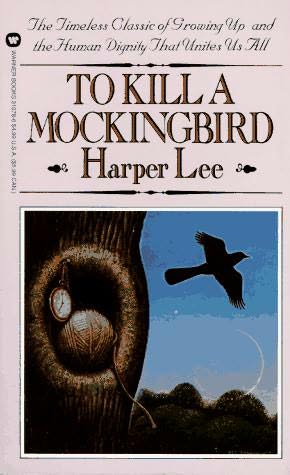
To Kill A Mockingbird (Harper Lee)

--The blurb--
""Shoot all the bluejays you want, if you can hit 'em, but remember it's a sin to kill a mockingbird". This is a lawyer's advice to his children as he defends the real mockingbird of this story - a black man charged with raping a white girl in the Deep South of the 1930s."

--The review--
Literature professors and other book lovers around the world, since time immemorial, have long argued about the purpose of literature. Is it to teach? To entertain? To transport, to allow for escapism? To reassure you that there's someone out there who has once felt as you now do? Or something else?

Harper Lee was working at a very sensitive time for America - and yet somehow, in the turbulence of the late 1950s and early 1960s, she managed to encapsulate all of these things in what is essentially her only work, To Kill A Mockingbird. It's certainly worth doing something only once if you do it right the first time, and this is proved by Lee's lingering legacy. Her only novel leaves an ongoing flavour in the mouth and mind as all five senses try to wrap themselves around the warmth of the Alabama summers, the noises of the courtroom, the taste of Coca-Cola out of a brown paper bag, the smell of Miss Maudie's beloved azaleas, and the unending motif of calm protagonist Atticus leaning over a book or newspaper. The author's powers of description and observation mean that the transportation of the reader is complete; it is this, combined with the compelling plot line, which make it difficult to extract oneself from what is being told.

Entertainment is not so prevalent in To Kill A Mockingbird in terms of laughs; Lee is, after all, dealing with a serious subject. The characters are strong, touching and eccentric in equal measure, and contrast each other enough to create real variety, while the plot is precise and carefully executed. Tension is built up successfully as Lee hangs onto control of the dénouement, throwing in a twist just as the reader believes that they know what will happen. This is not to say that the writer scores perfectly on all counts, however: at times the narration is too unrealistic to possibly come from the mouth of an eight-year-old, even a precocious one (a third-person omniscient narrator, or even the first-person voice of an older child, would have perhaps been better), and further expansion on the Boo Radley subplot would have added even further mystery. None of these flaws, though, prevent the reader from being riveted throughout.

At once the reader is somewhere else, and at the same time reminded of their life's own unfairnesses (even if only in the sense of how they diminish by comparison to the novel's main unfairness). But Lee does not encourage us to wallow - to the contrary, we are guided to take inspiration from the sage Atticus, who dispenses life advice throughout the novel at appropriate intervals, without seeming interfering. To Kill A Mockingbird perhaps contains life's most important lessons, but the reader does not feel patronised by this, as the author's points are well-made. 

It is therefore from the combination of all of the above "purposes of literature" that To Kill A Mockingbird has truly earned its place in the annals of literary acclaim. All should be urged to read it - and not only that, but to read it more than once.

Friday, 31 July 2009

The Nigger of the Narcissus (Joseph Conrad)

  --The blurb--
"The book draws on Conrad's own experience of twenty years as a master mariner; the Narcissus is sailing to London with two new hands, Wait and Donkin, and these two test the crew by Wait almost dying, and Donkin by attempting to raise the crew to mutiny. Regarded as Conrad's first masterpiece, the book is a disturbing and powerful portrait of the sea and sea-life."

--The review--
The censorship and alteration of already-published works is something that is rife in an increasingly politically correct world, with writers such as Enid Blyton and Hergé (author of the Tintin comics) being perhaps the most famously hit. It was therefore the apparent lack of censorship in the title of this work by Joseph Conrad that causes it to draw so much attention to itself on the shelf. Why is such a title allowed to slip through unscathed when many other less offensive texts are not? (Not that I'm pro-censorship, you understand.)

It is possible, of course, that the title's implicit racism was intended ironically by Conrad; however, given his track record (whereby he was accused of racism after the release of Heart of Darkness), it is equally possible that he was sincere. This is perhaps something that readers and critics will never be able to resolve, but it at least perhaps contributes to the generation of debate and to an increase in people picking up the novel when they may not have otherwise done. In any case, Conrad keeps the reader hanging for a while, not even mentioning the nigger in question until well after the first chapter has been and gone. Instead he chooses to concentrate on describing the ship, its travellers, and the beginning of its voyage. This can make for dense reading, particularly if one is not too interested in nautical history (it's rather comparable to trying to plough through Hemingway when one has no interest in jungle-based combat, and, again, seafaring).

However, while Conrad can be vague at times (it was difficult to really build up a picture of the other characters or form opinions of them), he builds up tension with smartness and subtlety, deliberately leaving readers in doubt as to what he really thinks. As with the works of Steinbeck, it is difficult to pronounce on who is intended as good and who is intended as evil, and what the story's underlying moral is (assuming that there is one). This sidestepping can leave the reader feeling a little flat at the end of the story: left with a Milligan-esque "I told you I was ill" kind of feeling, there is little else of substance with which to make any sort of judgement.

While Conrad does show some strong moments in his powers of description at times, on the whole the work did seem a little insipid, despite its occasional cleverness. It is perhaps more advisable, then, to kick off with some of Conrad's more established works, such as Heart of Darkness or Lord Jim, in order to make a better informed judgement on the author's alleged prowess.

Other works by Joseph Conrad
Almayer's Folly (1895)
An Outcast of the Islands (1896)
Heart of Darkness (1899)
Lord Jim (1900)
The Inheritors (1901; with Ford Maddox Ford)
Typhoon (1902)
Romance (1903; with Ford Maddox Ford)
Nostromo (1904)
The Secret Agent (1907)
Under Western Eyes (1911)
Chance (1913)
Victory (1915)
The Shadow of Line (1917)
The Arrow of Gold (1919)
The Rescue (1920)
The Nature of a Crime (1923; with Ford Maddox Ford)
The Rover (1923)
Suspense (1925)