Showing posts with label modern classics. Show all posts

Saturday, 9 August 2014

The Sorrow of War (Bao Ninh)

--The blurb--
"Kien's job is to search the Jungle of Screaming Souls for corpses. He knows the area well - this was where, in the dry season of 1969, his battalion was obliterated by American napalm and helicopter gunfire. Kien was one of only ten survivors. This book is his attempt to understand the eleven years of his life he gave to a senseless war."

--The review--
The world of modern fiction is already replete with classic war-based literature: Catch-22, All Quiet on the Western Front, Heart of Darkness, and Slaughterhouse-Five are just a few. One could argue that this leaves little to say; that the horrors of war have already been well-documented. However, a book that has been banned by the Communist Party, has won the Independent Foreign Fiction Prize, and which leaves its author reluctant to publish further works is always going to be a source of intrigue, and luckily Bao Ninh's The Sorrow of War does not just disappear behind this smokescreen of hyperbole, proving comparable in quality to the classics hitherto mentioned.

This high quality of work perhaps comes from the adage that it is best to write what you know; The Sorrow of War is based strongly on Ninh's own experiences in Vietnam, and thus the line between fiction and non-fiction begins to blur, with the novel raising compelling questions regarding dreams, hallucinations, and the imagined versus reality, as well as the reliability of protagonist Kien as narrator and the extent to which we can rely on our own memories. We also wonder, as readers, in what context Kien is retelling his story, and frequently question the chronology of the story itself, which doesn't make the plot unclear in any way, but rather opens the door to many future rereadings, so that readers can piece together the narrative in any number of new and different ways.

The piecemeal narrative is enhanced by the strength of the imagery and technique used by Ninh, which is elegant yet accessible throughout, while remaining simultaneously beautiful and ugly as he treats the sheer brutality of conflict with frankness and economy of style. In this way, he emphasises the worthlessness of human life, the ability of war to doom love, and the unforgiving aftermath of such bloodshed. The philosophical elements of this - such as whether ex-servicemen can ever be truly free post-war, and how far the characters in The Sorrow of War are acting according to their 'real' personalities - again make this work worth revisiting.

Even though the novel's title is so often reiterated throughout the novel as to seem contrived (Ninh has already shown us the sorrow of war; he does not need to tell us), the haunting themes, terrifying incidents, and compelling characters also contribute to this 1990 novel's status as a modern classic. Even the most briefly depicted personages are memorable for what the continued fighting has done to them, and the veiled references to the genre's forerunners (such as the emphasis on landscape, which is shared with Heart of Darkness) only emphasise The Sorrow of War's originality and flair, rather than detracting from it. It is therefore well deserving of its place in the literary canon, and one only hopes that Ninh will continue to publish what is surely a valuable extension of this highly significant Vietnamese view of one of the most tragic episodes in the country's history.  

Tuesday, 15 January 2013

The Help (Kathryn Stockett)

--The blurb--
"Amidst the turbulence of the Civil Rights movement, three Mississippi women quietly start their own revolution with a book, some toilets and a chocolate pie. Enter a vanished and unjust world: Jackson, Mississippi, 1962. Where black maids raise white children, but aren't trusted not to steal the silver...There's Aibileen, raising her seventeenth white child and nursing the hurt caused by her own son's tragic death; Minny, whose cooking is nearly as sassy as her tongue; and white Miss Skeeter, home from College, who wants to know why her beloved maid has disappeared. Skeeter, Aibileen and Minny. No one would believe they'd be friends; fewer still would tolerate it. But as each woman finds the courage to cross boundaries, they come to depend and rely upon one another. Each is in a search of a truth. And together they have an extraordinary story to tell..."

--The review--
Given that the highly successful The Help was published in 2009, it would appear that there are still some readers who are a little late to the party (including this writer). However, latecomers should not delay further - Kathryn Stockett's début novel deserves immediate attention. Even if you read nothing else in 2013, make this vibrant and moving opus a priority.

The novel's frequent changes in narrator could be confusing or frustrating, but instead serve to keep up the novel's pace and heighten tension in a positive way. Stockett's mastery of dialect, humour and malapropism is evident from the first pages, and this also keeps the reader hooked. It's perhaps inevitable that such dexterity is not consistently sustainable throughout the book: its weaknesses are that Mae Mobley sometimes speaks with far more perspicacity than is realistic for a three-year-old, that the friendship that purportedly existed between Hilly and Skeeter is insufficiently developed, and that the chapter on the Benefit is redundant (as its happenings could have been told just as easily in half the space through other characters' direct and overheard speech). However, this ultimately does not detract from enjoyment of The Help overall.

Stockett generally controls and develops the relationships in the novel effectively, reinforcing the bonds between Skeeter and Aibileen so that they go from strangers to friends in a realistic and heart-warming manner. As third protagonist Minny is drawn in, and their plans become even more intricate, the reader too becomes increasingly involved, making the unfolding of the trio's story addictive. All characters, without exception, are vivid and human, as well as taking on multiple dimensions so that no one group or person is clearly designated as hero or villain. 

Setting, lifestyle and history is also deeply ingrained in the story-telling, meaning that from Stuart's Confederate shrine of a home to the iced tea and grits prepared lovingly by Aibileen, the reader is left with a more developed understanding of the culture and circumstances in which the plot of The Help is enshrined. It's possible that the ending is a little rushed; however, by this stage readers feel so engaged in the characters' cause that the denouement is simply able to wash over them. The endings to each character's tale provoke mixed emotions, but are wholly appropriate after all that has gone on. The fruits of Stockett's meticulous research are well worth her efforts as readers shut the book with a sense of significance, satisfaction, and the desire to immediately reread (while waiting, of course, for Stockett's next book).

Thursday, 23 August 2012

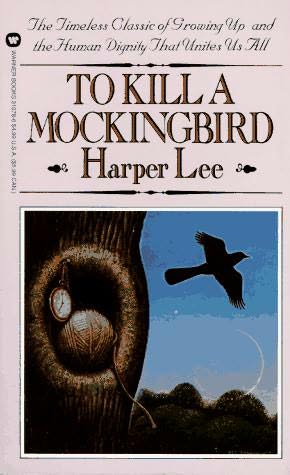
To Kill A Mockingbird (Harper Lee)

--The blurb--
""Shoot all the bluejays you want, if you can hit 'em, but remember it's a sin to kill a mockingbird". This is a lawyer's advice to his children as he defends the real mockingbird of this story - a black man charged with raping a white girl in the Deep South of the 1930s."

--The review--
Literature professors and other book lovers around the world, since time immemorial, have long argued about the purpose of literature. Is it to teach? To entertain? To transport, to allow for escapism? To reassure you that there's someone out there who has once felt as you now do? Or something else?

Harper Lee was working at a very sensitive time for America - and yet somehow, in the turbulence of the late 1950s and early 1960s, she managed to encapsulate all of these things in what is essentially her only work, To Kill A Mockingbird. It's certainly worth doing something only once if you do it right the first time, and this is proved by Lee's lingering legacy. Her only novel leaves an ongoing flavour in the mouth and mind as all five senses try to wrap themselves around the warmth of the Alabama summers, the noises of the courtroom, the taste of Coca-Cola out of a brown paper bag, the smell of Miss Maudie's beloved azaleas, and the unending motif of calm protagonist Atticus leaning over a book or newspaper. The author's powers of description and observation mean that the transportation of the reader is complete; it is this, combined with the compelling plot line, which make it difficult to extract oneself from what is being told.

Entertainment is not so prevalent in To Kill A Mockingbird in terms of laughs; Lee is, after all, dealing with a serious subject. The characters are strong, touching and eccentric in equal measure, and contrast each other enough to create real variety, while the plot is precise and carefully executed. Tension is built up successfully as Lee hangs onto control of the dénouement, throwing in a twist just as the reader believes that they know what will happen. This is not to say that the writer scores perfectly on all counts, however: at times the narration is too unrealistic to possibly come from the mouth of an eight-year-old, even a precocious one (a third-person omniscient narrator, or even the first-person voice of an older child, would have perhaps been better), and further expansion on the Boo Radley subplot would have added even further mystery. None of these flaws, though, prevent the reader from being riveted throughout.

At once the reader is somewhere else, and at the same time reminded of their life's own unfairnesses (even if only in the sense of how they diminish by comparison to the novel's main unfairness). But Lee does not encourage us to wallow - to the contrary, we are guided to take inspiration from the sage Atticus, who dispenses life advice throughout the novel at appropriate intervals, without seeming interfering. To Kill A Mockingbird perhaps contains life's most important lessons, but the reader does not feel patronised by this, as the author's points are well-made. 

It is therefore from the combination of all of the above "purposes of literature" that To Kill A Mockingbird has truly earned its place in the annals of literary acclaim. All should be urged to read it - and not only that, but to read it more than once.

Wednesday, 11 August 2010

Middlesex (Jeffrey Eugenides)

--The blurb--
"In the spring of 1974, Calliope Stephanides, a student at a girls' school in Grosse Pointe, finds herself drawn to a chain-smoking, strawberry-blond classmate with a gift for acting. The passion that furtively develops between them leads Callie to suspect that she is not like other girls. In fact, Cal has inherited a rare genetic mutation. The biological trace of a guilty secret, this gene has followed her grandparents from the crumbling Ottoman Empire to Detroit and has outlasted the glory days of the Motor City, the race riots of 1967, and the family's second migration, into the foreign country known as suburbia. Thanks to the gene, Cal is part girl, part boy. And even though the gene's epic travels have ended, her own odyssey has only begun."

--The review--
When Homer Simpson decides, in yet another new line of work, to get a fake qualification online that allows him to conduct marriage ceremonies, quite a few people step up to tie the knot under his dubious jurisdiction. One of these couples is composed of Brandine and Cletus, a recurring hick-town couple in the show. Just as Homer is about to pronounce them man and wife, he suddenly stops and says "Hey, are you two brother and sister?!", to which the couple gaily reply, "We's all kinds of things!"

It is this premise of incest, and the disastrous chain of events that it can provoke, that provides the basis of Eugenides' second novel, Middlesex. Even though the novel's approach can seem slightly contrived in places, it is mostly believable, with the author assuming the female voice very successfully. Epic in its scope, the novel is not only detailed in its plot construction and scientific research, but also gives the reader a sweeping panoramic view of twentieth-century American history. This ambition could easily leave the reader lost, but Eugenides not only traverses the different generations and time periods with ease but does well, too, in making the novel accessible as well as unusual. Writing the novel chiefly from Callie's point of view, Eugenides occasionally slips into a more omniscient tone than might be considered appropriate, and yet in conjunction with the resolution of the novel, it does end up seeming appropriate after all.

In spite of the novel's length, and the author's sophisticated use of vocabulary, it has all the momentum of a runaway freight train, compelling the reader to read on. The characters are highly human and the spanning across three generations is something that I believe to have been influenced by Zadie Smith's White Teeth. It is possible, too, that Charlie Anders drew a little inspiration in Choir Boy from the relationships that Eugenides depicts. However, one aspect of the characterisation that will be lost on the vast majority of readers is the naming of protagonist Callie's brother only as Chapter Eleven, which is an obscure political reference that I had to look up in order for it to be explained. Even if it does hold some minor element of foreshadowing, this ultimately does not enhance the story in any way, and hinders rather than helps the reader.

Colm Toibin's introduction to the novel also does not help the reader in any meaningful way: to my mind, introductions to novels should help to explain to the reader or shed further light on issues arising in the novel. Toibin's introduction, however, is more of a book review in itself, and while admittedly it is a good one, his opinion is the sole focus, and this for me has no place in an introduction (or at least very little). In any case, Eugenides' work speaks for itself, with him handling the transition between scenes with dexterity and ease. Particularly interesting is the non-chronological order in which the story is told, which leads to increasing curiosity on the reader's part not only about how Callie has got to the present day but also about Callie's burgeoning relationship with Julie. The last we see of Callie and Julie is when Callie is just about to tell Julie about her past, and even though we don't get to see Julie's reaction, this feels right: we feel as if we ought to creep away quietly and let them get on with it in private.

The novel is neither wholly a sentimental family saga nor wholly an academic treatise on gender versus sex; its blend of various genres and topics makes it more significant than this, particularly as attitudes to sexuality and gender become more open and understood, especially in relation to the recent case of Caster Semenya. In trying to alert people to and inform people about the subject of hermaphrodism and intersexuality, Eugenides certainly succeeds. As previously mentioned, it also serves as a microcosm of American history over the past century, and also incorporates James Bond-style elements, such as car chases and dodgy deals. The reader is left beyond satisfied in virtually all respects, this highly influential work deserving a place on every modern bookshelf.

Thursday, 27 May 2010

Catch-22 (Joseph Heller)

--The blurb--
"At the heart of Joseph Heller's bestselling novel, first published in 1961, is a satirical indictment of military madness and stupidity, and the desire of the ordinary man to survive it. It is the tale of the dangerously sane Captain Yossarian, who spends his time in Italy plotting to survive."

--The review--
Within the parameters of your average classic novel, you could argue that this book doesn't even feature: it is untraditional in its approach, inflammatory, confusing and bewildering, making it a real baptism of fire for anyone reading it, whether this is their first foray into classic literature or otherwise. Even though it is (perhaps indisputably by now) firmly situated in the modern classics hall of fame, this is definitely not a book for everyone. You could even call it a "Marmite book" - you either love it or you hate it from the very first taste.

The fact that there is virtually no middle ground of opinion relating to Heller's 1961 opus means that it is maybe unsurprising to feel that it owes plenty to Proust. Initially overwhelming, it meanders unashamedly, and rather than following any conventional narrative strand, the majority of the space is spent describing people and atmospheres rather than situations and events. When more orthodox episodes do feature in a way that relates to plot, then, they are rendered all the more striking by the type of writing that surrounds them. Heller holds the dubious distinction of being harrowing and hilarious in equal measure, and by this I mean the good kind of hilarious - not the kind that raises a mild chuckle, or sets off a small connection in your brain that says "Ah, I see what you did there", but the genuine and original kind of hilarity that can make you burst out laughing in front of whoever you are with at the time. Equally, in the harrowing stakes, Heller doesn't do things by halves, with the horror he describes popping off the page and making your jaw drop. This is certainly not just your average WWII novel. Eloquent and vivid, the author is capable of creating images that stay with the reader forever.

The novel is saturated in wry sarcasm and black humour, satirising the situation of being at war, and yet simultaneously, you get the feeling that Heller isn't joking about the ways in which young men frequently play dice with their lives. The ending is as absurd as you would expect, but seeming somehow so fitting. Repetition is a strong feature of Catch-22, and it's easy to see why some readers may become frustrated with the novel's style and with its highly farcical nature. However, if you pursue it, and like it, you just might find that it's one of the best books that you've ever read.

Other works by Joseph Heller
Something Happened (1974)
Good As Gold (1979)
God Knows (1984)
Picture This (1988)
Closing Time (1994)
Portrait of an Artist, As An Old Man (2000; published posthumously)

Saturday, 30 January 2010

Love in a Cold Climate (Nancy Mitford)

--The blurb--
"Set in the privileged world of the county house party and the London season, this is a comedy of English upperclass manners between the wars."

--The review--
My two major literary discoveries of 2009 were Stella Gibbons and Wilkie Collins, and (as you may have been able to tell from my previous Nancy Mitford review this month) I can equally see the works of Nancy Mitford becoming a permanent fixture on my bookshelf. While Love in a Cold Climate took much longer to pick up speed than The Blessing (for without the expatriate element, which still holds some relevance today, it is in many ways just another tale of aristocratic exploits), it thankfully ends on the same scintillating note.

Despite the fact that Love in a Cold Climate is a loose sequel to The Pursuit of Love, and a similarly linked prequel to Don't Tell Alfred, the fact of having read neither of them is in no way a disadvantage, as it stands perfectly well on its own. It does take some time to get to know the characters and to appreciate the plot in amongst the faceless aristocrats, but once this has been achieved, the novel becomes instantly more enjoyable.

As we get to know Boy and Polly better, the novel assumes more of a soap-opera quality, in the sense that it keeps readers riveted, gagging for the next instalment, and wanting desperately to know the outcome. The novel is equally enlivened with the introduction of Cedric, who adds a hilarious touch, and who cannot help but make the reader visualise how this character would be played in a film (thankfully, the novel has been adapted twice for television in the past thirty years). The novel's ends are tied up ingeniously, showing us ever further how it is Mitford's mastery of character, rather than necessarily setting, that light up her novels and make them what they are.

Other works by Nancy Mitford
Highland Fling (1931)
Christmas Pudding (1932)
Wigs on the Green (1935)
Pigeon Pie (1940)
The Pursuit of Love (1945)
The Blessing (1951)
Madame de Pompadour (1954)
Voltaire in Love (1957)
Don't Tell Alfred (1960)
The Water Beetle (1962)
The Sun King (1966)
Frederick the Great (1970)

Monday, 11 January 2010

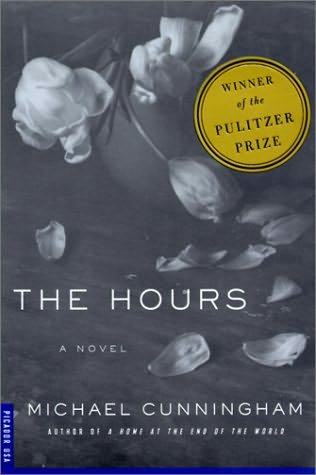
The Hours (Michael Cunningham)

--The blurb--
"Exiled in Richmond in the 1920s, Virginia Woolf struggles to tame her rebellious mind and make a start on her new novel. In 1990s New York, Clarissa Vaughan goes shopping for flowers for a party for her AIDS-suffering poet-friend. This novel meditates on artistic behaviour, love and madness."

--The review--
Reputation can be a superficial and perilous thing, but having never been a huge fan of Woolf's work, I picked this up on the basis of reputation alone. Something that won the Pulitzer and was made into an award-winning film must have something going for it, I thought, and surely people don't go on about Virginia Woolf for nothing?

However, as one begins to read, it quickly becomes clear that it is Michael Cunningham, rather than Virginia Woolf or Mrs Dalloway (the novel on which The Hours is based) that is the real star of the show. Even though it is occasionally difficult to see the links that Cunningham makes at times (which makes me think, for once, that this is one of those rare occasions where extrinsic knowledge when reading a novel may be of value), with the final chapter, where all three main characters meet, perhaps being the most bewildering of these, all three women's stories are compelling and realistic. Each are hypnotic in their own very human ways, and these qualities are further drawn out by the qualities of the peripheral characters, especially Richard.

Cunningham's prose is utterly poetic, serving as a real cornerstone for the standard of fine fiction. This, however, should not put it out of readers' reach: the novel contains plenty of the standard themes of shock, love, friendship and frustration, as well as examining madness in a way that is simultaneously critical and faithful, without being overly romantic. Consequently, even if you finish the novel without wanting to know anything more about Virginia Woolf, you will be wanting to know more of the works of Michael Cunningham.

Other works by Michael Cunningham
Golden States (1984)
A Home at the End of the World (1990)
Flesh and Blood (1995)
Specimen Days (2005)
Olympia (2010)

Saturday, 31 October 2009

A Short History of Tractors in Ukrainian (Marina Lewycka)

--The blurb--
"Two years after his wife dies, Nikolai, a Ukrainian who migrated to London after the Second World War, meets and falls for Valentina, a fellow Ukrainian who is nearly 50 years his junior. His daughters, Vera and Nadia, who have had a poor relationship with each other since their mother died, suspect Valentina of being after Nikolai’s money and of wanting a way to ensure that she and her son can remain in the West. Valentina is brash and manipulative, but she unites the previously feuding Vera and Nadia in their desire to have her removed back home. As a result of their renewed contact with each other, Nadia learns of family secrets."

--The review--
In setting us up with an outwardly classic scenario (old man falls for bimbo barely half his age), one could be forgiven for thinking that this might be a predictable or boring read. However, even from the unconventional title itself, Lewycka immediately shows us that this is not the case at all, and from the novel's first moments, the traditional Ukraine collides with modern-day Britain with a crash.

None of the characters are painted as angels; they all have their very realistic faults. While Vera and Nadia come across as being fairly normal, they are contrasted by the extreme caricatures in the forms of Valentina and their father. This is realistic and well-sustained as well as being imbued with pathos when appropriate; and, despite the fact that all characters come from the same foreign country, and despite the fact of Valentina and Nikolai likely having the same level of English, and Vera and Nadia sharing a similar level too, the dialogue never becomes two-dimensional, with Lewycka managing to maintain distinct personalities and unwavering mastery of dialect. The novel is very sensory and visual as a result, thanks to this successful development of character as the foreground to the often murky physical settings.

Equally, pace and humour play their part, and it becomes easy to see how this novel propelled Marina Lewycka to seemingly overnight acclaim. The reader becomes tranfixed by the text, wanting to see the novel through to its (highly fitting) end. While the ways in which Lewycka transforms the basic situation make it unique, it still remains grounded enough for readers to see places, circumstances, and even people that they know in the novel's web. Even though extracts from Nikolai's book (from which the title comes) can drag a bit, and seem dry in comparison to the rest of the novel, one suspects that this was exactly Lewycka's intention. The result is a compelling, amusing read that should hook even the most cynical onto the author's work; I certainly look forward to dipping my toe into more.

Other works by Marina Lewycka
Two Caravans (2007)
We Are All Made of Glue (2009)

Saturday, 10 October 2009

One Flew Over The Cuckoo's Nest (Ken Kesey)

--The blurb--
"Boisterous, ribald, and ultimately shattering, Ken Kesey's One Flew Over the Cuckoo's Nest is the seminal novel of the 1960s that has left an indelible mark on the literature of our time. Here is the unforgettable story of a mental ward and its inhabitants, especially the tyrannical Big Nurse Ratched and Randle Patrick McMurphy, the brawling, fun-loving new inmate who resolves to oppose her. We see the struggle through the eyes of Chief Bromden, the seemingly mute half-Indian patient who witnesses and understands McMurphy's heroic attempt to do battle with the awesome powers that keep them all imprisoned."
Blurb from www.amazon.co.uk

--The review--
One Flew Over The Cuckoo's Nest is a novel that consistently appears not only in lists of the best novels ever written but also in lists of books that have attracted controversy. This combination of popularity and provocation makes me wonder why I didn't read it before, and it did not disappoint.

That's not to say this is an easy novel: with complex sentences, dense fields of text, and many an abstract idea to absorb, this poses an intellectual challenge as well as confronting us emotionally with horrific scenes of the treatments used in mental hospitals at this time. It's also difficult to realise what exactly is wrong with the Chief mentally, if indeed anything; Kesey approaches the Chief's thoughts with such sensitivity and realism that they can seem almost normal to us.

However, there's plenty to make this approachable, too, despite the novel's combination of intellect and gruesomeness: the diversity of the characters in the novel is to be commended, as is the ease with which readers can visualise them. Kesey keeps the pace, matching the Chief's languorous thoughts and visions with events that are hilarious and intimidating in equal measure. Kesey also grounds himself as a key influence in literature that is to come on the subject of mental illness: echoes of his work can be seen in Clare Allan's Poppy Shakespeare, to give just one example.

Equilibrium is continuously disrupted in the novel, with Kesey leaving us quite often not knowing what to expect next, although perhaps not with the same intensity of twists and turns as in Roald Dahl's short stories for adults. The ending, though, is fitting, balancing out the arguable injustice of McMurphy's fate with the eerie calm of Chief Bromden's.

Other works by Ken Kesey
Sometimes A Great Notion (1964)
Caverns (1989)
Sailor Song (1992)
Last Go Round (1994; with Ken Babbs)

Tuesday, 21 July 2009

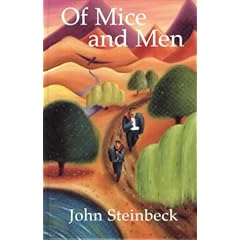
Of Mice and Men (John Steinbeck)

--The blurb--
"“Guys like us, that work on ranches, are the loneliest guys in the world. They got no family. They don’t belong no place ...With us it ain’t like that.We got a future ... because I got you to look after me and you got me to look after you.”

George and Lennie are migrant American labourers –the one alert and protective and the other strong, stupid and potentially dangerous. This is the powerful story of their relationship and their dreams of finding a more stable and less lonely way of life."

--The review--
It is arguably the job of an author to bring to life a world that is previously unknown to their readers, and yet the scene that opens Of Mice and Men is perhaps more universal than this: the paradisiacal setting of American countryside is awash with rich colour and is almost synaesthetic in its ability to make words morph into textures and sounds and breaths of sunny breeze. Steinbeck then goes on, however, to narrow down the experience and fuse the pan-global landscape with the more specific toils and backgrounds of the two main characters.

Starting off very slowly and languorously, Steinbeck allows the reader to savour every word and moment before taking them on a rollercoaster of increasingly serious events whereby George and Lennie are under ever-more serious threats to their jobs, dreams and lives. Steinbeck successfully manages to provoke pathos in the reader towards each of these characters, though for very different reasons, and keeps the plot incredibly tight and concise, which is perhaps the main contributor to its success.

The novel's ending is both finished and unfinished, leaving the reader stunned and with many unanswered questions about the nature of friendship. Is the previously paradisiacal arena now just a personal hell? And does George's final action make him the greatest of enemies or the greatest of friends? In addition to this, the novella raises the issue throughout of how mental illness is, was and should be treated, and it is perhaps Steinbeck's treatment of these timeless themes that reveals the key to the enduring success of his work. It perhaps proves that an author's job is therefore not entirely to bring a different world to their readers, but rather to combine it with themes that are familiar across humanity in order to create a truly great story that echoes down the ages.

Other works by John Steinbeck (selection)
Cup of Gold (1927)
The Red Pony (1933)
Tortilla Flat (1935)
The Grapes of Wrath (1939)
The Pearl (1947)
East of Eden (1952)

Tuesday, 30 June 2009

Flaubert's Parrot (Julian Barnes)

--The blurb--
"Which of two stuffed parrots was the inspiration for one of Flaubert's greatest stories? Why did the master keep changing the colour of Emma Bovary's eyes? And why should it matter so much to Geoffrey Braithwaite, a retired doctor haunted by a private secret? In "Flaubert's Parrot", Julian Barnes spins out a multiple mystery of obsession and betrayal (both scholarly and romantic) and creates an exuberant inquiry into the ways in which art mirrors life and then turns around to shape it."
from www.amazon.co.uk

--The review--
The lives of famous writers do not often take the stage in modern fiction; however, this does not mean that we are necessarily short of examples. Colm Toibin's The Master, for instance, adeptly covers the life of Henry James; Passionate Minds, by David Bodaris, fictionalises the life and loves of Voltaire; and finally, of course, the arguably most famous example presents itself in the form of Michael Cunningham's The Hours, which stars Virginia Woolf. However, none of these perhaps combine academic writing with fiction to quite the same extent as Barnes in his treatment of the life of Flaubert. Perhaps unfortunately for Barnes' readers - regular or otherwise - it swings more in the direction of academic writing. It is a clever novel, but there is 'clever' in the way that most people will identify with and enjoy and there is clever in a way that reaches out only to very few.

There is no denying that this novel is tight, well-researched, occasionally witty, makes subversive and intelligent use of language, and makes excellent use of quirkier details that other biographers would miss. Despite this, though, while the style of the novel is readable and accessible, the ideas perhaps are not, as well as at times only being of interest to the most die-hard of Flaubert fans (which cuts out a significant proportion of the reading population). This weakness is also perhaps augmented by the fact that the narrator is extraordinarily underdeveloped. The connections between his life and the life of Flaubert is only especially prominent in one chapter and is hardly detectable at all in the others. Being able to 'sense' the main character or narrator is important to most people when reading, even if actually liking the character is not; if you can barely even form a picture of said character or narrator, you are arguably in trouble.

This is therefore not the most enchanting start to Barnes' oeuvre; there are novels of his that are wittier and more crowd-pleasing. Do not start here: make a dash for his more digestible and amusing History of the World in 10 1/2 Chapters, or, for that matter, if you are not put off by the format of a novel chronicling the life of another author, opt for a tale based on the life of Sir Arthur Conan Doyle, Arthur and George.

Other works by Julian Barnes
Metroland (1980)
Before She Met Me (1982)
Staring at the Sun (1986)
A History of the World in 10 1/2 Chapters (1989)
Talking It Over (1991)
The Porcupine (1992)
England, England (1998)
Love, etc (2000)
Arthur and George (2005)

Wednesday, 10 June 2009

The Crucible (Arthur Miller)

--The blurb--
"Arthur Miller's classic parable of mass hysteria draws a chilling parallel between the Salem witch-hunt of 1692 - 'one of the strangest and most awful chapters in human history' - and the McCarthyism which gripped America in the 1950s. The story of how the small community of Salem is stirred into madness by superstition, paranoia and malice, culminating in a violent climax, is a savage attack on the evils of mindless persecution and the terrifying power of false accusations."

--The review--
Nestling comfortably alongside the more conventional religions are several arguably more 'niche' and less conventional ones, such as Jedi, Hare Krishna, and Wicca. Given the increasing acceptance of the majority of religious beliefs in modern culture, it is perhaps difficult to reconcile today's tolerance with the notion that those sharing Wiccan beliefs, or something similar to them, could have been killed for it a couple of centuries ago, even if the people concerned were falsely accused.

This, however, is the gruelling reality of Arthur Miller's (arguably most famous) play, The Crucible. Founded on a complex web of lies, spin and hysteria, Miller effectively depicts the struggles and attitudes of 17th-century residents of Salem, Massachusetts, at the heart of the notorious witch trials. Creeping under the reader's skin similarly to Henry James' The Turn of the Screw, it combines emotion and humanity with darkness, coldness and distance.

Miller's stage directions, however, are highly Stanislavskian, proving dense in detail and providing information on the characters' background that would normally be more suitable for a novel, and that only readers and directors of the play will ever get to know (there are no instructions for this information to be communicated to the audience during the play, Brecht-style). There is something of the omniscient narrator about it, à la the narrator of Fantasia, meaning that Miller is strongly there with us throughout our reading of the play. It is easy for a reader or director to visualise the characters, and Miller's manipulation of dialect is extremely skilful. Moreover, the narrative arc is as realistic and touching as it is chilling, and Miller's depth of research is not to be sneezed at: as well as depicting events with presumably the greatest possible accuracy, his work goes right down to using the same people who were at the centre of the scenario in 1692, including the use of their real names.

However, the historical context is extremely intricate, and in itself can potentially require deep study, which means that this text easily merits multiple readings (or viewings, if actually seeing the play is more your thing). It's easy to see how the play has known such success since its publication; Miller's writing is very vivid, with characters and scenarios just leaping off the page. Perhaps even more poignant and significant than an intrinsic reading of the play (=just considering the events of the play in themselves) is the fact that Miller wrote this play at the height of the red scare, in 1953, which brings into focus a series of political parallels that are still relevant today.

The play's complexity is perhaps the only offputting element, but this is something which should be relished by those who enjoy a challenge, and the play has clearly not lost appeal with the general public because of it. Truly intellectual crowd-pleasers are often difficult to come by, and it is perhaps this that proves Miller's most powerful legacy.

Other works by Arthur Miller (selection)
No Villain (1936)
They Too Arise (1937)
Honors at Dawn (1938)
The Man Who Had All The Luck (1940)
Focus (1945; a novel)
All My Sons (1947)
Death of a Salesman (1949)
A View from the Bridge (1955)
After The Fall (1964)
The Creation of the World and Other Business (1972)
The American Clock (1980)
Broken Glass (1994)
Resurrection Blues (2002)
Finishing the Picture (2004)

Friday, 5 June 2009

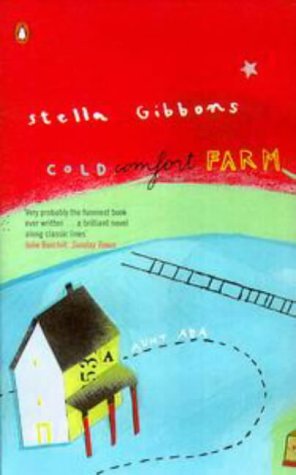
Cold Comfort Farm (Stella Gibbons)

--The blurb--
"Flora has been expensively educated to do everything but earn her own living. When she is orphaned at 20, she decides her only option is to go and live with her relatives, the Starkadders, at Cold Comfort Farm. What relatives though. Flora feels it incumbent upon her to bring order into the chaos."
from www.amazon.co.uk

--The review--
In the novels I've reviewed recently, there have (unfortunately) been far too many silly, simpering and just downright bland female protagonists, about which I have complained vociferously of late. With Gone With The Wind being one of my all-time favourite novels, it is perhaps natural to want to compare these heroines to Scarlett O'Hara and find that they don't quite square up to her standards, but finally, in Cold Comfort Farm, readers are introduced to a heroine that not only embodies the silliness of the heroines of this period (in Gibbons' delightfully tongue-in-cheek style) but also gives us a glimmer of the future Scarlett O'Hara's devil-may-care attitude (Cold Comfort Farm having been published a mere four years before Margaret Mitchell's wartime classic).

The setting is slightly reminiscent of Frances Hodgson Burnett's The Secret Garden: a neglected dwelling nestled away in dark countryside, miles away from anything (although Burnett's residence is a rich mansion in the north of England, while Gibbons sets the action in a more modest group of farm buildings in Sussex), and the feeling of change being in the air is common to both novels. The novel is perhaps arguably also the first modern sitcom novel - the coming together of a rich finishing-school girl with more humble relatives is set up very deliberately to have hilarious and awkward consequences.

While the novel isn't laugh-out-loud funny (though I appreciate that the sense of humour of modern readers may have taken a significant shift since the book's publication in 1932), there are some amusing moments in a couple of incisive one-liners and vibrant similes and metaphors, which find humour in their apparent total randomness (though I'm sure that Gibbons worked harder on them than their effortlessness would have us believe). The characters, while in one sense clear caricatures, were also believable - the reader is led to care about them and what happens to them and is allowed to actively seek out a happy ending. The ending itself is therefore surprising. To paraphrase the Simpsons for a moment, one could confess confusion in not knowing if it's a happy ending or a sad one. Ultimately it is an ending, and that is enough - and yet upon learning that there is a sequel available, in the form of Conference at Cold Comfort Farm, as well as a collection of short stories (Christmas at Cold Comfort Farm), one immediately wants to know what will happen to Gibbons' unique cast of characters next. It is lamentable that these sequels are no longer still in print, though perhaps with a bit of clever detective work online copies may still be found (one hopes).

The notion of Cold Comfort Farm parodying sentimental rural novels of the time is a nice one, but appears initially a little too 'niche' for the vast majority of readers. However, the novels of DH Lawrence and Thomas Hardy are often flagged as touchstones for the situations and setting on which Gibbons has based her story, and upon reflection this can be detected, even if it is in no way central to understanding and enjoying the novel. Gibbons' powers of description are highly poetic while keeping the writing accessible, and the novel combines tradition and modernity with sharpness and subtle humour throughout, as well as using extremely successful character development to keep the reader hanging on right to the end.

Other works by Stella Gibbons
Nightingale Wood (1938)
Christmas at Cold Comfort Farm (1940)
Ticky (1943)
The Bachelor (1944)
Westwood (1946)
Conference at Cold Comfort Farm (1949)
Starlight (1967)

*Stella Gibbons also published several volumes of poetry during the 1930s and wrote a story for children (The Untidy Gnome, 1935).

Monday, 4 May 2009

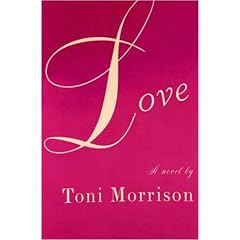
Love (Toni Morrison)

--The blurb--
"Nobel Prize laureate Toni Morrison's spellbinding novel is a Faulknerian symphony of passion and hatred, power and perversity, color and class that spans three generations of black women in a fading beach town. In life, Bill Cosey enjoyed the affections of many women, who would do almost anything to gain his favor. In death his hold on them may be even stronger. Wife, daughter, granddaughter, employee, mistress: as Morrison's protagonists stake their furious claim on Cosey's memory and estate, using everything from intrigue to outright violence, she creates a work that is shrewd, funny, erotic, and heartwrenching."
from www.amazon.com

--The review--
Toni Morrison is often cited as a defining voice of both her generation and her race, most frequently through her more famous works, Beloved and The Bluest Eye. And yet she, among other black authors such as Mildred D Taylor (author of Roll of Thunder, Hear My Cry) and James Baldwin (Go Tell It On The Mountain) are often passed over by readers before university age in favour of white authors such as Harper Lee and JD Salinger. But why? The novels by the latter authors can certainly compete in terms of angst and in terms of facing controversial issues. But do they compete in subtlety and complexity too?

Having never read any Toni Morrison before now (yes, even as a student studying English at university she passed me by, due to a combination of her not appearing in any of my modules, me having to plough through various other delights for Classics - multiple readings of Homer, anyone? - and me constantly dashing around various extra-curricular diversions), I am perhaps not qualified to comment on her work as a whole (yet), but Love, while not her best-known work (written in 2003, it is one of her most recent), certainly seems a fine start. It also heartens me that Toni Morrison's books have sensible gaps between them - this not only allows personal and critical evolution as an author, and for us as readers, but also reassures us that the work will be of high quality (I'd rather have 10 excellent books than 20 dross, wouldn't you? These writers who seem to have a new book out every five minutes often quite displease me). The reader is confronted by a web of knotted family ties - the hotel is run by Heed (Bill Cosey's widow) and Christine (Cosey's granddaughter), and we also have input from his daughter-in-law May; the resort's receptionist, Vida; his ex-lover, Celestial; his ex-cook L (she narrates the story; we never find out what 'L' stands for); and a new employee, Junior, who only arrives after Cosey's death. Cosey is a mythical figure, portrayed as God-like by all these different women in all their different ways.

Despite all the different inputs from the above characters, it is difficult to get to know Bill Cosey - he is just a name on a pedestal, and multiple readings are, to my mind, required in order to get to know him better (although this is arguably the case with all the characters). Morrison weaves the story deftly and incrementally, letting everything rise in a delightful crescendo so that all the main details are only really revealed at the end. It not only deals with the many faces of love but also with these very real women, from their jealousy and happiness to their sexual promiscuity. The story is short but intense: Bill Cosey dies 25 years before the story takes place, and yet the female characters all speak of him in a more immediate sense, as if he had died only very recently.

The chapters are of a manageable length and imaginatively titled, providing a thoughtful framework to the plot and characters. Equally, the characters were quite well sketched, allowing easy visualisation of the 'main characters' in particular (though people's opinions will differ as to who these are; Heed, Christine and Junior came most easily to me). Bill Cosey had more of a gloss, as mentioned, and it was more difficult to visualise him well. The recommendation of multiple reads serves not only on this level but will also allow for a greater familiarity with the plot - you need to concentrate on the rises and falls of Love's plot in order to appreciate the full richness of Morrison's narrative arc (the split narrative device in itself, which I've been told is a common theme of Morrison's novels, takes some getting used to).

Love, it seems, is therefore a good one to turn to if you're looking for something more unusual from an established literary canon. Arguably, in tentative response to the question posed at the start of this review, this is why such authors and such works can be occasionally overlooked: people can fear the unknown, and these books offer a walk through the hitherto unexplored.

Other works by Toni Morrison
A Mercy (2008)
Paradise (1999)
Jazz (1992)
Beloved (1987)
Tar Baby (1981)
Song of Solomon (1977)
Sula (1974)
The Bluest Eye (1970)