Showing posts with label 20th-century literature. Show all posts

Wednesday, 7 August 2013

Thank You, Jeeves! (PG Wodehouse)

 --The blurb--
 "The valet Jeeves resigns over Bertie's dedicated but somewhat untuneful playing of the banjo. In high dudgeon, Bertie disappears to the country as a guest of his chum Chuffy - only to find his peace shattered by the arrival of his ex-fiancee Pauline Stoker, her formidable father and the eminent loony-doctor Sir Roderick Glossop."

--The review--
As with any other country, stereotypes about Britain abound: afternoon tea. Strawberries and cream. The Queen. Wimbledon. Oxbridge. Butlers. Posh accents. Red buses and telephone boxes. Public schoolboys. The English breakfast. Black cabs. Country estates. And so on. It would be absurd to suggest that Brits indulge in all of these things every day - but equally, most stereotypes arise from the grain of truth that lurks within them. Thank You, Jeeves!- the first full-length novel in PG Wodehouse's Jeeves series - exploits many of these stereotypes to their fullest in the form of a light-hearted romp that becomes more and more farcical at every turn.

The farce is at times difficult to believe, with the events immediately preceding the ending, in particular, seeming rushed, and thrown together purely to bring the novel to a close, rather than providing intrinsic value themselves. However, it's worth remembering at this point the function of farce: the objective of the events is to place characters in untoward situations, and to observe their reactions as they unfold. While the events can be funny, it is the characters who serve even further as the object of the comedy: they are merely pawns in the writer's game, and thus a source of entertainment for us. To this end, Wodehouse deploys the characters and events extremely well.

Furthermore, there are other sources of pleasure in Thank You, Jeeves! beyond the characters' antics. Politically incorrect plot twists, archaic turns of phrase and the sheer extravagance of the setup just involved in having a butler provides plenty of nostalgia for Brits - even if that is a throwback to a time that never really existed. For foreign readers, it gives them a chance to indulge in the classic British stereotypes - even if they know that these stereotypes are not completely true representations of Brits and British life as it is today. Equally, it's possible that those same stereotypes had a cathartic purpose for Wodehouse, who in reality spent most of his life in other countries. Did the deployment of these stereotypes help to remind him of, and even construct for him, an exaggerated version of his homeland? 

To this end, one can wonder if the author intended the events and characters in Thank You, Jeeves! to be sincere or satirical. Given Wodehouse's public-school background and wealthy parents, it's entirely possible that he would have encountered people like these - hence, perhaps, the sharply-drawn characters. However, these same characteristics, and their roots in stereotype, can seem satirical to others - and this, too, is a source of humour, alongside the acerbic one-liners and fast-paced dialogue. The happy ending that Wodehouse produces, which links neatly with the apparently non-sequitur beginning, rounds off the narrative arc beautifully, and concludes this amusing and stress-free read. Off the back of this first Jeeves novel, the entire collection is to be recommended for light relief all year round - and not just in the summer when we all have more time to read - naturally alongside a pot of tea.

other works by PG Wodehouse
A full list of PG Wodehouse's works can be found on Wikipedia. The Jeeves canon consists of 35 short stories and 11 novels.

Saturday, 23 February 2013

The Flying Creatures of Fra Angelico (Antonio Tabucchi)

--The blurb--
"The reader meets a flying creature of ambiguous species in a priest's vegetable garden, and a revolutionary who is told her incredible future by Mademoiselle Lenormand, a fortune teller from the shadow world." 

--The review--
With the popularity of artists such as Laura Pausini, Eiffel 65 and Andrea Bocelli, and the success of Italian films such as Scialla!, it seems only naturally that the English-speaking public should also be interested in contemporary literature by Italian authors (Dario Fo and Umberto Eco are just two Italian writers who are still alive and still popular today, and whose works are already considered classics). So how does Antonio Tabucchi, who died in 2012, measure up to these greats?

Tabucchi was a prolific writer and academic who published 31 works between 1975 and 2011, including the greatly-lauded Indian Nocturne. Expectations are therefore great. Specifically, what of his 1987 collection of short stories, The Flying Creatures of Fra Angelico? 

There are certainly elements that are worthy of applause. Tabucchi was clearly wildly imaginative and a talented creator of beautiful description. The story entitled Messages From The Shadows is perhaps the best example of this, proving mysterious, elegant and poetic. The Flying Creatures of Fra Angelico, which is the first story in the collection, is eminently readable and should appeal broadly.

However, there were several problems, which can be attributed respectively to the writer, the translator, and those responsible for formatting this book for Kindle.

Several aspects of the story were unsatisfying, thanks to various instances of unsophisticated syntax, abrupt endings, undeveloped plotlines, telling rather than showing, pretention, narcissism, poor punctuation, awkward phrasing, and a general lack of clarity, precision and direction. However, due to reading The Flying Creatures of Fra Angelico in translation, it is not necessarily possible to tell whether this is the fault of Tabucchi himself, or his translator (in this case, Tim Parks, who has been nominated for the Booker Prize twice for his own works of fiction). For this reason, I would not completely discount reading other works by Tabucchi if translated by others.

Formatting problems for the Kindle edition of the text were equally bothersome: paragraphing was destroyed by random gaps and lines were interspersed with odd sequences of unrelated text and symbols. Equally, instinct tells the reader that pictures are supposed to accompany and thus enhance the text; none of these images were, however, visible in the text's Kindle edition. This is a great shame, as given that the collection's title is so heavily rooted in art, it is almost certain that the inclusion of images would greatly supplement the stories.

So while perhaps Tabucchi does not reach the dizzying heights of Fo and Eco in the annals of 20th-century literature with The Flying Creatures of Fra Angelico, this one work alone is not reason enough to discard his oeuvre completely. Perhaps instead seek out Pereira Maintains, which won Tabucchi the Viareggio Prize in 1994 - a prize also accorded to another Italian great, Primo Levi.

Sunday, 30 December 2012

Blaming (Elizabeth Taylor)

--The blurb--
"While on holiday in Istanbul, tragedy strikes, and suddenly the comfortably middle-aged, middle-class Amy is left stranded and a widow. Martha, a young American novelist, kindly helps her, but upon their return to England, Amy is ungratefully reluctant to maintain their friendship—on home soil she realizes that in normal circumstances, Martha isn't the sort of person she would be friends with. But guilt is a hard taskmaster, and Martha has a way of getting under one's skin..."

--The review--
Death has been a common theme in writing virtually since humans learnt to tell stories or put pen to paper. The process of grieving itself, however, is far less often explored. It is for this journey into love, loss and the process of absolving oneself of responsibility for actions that seem to factor in, at the time, to the death of others, that this lesser-known Elizabeth Taylor is one that should equally be a household name.

A contemporary of Iris Murdoch, Doris Lessing, and Jean Rhys, Taylor produced 12 novels between 1945 and 1976 but kept a relatively low profile and controversy-free life. Having started out as a librarian and tutor, she turned exclusively to writing following her marriage in 1936. Being determined to keep her private life private (to the point of destroying her own collection of letters), we cannot know how far exactly Blaming was derived from her own feelings. However, the authenticity of emotion involved means that it possibly does not come recommended for the recently bereft: it offers an insight into the extent of bewilderment and devastation that comes with the loss of a companion of so many years, and for this many readers will be reminded of relatives or even of themselves, coming out of the experience of reading Blaming feeling stronger or filled with greater admiration and empathy.

This experience as described by Taylor feels in no way unrealistic. There are no extraordinary events that we as readers feel could not happen to us, and in spite of protagonist Amy's passage through the classic stages of grief (including denial, anger and finally acceptance), Taylor's portrayal of these emotions does not feel hackneyed. Her pared-back style and carefully-chosen words mean that we are moved by the minimalist simplicity and rawness of the loss that has occurred, rather than being overwhelmed by layers and layers of complex description.

Taylor does layer in other ways, though: the 'blaming' of the title focuses not only on how far Amy can blame herself for the death of her husband (no matter how rational or irrational this may be) but also on the extent to which Amy could have changed the fate of acquaintance Martha (for whom the word "friend" does not seem quite right, for reasons that become clear during reading, even though friendship is what Martha tries to force on the grieving Amy). As well as grieving being explored relatively little in literature, it appears that this aspect of grief specifically is looked into very little, in spite of its validity.

The only criticism arguably lies in the notion that Taylor voices adults (men and women) far better than children: the grandchildren that feature in the story do not speak or act in a way that befits children, and it is clear that this is not one of the author's strengths. However, this happily does not detract too much from what we ultimately gain from Blaming.

That Taylor has been so consistently underrated is a shame: Blaming is elegant, concise, thought-provoking and heart-rending without falling into the traps of cliché and sentimentality. A timeless classic that paves the way for healing, regardless of the nature of our loss.

other works by Elizabeth Taylor
At Mrs Lippincote's (1945)
Palladian (1946)
A View of the Harbour (1947)
A Wreath of Roses (1949)
A Game of Hide and Seek (1951)
The Sleeping Beauty (1953)
The Real Life of Angel Deverell (1957)
In A Summer Season (1961)
The Soul of Kindness (1964)
The Wedding Group (1968)
Mrs Palfrey At The Claremont (1971)

Thursday, 23 August 2012

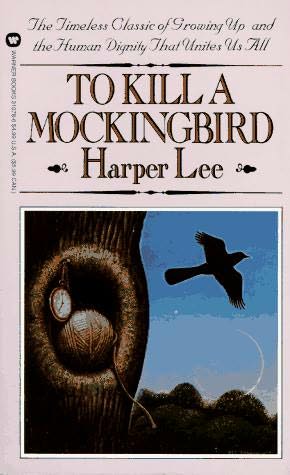
To Kill A Mockingbird (Harper Lee)

--The blurb--
""Shoot all the bluejays you want, if you can hit 'em, but remember it's a sin to kill a mockingbird". This is a lawyer's advice to his children as he defends the real mockingbird of this story - a black man charged with raping a white girl in the Deep South of the 1930s."

--The review--
Literature professors and other book lovers around the world, since time immemorial, have long argued about the purpose of literature. Is it to teach? To entertain? To transport, to allow for escapism? To reassure you that there's someone out there who has once felt as you now do? Or something else?

Harper Lee was working at a very sensitive time for America - and yet somehow, in the turbulence of the late 1950s and early 1960s, she managed to encapsulate all of these things in what is essentially her only work, To Kill A Mockingbird. It's certainly worth doing something only once if you do it right the first time, and this is proved by Lee's lingering legacy. Her only novel leaves an ongoing flavour in the mouth and mind as all five senses try to wrap themselves around the warmth of the Alabama summers, the noises of the courtroom, the taste of Coca-Cola out of a brown paper bag, the smell of Miss Maudie's beloved azaleas, and the unending motif of calm protagonist Atticus leaning over a book or newspaper. The author's powers of description and observation mean that the transportation of the reader is complete; it is this, combined with the compelling plot line, which make it difficult to extract oneself from what is being told.

Entertainment is not so prevalent in To Kill A Mockingbird in terms of laughs; Lee is, after all, dealing with a serious subject. The characters are strong, touching and eccentric in equal measure, and contrast each other enough to create real variety, while the plot is precise and carefully executed. Tension is built up successfully as Lee hangs onto control of the dénouement, throwing in a twist just as the reader believes that they know what will happen. This is not to say that the writer scores perfectly on all counts, however: at times the narration is too unrealistic to possibly come from the mouth of an eight-year-old, even a precocious one (a third-person omniscient narrator, or even the first-person voice of an older child, would have perhaps been better), and further expansion on the Boo Radley subplot would have added even further mystery. None of these flaws, though, prevent the reader from being riveted throughout.

At once the reader is somewhere else, and at the same time reminded of their life's own unfairnesses (even if only in the sense of how they diminish by comparison to the novel's main unfairness). But Lee does not encourage us to wallow - to the contrary, we are guided to take inspiration from the sage Atticus, who dispenses life advice throughout the novel at appropriate intervals, without seeming interfering. To Kill A Mockingbird perhaps contains life's most important lessons, but the reader does not feel patronised by this, as the author's points are well-made. 

It is therefore from the combination of all of the above "purposes of literature" that To Kill A Mockingbird has truly earned its place in the annals of literary acclaim. All should be urged to read it - and not only that, but to read it more than once.

Sunday, 22 July 2012

Starlight (Stella Gibbons)

--The blurb--
"Gladys and Annie Barnes are impoverished sisters who have seen better times. They live in a modest cottage in the backstreets of Highate with Mr Fisher, a mild but eccentric old man living secretively in the attic above them. Their quiet lives are thrown into confusion when a new landlord takes over, a dreaded and unscrupulous 'rackman'. He installs his wife in part of the cottages in the hope that there she will recover from an unspecified malady. With a mounting sense of fear, Gladys and Annie become convinced she is possessed by an evil spirit..."

--The review-- 
When an author has such success with just one novel from their back catalogue (in Stella Gibbons' case, Cold Comfort Farm), it is perhaps tempting to avoid releasing the rest of their works so many years after they were originally published in order to avoid the risk of criticism that this exposes them to - after all, they have a lot to live up to when the writer's most successful work has sold millions and been made in numerous stage and film adaptations. So how far has it paid off in Gibbons' case?

Many of her other works prove incisive, well-developed, humorous, and tautly told, with winning characters to boot. My American is one such work which stands up sufficiently on its own to rival the strength of Cold Comfort Farm and its sequels, and Gibbons' short stories are also promising. However, others, such as Nightingale Wood, are readable enough at the time but ultimately prove forgettable. 

Starlight falls somewhere in between the two. While perhaps not a long-lasting classic in the way of My American, it has too intriguing and distinctive a basis to be best consigned to the annals of history in the way of Nightingale Wood. The main characters are potentially charming, but are frequently too caricatured in appearance and in foibles of speech to be taken in any way seriously. The relationship between Peggy and Arnold is equally improbable and the reader at no point truly believes in it, meaning its resolution seems equally implausible. 

The at-times solid relationships and situations that Gibbons does create for us in Starlight, though, are frequently let down by a lack of detail. For instance, it is not clear why the 'rackman' (or landlord) would strike such fear into the hearts of Gladys and Annie, and it's possible that today's readers require a little more historical context for a fuller understanding (even extensive Googling furnishes the 21st-century reader with no further enlightenment). The concept of 'starlight' is only thinly threaded throughout the novel, in a way that is nowhere near substantial enough to make the link with the title obvious. Subplots (such as Gladys' relationship with her former employer, or Peggy's relationship with her current one) are glossed over and rushed and the reader is left feeling as if they have missed out in some way.

This lack of attention to detail (which is most uncharacteristic of Gibbons' work) results in an equal deficiency of empathy and sympathy towards the characters, and even those that we should have arguably cared about the most (such as the lovable yet eccentric Mr Fisher, or the long-suffering Erika) have their stories cut short or so rushed that we cannot care too much about how they end up. It is a shame that a story with such a unique and original basis could have fallen so short of expectations, especially as it does not seem that it was beyond Gibbons' capabilities to fulfil these.

From all of these observations, great hope in the novel can still be found. Although imperfect, it merits a second read so that readers can extract details that they may have missed the first time through, and certainly has a place among Gibbons' more widely-read works.

A full list of works by Stella Gibbons can be found here.

Friday, 18 May 2012

My American (Stella Gibbons)

--The blurb--
"My American follows the lives and loves of Amy Lee and Robert Vorst: from a chance childhood meeting to the [...] trysts that follow. A baker's daughter, Amy has dreams of becoming a writer, whilst Robert is destined to be a doctor. Later, embarking on a lecture tour, Amy is reminded of 'her American' and endeavours to find him amidst Depression-era America."

--The review--
Fans of the work of Enid Blyton and Nancy Mitford will find Stella Gibbons' work something to truly treasure. Gibbons typically combines the disparate skills of her two contemporaries into something that is simultaneously touching and witty, and My American is no exception. Setting us up to root for the underdog, Gibbons mixes Mitford's acerbic wit with Blyton's standard plot pattern (whereby the goodies and baddies all get what they deserve) to create something truly unique.

While perhaps not groundbreaking, My American proves a comfortable and satisfying read, which is intensified by Gibbons' unpredictable twists and turns and an increase in our desire to root for the initially plain and introspective heroine. The sometimes wet and dreary London setting is contrasted with the lovingness of Amy's foster family and the adventurous and romantic Vine Falls in America, and wherever we are in the novel, the author always manages to completely and utterly transport her readers. We feel that Gibbons truly puts something of herself into aspiring writer Amy, expressing feelings about the act of writing to entertain an audience that are completely authentic.

Balancing dialogue and description with finesse, Gibbons is also commendable for her skills in terms of concision and pace: she jumps between different settings and characters with ease, never once allowing the reader to feel like one situation is being dragged out or that we are torn from another too soon. Equally, information is always revealed carefully, with the ending being a surprise almost right up to the moment of it happening, which is a big plus for those disappointed by certain twenty-first century chick lit.

Gibbons is just as powerful in her expression of devastation as in her expression of happier moments, and even though the suspension of disbelief is at times required while reading her novels, that precept does not apply to these moments, where she successfully manages to hit the reader right between the eyes every single time. Serious, beautiful, visual, precise and rereadable, what My American does provide is a strong plot, memorable characters, and a little life lesson to take away for everyone who reads it: that with a bit of luck, even if there is some suffering and hard work along the way, and even if we have to wait a long time for it, there is every chance that our dreams can still come true even when all hope seems lost and the whole world seems against us. Blyton-esque indeed.

A full list of works by Stella Gibbons can be found here.

Wednesday, 16 November 2011

Time Regained (Marcel Proust)

--The blurb--
""Time Regained" begins in the bleak and uncertain years of World War I. Years later, after the war's end, Proust's narrator returns to Paris and reflects on time, reality, jealousy, artistic creation, and the raw material of literature - his past life."

--The review--
I have often criticised throughout my reading of Proust's epic his frequently over-complicated and vague style which seems designed to tie our brains in knots. The final volume of the heptalogy, Time Regained, starts off much more clearly and lucidly, which makes us feel that the narrator has the benefit of hindsight at last - which, with it being set more towards the end of his life, seems fitting. At least initially, it is less furious and intense, and more thoughtful.

However, we are soon treated to a glut of the meaningless gossip that pervaded earlier volumes. While this gives us a clue as to the nature of the narrator's life and social circle, it is maddening at the same time - if you have no time for celebrity-type gossip in real life, you are unlikely to have much patience for it in literature. Some of it is perhaps intended to show characters up as being hypocritical, but the targets of their hypocrisy probably took place so long ago that the effect is lost. Proust's political commentary on the war is equally uninteresting and is clearly aimed at those who already have knowledge of or opinions on the subject at hand. 

There are even examples of bad style, such as the line "To return to Mr Charlus..." (it is surely an elementary rule of narrative writing that such transitioning phrases are not required), and the fact that the first-person narrator has access to conversations and information in this volume that simply would not be possible. Punctuation needs to be more varied (a person can only take so many commas, although thankfully a semi-colon does appear...on page 320), and the volume is also loosely or badly organised, to the degree that we risk missing key events. But then again, are all of our own thoughts beautifully organised? Probably not.

To go on: we do not end up caring much for the death of one of the recurring characters due to the estrangement between himself and the narrator. The narrator's self-deprecation and false modesty is extremely annoying (especially when in the same breath he then goes on to talk as if he were an expert), and yet we must admit that it is natural for even the hugely talented to have doubts from time to time.

Plenty of the novel, however, still rings true today. Narcissistic though they may be, it is the narrator's thoughts and relationships that are of interest, not the author's attempts at political comment (it should be noted that supreme effort is apparently required to divorce narrator and author in this work of autobiographical-fiction-meets-history-and-philosophy). There is great irony in the author's recognition that all we do, or are, is so insignificant against the world's might.

The passages of memory after the narrator's return from convalescence are truly beautiful and testify to the author's powers of description. Despite certain episodes seeming contrived, the author's ability to still be relevant and appreciated today is staggering: his comments on pop art (how far is it truly enjoyed by 'laymen' and how far is it still a middle-class hobby?) are as accurate now as when they were written. He is correct that things from our childhood reawaken in us a sense of hope and wonder, and he posits ideas that still give us plenty to consider (for instance: is something still real if only we experience it, or does it have to be shared or common in order to qualify? Does truth go beyond fact?).

While a new edition is perhaps needed in order to increase mass appeal (Lydia Davis' looks promising), this does not mean that Time Regained (or even the heptalogy as a whole) is not worth pursuing in its current form. Proust has the ability to make us laugh (with his caustic descriptions of characters) and to make us cry (with his moving descriptions of landscapes and feelings). By the end of the seven volumes, most people have probably spent a year or more with Proust, and by then he's like an annoying family member: he's eccentric, digressive, annoying, boring at some moments, confusing at others; but he's also incisive, witty, intelligent, thought-provoking, sensitive and deeply poetic. In short, in spite of his shortcomings, we love him anyway.

Other works by Marcel Proust
Swann's Way (volume 1)
Within a Budding Grove (volume 2)
The Guermantes Way (volume 3)
Sodom and Gomorrah (volume 4)
The Captive/The Fugitive (volume 5/6)

Sunday, 15 March 2009

The Golden Gate (Vikram Seth)

--The blurb--
"Written in verse, this was Vikram Seth's first novel. Set in the 1980s, in the affluence and sunshine of California's silicon valley, it is the story of twenty-somethings looking for love, pleasure and the meaning of life."

--The review--
Having first encountered Seth's work in his most recent novel, An Equal Music, some years ago, I don't know why I didn't gravitate towards his other novels and poetry in the more immediate aftermath of reading it. However, The Golden Gate, which blends Seth's skills in building the narrative arc with his manipulation of diction and poetic phraseology, seemed a perfect choice when I happed upon it while browsing the library. It is of a reasonable length - not being a hefty tome like his other two novels - and one is able to easily read it as the backdrop to a lazy Sunday or to use it as a tool of light distraction during the journey to work.

While occasionally the rhymes seem a little forced, particularly towards the beginning of the novel when one is still adapting to the style and concept of the thing, generally they are creative, sometimes amusing, and almost always eloquent: you can open any page and find a line to take your breath away with its poetic beauty. The said poetic beauty does not, however, inhibit understanding of the plot, Seth twinning lucidity and mellifluity with panache and success. The storyline is absorbing and character is built effectively, although setting is often secondary. The fact of there being just a few characters serves to make The Golden Gate even more intense; an intensity which is even further compounded by Seth's kaleidoscopic vocabulary. His consistently high register is perhaps the only thing which does not make the novel accessible: as well as being a novel in verse, which is perhaps not the most appealing format for people who do not read very much, the author has an excellent command of the English language, and, in an age where things are allegedly being dumbed down all the time, perhaps unsurprisingly wishes to express it.

These things, however, were not negatives as far as I was concerned, only allowing me to enjoy the opus even more. Seth has successfully rendered life as we know it into the style of ancient epic, and this unique combination is something that he is unlikely to repeat, lest it become hackneyed (he presumably wishes to keep his fans on their toes). Any author would be proud of it at any time in their careers, let alone as a first novel, and this staggering debut should convince anyone who has not already been sold to advance further into Seth's oeuvre.

Other works by Vikram Seth
Novels
A Suitable Boy (1993)
An Equal Music (1999)

Poetry
Mappings (1980)
The Humble Administrator's Garden (1985)
All You Who Sleep Tonight (1990)
Beastly Tales (1991)
Three Chinese Poets (1992)

Non-fiction
From Heaven Lake (1983)
Two Lives (2005)