Sunday, 3 August 2014

Heart of Darkness (Joseph Conrad)

--The blurb--
"At the peak of European Imperialism, steamboat captain Charles Marlow travels deep into the African Congo on his way to relieve the elusive Mr Kurtz, an ivory trader renowned for his fearsome reputation. On his journey into the unknown Marlow takes a terrifying trip into his own subconscious, overwhelmed by his menacing, perilous and horrifying surroundings."

--The review--
Joseph Conrad is perhaps thought of as being one of the United Kingdom's most quintessentially British authors, so it is arguably surprising to find that he was in fact a first-language Polish, and second-language English, speaker who was granted British nationality at the age of 29. This surprise arises from the unmistakable richness of his work, of which Heart of Darkness is an excellent example.

While the nautical settings of Conrad's works may seem on the niche side, this merely serves as a framework for the precise, eloquent and well-paced descriptions for which the author is famous. This high level of imagery also lends Heart of Darkness a degree of classicism that some of his more dated works, such as The Nigger of the Narcissus, lack. This is compounded by the other techniques used by Conrad to convey a sense of impending doom, such as motifs and pathetic fallacy, which leave little work to be done in terms of plot and character.

This is not to say that Conrad does not handle these elements of the novella with his characteristic tautness and panache. Not a word is wasted and despite the descriptions, the plot is still being moved forward with every turn of the boat and every movement of the sun. Character is also mainly built up through anticipation, as well as the descriptions and dialogue of others; this has the other equally important effect of building tension and suspense, leaving the reader wanting to meet the protagonist (Kurtz) while wanting simultaneously turns away. As Conrad reiterates throughout the text, "the horror, the horror" is all-pervasive and present not only in the characters and events but also in the atmosphere and landscape.

Naturally, some of this anticipation would be lost on subsequent readings; however, the quality of the description and overall craftsmanship of the writing make excellent reasons to reread, before one even considers the deep moral and existential questions raised by the storyline and characterisation. The richness of the imagery is what makes one reach for Conrad's volume, rather than watching Apocalypse Now (a well-executed adaptation to be recommended for the ways in which is capitalises on the author's precisely-woven plot and intriguing protagonists), and it is this that makes Heart of Darkness such a resounding introduction to one of the great figures of English literature.

Other works by Joseph Conrad
Almayer's Folly (1895)
An Outcast of the Islands (1896)
The Nigger of the Narcissus (1897)
Lord Jim (1900)
The Inheritors (1901; with Ford Maddox Ford)
Typhoon (1902)
Romance (1903; with Ford Maddox Ford)
Nostromo (1904)
The Secret Agent (1907)
Under Western Eyes (1911)
Chance (1913)
Victory (1915)
The Shadow of Line (1917)
The Arrow of Gold (1919)
The Rescue (1920)
The Nature of a Crime (1923; with Ford Maddox Ford)
The Rover (1923)
Suspense (1925)

Saturday, 2 August 2014

Ooh wow...an apology is clearly in order.

It's pretty clear that this blog has been on extreme hiatus for the past 4 months or so. There have been reasons for that, although perhaps not very good ones.

I've been working towards my teaching certificate this year, which has led to me a) reading a lot of education books. Not something that was on this year's literary challenge list.

It's also led to b) a state of exhaustion, which doesn't leave much energy to tackle the heavyweights on my list.

This means that when I have been reading, it's mainly been c) the weekly papers, which are quick and easy to read bits of, and d) total junk that's basically marshmallows for the brain, like the typical 'Brits in the shit' stories of Little-Englanders packing up and moving to France...mainly so I can have a laugh at their stupidity without concentrating too hard myself.

I've therefore rather neglected this year's challenge, having not picked the best year to embark on it.

But now it's August, I've qualified as a teacher, and I'm finally beginning to slip into holiday mode. So I'll be catching up on the reviews of the books I did manage to read off my initial list, and making time to read the rest as 2014 marches on. There's still 150 days to go of the year, and I reckon I can make a pretty big dent in the rest of my list in that time. Thanks for reading this far, if there's anyone still out there :)

Sunday, 23 March 2014

The Pearl (John Steinbeck)

--The blurb--
"Kino is a desperately poor Mexican-pearl diver. But when he finds 'The Pearl of the World' he believes that his life will be magically transformed. Obsessed by his dreams, Kino is blind to the greed, fear and even violence the pearl arouses in his neighbours - and himself."

--The review--
John Steinbeck is known for the scenic descriptions of desolate yet beauteous landscapes that he portrays. When combined with the moral dilemmas that his characters often face, or the grave situations in which they find themselves, their power is increased. 

This is equally true in The Pearl, where Kino's discovery of a valuable black pearl drives him to the desire to use it to change his family's life for the better. Barren Mexican panoramas are lit up by his love for his family and the simplest pleasures of his life, and just as quickly darkened by the increasing horror of his quest to sell the pearl.

In many ways this is done to great effect: we, the readers, are on Kino's side, urging him on and longing for his success. As mentioned, the descriptions of emotions and the natural world are bewitching, and the short length of The Pearl means that the story's pace is kept taut throughout.

However, it is all dashed to pieces almost from the start by our knowledge that Kino is doomed - if he is able to sell the pearl successfully, it will be an even shorter story than it already is, and as his agony is drawn out, we have the sinking feeling that there is less and less chance of it ending well. This is arguably the novella's weakness: in Of Mice And Men, which is almost as short, there was always a tantalising ambiguity and a chance that the dream could come true. It is clear early on in The Pearl, however, that this is unlikely to be the case.

And yet we read on. Why? This is testament to the power of Steinbeck's storytelling. It's like seeing a film that's based on a book you've already read: you have a clear idea of how it will end, but you want to see how the director will portray it. In that sense, Steinbeck does step into that role of film director, painting clear visions in front of our eyes of Kino's flight from (and, simultaneously, towards) disaster - and it is therefore this magical quality that makes the story indeed a rare pearl. 

Other works by John Steinbeck (selection)
Cup of Gold (1927)
The Red Pony (1933)
Tortilla Flat (1935)

Of Mice and Men (1937)
The Grapes of Wrath (1939)
East of Eden (1952)

Sunday, 16 March 2014

Tender is the Night (F Scott Fitzgerald)

 --The blurb--
"Dick and Nicole Diver are handsome and rich, their dinners are legendary, their atmosphere magnetic. But Nicole has a secret and Dick has a weakness. Together they crash their lives on the rocks and only one of them really survives."

--The review--
With the glittering success of the latest film adaptation of The Great Gatsby still ringing in everybody's ears, it's in some ways unsurprising that this novel is Fitzgerald's most well-remembered. But is this a fair assessment?

Tender Is The Night was Fitzgerald's final novel, so one could argue that by this stage he should have been at his peak. Sadly, it seems more likely that Gatsby was his apex, and that from there on his work declined. 

The glitz and glamour (whether real or imagined) that makes the story of Jay Gatsby so successful still resonates in the lifestyle of Dick and Nicole Diver, the protagonists of Tender Is The Night. The parade of parties and aura of sophistication surrounding them both is really what lingers after one puts the book down, indicating that it is perhaps this descriptive power that lies at the heart of Fitzgerald's literary legacy. However, in Dick's smouldering not-quite-there affair with Rosemary, Fitzgerald creates a relationship that is reminiscent of Gatsby and Daisy - and this is where the cracks begin to show in Tender Is The Night.

On one hand, Dick and Rosemary's relationship is the most alluring part of the book - even if we don't know whether to want them to consummate it, being carried away with the romance of it all; or whether to be furious with Dick for his betrayal of Nicole. This is especially true when comparing the intensity of it to all of the seemingly insipid and insignificant subplots occurring in the background. However, Fitzgerald doesn't create anything new in this relationship. The fascination that readers (and viewers) often have with Gatsby and Daisy is that, depending on interpretation, their love either seems so real that Daisy leaving her husband is a real possibility, or it's clear that Gatsby is doomed to be heartbroken by the superficial Daisy (who is so silly at times that readers can truly wonder what on earth he sees in her).

None of these nuances exist in the relationship between Dick and Rosemary, meaning that some readers may be disappointed by the liaison's (some would say predictable) outcome. This damp squib of a novel will therefore leave fans returning to The Great Gatsby for a fuller, more complex and more developed tale - or perhaps instead opening Fitzgerald's other famous novel, The Beautiful and the Damned, in the hope of obtaining satisfaction.

other novels by F Scott Fitzgerald
This Side of Paradise (1920)
The Beautiful and the Damned (1922) 
The Great Gatsby (1925)
The Love of the Last Tycoon (unfinished and published posthumously; 1941)

Monday, 17 February 2014

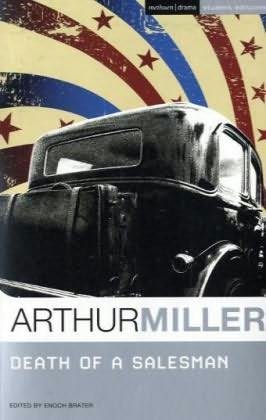
Death of a Salesman (Arthur Miller)

--The blurb--
"Willy Loman is on his last legs. Failing at his job, dismayed at his the failure of his sons, Biff and Happy, to live up to his expectations, and tortured by his jealousy at the success and happiness of his neighbour Charley and his son Bernard, Willy spirals into a well of regret and reminiscence."

--The review--
In the snap-happy world of celebrity, Arthur Miller is perhaps more famous for his ill-fated fling with Marilyn Monroe than for his plays. However, in the worlds of stage, screen and even schools, Miller's plays are still incredibly treasured and well-liked.

The notion of being "well-liked", and the use of this phrase, is something that dogs Death of a Salesman's main character, Willy Loman, throughout this early Miller play. As well as being an aspiration with which he pressurises himself, it also becomes a stick with which he metaphorically beats his sons Biff and Happy. 

Death of a Salesman is also riddled with irony, with this being most immediately present in Happy's name (or nickname, we should say, as his real name is revealed to be Harold). One is left wondering how he ever managed to acquire it, as it hardly proves an example of nominative determinism. Thanks to Willy's forceful style of parenting, Biff and Happy are both made to feel like failures, unable to fulfil the high expectations set out by their father in the wake of the Great Depression and the nascence of the American dream. Willy's self-perceived failure, too, to achieve these goals also lends the play an underlying tinge of sadness and desperation throughout.

It is also this touchstone of the American dream that contributes to Death of a Salesman's popularity in schools, as it has echoes of the dream held by the protagonists of Of Mice and Men - another highly popular GCSE text. Furthermore, Willy's desolation, and the densely descriptive stage directions, parallel those seen in The Glass Menagerie (one of Tennessee Williams' most famous plays, frequently studied at A Level). These comparisons are easy fodder for schools and exam boards, and also enable the texts to be studied extrinsically.

There are further similarities between The Glass Menagerie and Death of a Salesman - particularly in terms of the surreal set design and non-chronological structure. These elements mean that at times the latter play particularly can read confusingly on the page, with Miller's ideas at times being difficult for readers to visualise. However, as plays are written to be seen and not read, this may be a moot point unless you happen to be a director (in which case, your interpretation can be as strict or loose as you wish anyhow).


However, intrinsically speaking, Death of a Salesman's appeal is evident. The human conditions of Willy, Biff, Happy and wife and mother Linda are easily conditions in which any modern reader may find themselves: failing to achieve their dreams, the struggle for popularity, being downtrodden by dominant family members, talking up our paltry achievements in an attempt to impress others, the feeling of life as a treadmill that slips away under your feet, and treating life as a party rather than settling down are all situations in which today's readers and viewers can find themselves. This timelessness is the hallmark of a real classic, making it clear why Miller's plays are still so "well liked".

a selection of other works by Arthur Miller
No Villain (1936)
The Man Who Had All The Luck (1940)
All My Sons (1949)
The Crucible (1953)
A View from the Bridge (1955)
After The Fall (1964)
The Price (1968)
The Creation of the World and Other Business (1972)
The Archbishop's Ceiling (1977)
The American Clock (1980)
The Last Yankee (1991)
Broken Glass (1994)
Mr Peter's Connections (1998)
Resurrection Blues (2002)
Finishing The Picture (2004) 

A complete list of Arthur Miller's works can be viewed on Wikipedia.

Tuesday, 31 December 2013

Books Read: 2013

Every year, whether it's a spoken or unspoken target, I challenge myself to read 50 books a year. So did I manage it in 2013? Let's find out:

1. Embassytown (China MiƩville)
2. The Help (Kathryn Stockett)
3. An Imperfect Life (Rosemary Okun)
4. The Flying Creatures of Fra Angelico (Antonio Tabucchi)
5. The Shadow of the Wind (Carlos Ruiz Zafon)
6. Room (Emma Donoghue)
7. A Proper Place (Joan Lingard)
8. The Best Exotic Marigold Hotel (Deborah Moggach)
9. The Great Divorce (CS Lewis)
10. Falling Leaves (Adeline Yen Mah)
11. Don't Sleep, There Are Snakes (Daniel Everett)
12 and 13. The Etymologicon and the Horologicon (both by Mark Forsyth)
14. Major Pettigrew's Last Stand (Helen Simonson)
15. The Tragedy of Fidel Castro (Joao Cerqueira)
16. Incomplete and Utter History of Classical Music (Stephen Fry and Tim Lihoreau)
17. Food and Philosophy: Eat, Think and Be Merry (eds: Allhof/Monroe)
18. The Breakfast Bible (Seb Emina et al)
19. Let It Be (Chad Gayle)
20. What's Science Ever Done For Us? (Paul Halpern)
21. Chicken Soup for the Soul 20th Anniversary Edition (eds: Canfield, Hansen, Newmark)
22. Chicken Soup for the Soul: Teacher Tales (eds: Canfield, Hansen, Newmark)
23. The Perks of Being a Wallflower (Stephen Chbosky)
24. Heidi (Johanna Spyri)
25. We Are All Made of Glue (Marina Lewycka)
26. Things I Didn't Expect (Monica Dux)
27. The Marriage Plot (Jeffrey Eugenides)
28. Thank You, Jeeves! (PG Wodehouse)
29. Islamophilia (Douglas Murray)
30. The Rest is Noise (Alex Ross)
31. The Great Lover (Jill Dawson)
32. When God Was A Rabbit (Sarah Winman)
33. Great Days At Work (Suzanne Hazelton)
34. How To Survive Your First Year in Teaching (Sue Cowley)
35. The Diving-Bell and the Butterfly (Jean-Dominique Bauby)
36. O, What A Luxury! (Garrison Keillor)
37. Flowers for Algernon (Daniel Keyes)
38. The Flight of the Maidens (Jane Gardam)
39. Swimming and Flying (Mark Haddon)
40. The Growing Pains of Adrian Mole (Sue Townsend)
41. The Secret Diary of Adrian Mole (Sue Townsend)
42. The True Confessions of Adrian Albert Mole (Sue Townsend)
43. A Little Love Song (Michelle Magorian)
44. Love is a Mixtape (Rob Sheffield)
45. Beloved Stranger (Clare Boylan)
46. The Man Who Understood Women and other stories (Rosemary Friedman)

Surprised to have even reached 46 as I was sure it would be less! With rereads (which I don't count), it almost certainly would come to 50.

So what does this tell us about my reading habits (apart from the fact that I clearly a] spend too much time online/watching TV instead of reading, and b] that I really ought to read more in French given that I speak the language?!)?


  • 46 books over one year roughly translates to one book every 8 days
  • All of the books read were written in the 20th and 21st centuries
  • Nearly 46% of the books I read in 2013 were written by female authors
  • The longest book on the list was The Rest Is Noise at 214,000 words
  • The shortest was Mark Haddon's Swimming and Flying at 7,564 words
As for the quantity of books read, I could probably offer up a variety of excuses as to why I didn't attain the magic 50: life is just generally busy (and I don't even have small children like many of my friends, so don't have that excuse). A full-time job, co-running a household, at least attempting to stay physically fit, working towards my teaching certificate (in the latter half of 2013) and writing blog posts from time to time all stack up the hours. However, I have a long commute (approximately a 3-hour round trip five times a week), and so this should certainly help me to improve my reading time in 2014 if I actually put my mind to it (and not just doze and listen to music by default).

Perhaps more importantly, which of these books did I actually enjoy the most? Statistically, this blog's readers chose Adrian Mole, with the posts on these books being the most popular of 2013. I agree that they are classics without doubt, with the first book in the series managing in particular to always raise a chuckle. The list of books that I read this year also showcases plenty of newer talent, with Kathryn Stockett, Emma Donoghue, and Carlos Ruiz Zafon being especially notable. Also not to be forgotten from earlier times are the classic comedies of PG Wodehouse and the philosophical musings of CS Lewis.

However, as you may recall, my focus in 2014 will be to read classics that as a former student of English literature (and current teacher of English language and literature) I really should have read by now. This challenge will be significant given that several of the books on the list are rather long, and especially so if my thesis that the classics offer even greater rewards than contemporary literature is proved correct. And with 50 on the list, I'd better get cracking - starting tomorrow with Victor Hugo's Les MisƩrables. News of your literary challenges also always make welcome reading - and you can be sure that you will hear of my own progress throughout the year.

Monday, 30 December 2013

Beloved Stranger (Clare Boylan)

 --The blurb--
"Dick and Lily have been married for fifty years, and Lily finally believes that marriage is like an old tune you take for granted but find yourself whistling when you're happy. Until the night she wakes to find her husband's pyjamaed bottom poking out from under the bed. He claims there's an intruder and he's got him in his sights. When she turns on the light he backs out, holding a shotgun. 'Bugger got away when you created a diversion,' he says. The comic incident marks the start of Dick's terrifying plunge into insanity. He enters a world of imaginary enemies, fantastic opportunities, and sexual rivals. For an old-fashioned wife who accepted her partner for better or worse, there is nowhere left to turn except to her only daughter. Ruth, who has turned her back on emotional commitment in favour of good sex with good friends, is now forced to penetrate the conspiratorial and chaotic web of her parents' marriage."

--The review--


Elizabeth Taylor’s novella Blaming - posthumously published in 1976 - gave a terrifying insight into the life of those left behind when a spouse dies. Perhaps even more striking than the sudden death of Amy’s husband in this story, however, is the horrifying descent towards life’s end as experienced by Lily's husband Dick in Clare Boylan's Beloved Stranger, set in Ireland and published a little over twenty years later.

Despite a slow start to this ultimately readable novel, Boylan manages to deftly balance Dick’s dementia not only from his viewpoint but also from the receiving end of wannabe feminist Lily and their put-upon daughter Ruth. This, in turn, is interwoven skilfully with the subplot of Ruth’s own life, in which she tries to overcompensate for her parents’ suffocating relationship by choosing short-term sexual liaisons instead of long-term commitment, and focusing on her career and personal independence. These multiple plot lines allow the pace to be successfully controlled, and are dexterously decorated with carefully chosen similes and beautiful imagery.

Although the final months of Dick’s life are naturally of interest to the reader given his erratic behaviour and the reactions to this by others, we are equally interested in what appears to be a tale of identity: Lily is chasing her real self through old photographs and feminist tracts, while Ruth tries to do the same by grieving for the relationship that she wanted (but never had) with her parents, and by chasing a potential non-starter of a new relationship of her own. These evolutions also track generational differences and ensure that there will be something to resonate with every reader, or for every reader to react against.

Beloved Stranger also reiterates, in a non-religious way, the message that death is not necessarily the end, as indicated by the last line of the story, which is spoken by Lily. This makes the reader wonder if Ruth – and, indeed, Lily herself, as well as other family members - can ever truly escape Dick's influence, adding an even slightly sinister meaning to the 'Beloved' of the book’s title.

However, an equally disquieting theme that is not fully addressed by Beloved Stranger is the notion that even the most beloved will eventually become strangers. While this is partly achieved by some due to their dementia, it is a sad truth that most of us, in three generations, will be forgotten by our descendants, no matter how much we are loved. Beloved Stranger is perhaps, as well as being a thought-provoking work that shows how far Boylan ought to be better-known, therefore also a call to all of us to ensure, as far as possible, that those we love never do become strangers. 

other novels by Clare Boylan
Holy Pictures (1983)
Last Resorts (1984)
Black Baby (1988)
Home Rule (1992)
Room for a Single Lady (1997)
Emma Brown (2003) 

Sunday, 29 December 2013

Love Is A Mixtape (Rob Sheffield)

 --The blurb--
"Mix tapes: Stick one into a deck and you’re transported to another time in your life. For Rob Sheffield, author of Turn Around Bright Eyes, that time was one of miraculous love and unbearable grief. A time that spanned seven years, it started when he met the girl of his dreams, and ended when he watched her die in his arms. Using the listings of fifteen of his favourite mix tapes, Rob shows that the power of music to build a bridge between people is stronger than death."

 --The review--

Writers from Nick Hornby to Jonathan Coe have reminisced on the music of days gone by, invoking images of vintage records, past romances, and even political landscapes. Rob Sheffield has now joined the ranks of these British authors by producing an American rival in the form of Love is a Mix Tape, published in 2007. By capitalising on the 80s and 90s nostalgia of a mix tape, this iconography is set to draw in a whole new generation of music lovers’ ruminations on the tracks they treasure(d).

Such books are arguably better suited to life as audiobooks due to their hybrid nature. By giving each chapter the title of a mix tape that he has made, Sheffield makes the reader want, while they read, to be able to hear the music that each chapter is set to. However, the book’s interdisciplinary nature is even more layered than this, making its genre even more difficult to categorise: it crosses the borders of fiction, non-fiction, autobiography and popular history, to name but a few. This makes its appeal very broad, and this is further emphasised by the accessible style in which it is written.

Accessibility, though, should not be read as debased. Despite the narrator’s matter-of-fact personality, he can also be heartbreakingly poignant in what is also one of the greatest love stories (or should that be songs?) ever told, effectively making the book a paean to his first love, RenĆ©e, without putting her up onto too much of a pedestal. The reason for this becomes apparent as we read, adding further to the narrative's pathos.

Nonetheless, this does not result in depressing the reader: by the end of Love Is A Mix Tape, we not only want to go out and discover the unknown tracks recommended to us by the author, but we also feel even more grateful for our lives, giving us the urge to pass on Sheffield's story to others, in a way that even Nick Hornby is perhaps unable to do.

other works by Rob Sheffield
Talking to Girls About Duran Duran (2010)
Turn Around, Bright Eyes (2013)  

Monday, 23 December 2013

The Man Who Understood Women and other stories (Rosemary Friedman)

--The blurb--
"From the spinsterish librarian who opens the door for her female readers to fulfil their fantasties, through the man whose life is haunted by an adolescent misdemeanour, and a sad, sexually predatory New York millionairess, to the streetwise divorcƩe who briskly road-tests her internet date, these stories, written over the past 50 years, provide a portrait of women in a rapidly changing world."

--The review--
As something that arose only around the 17th century, short story writing is relatively new compared to play-writing (which goes back to ancient times) and novel-writing (which arguably originated with The Golden Ass, written in 150AD). However, short stories are perhaps the ideal form of entertainment for the world today, particularly when it comes to modern city living. People's lives feel busier than ever as those of working age (particularly women) try to juggle the commitments associated with both careers and children. Just as half-hour television episodes provide an instant half-hour hit of satisfaction, short stories can certainly have the same impact, leaving your mind reeling and your eyes staring into space after reading just one.

Accomplished fiction writer Rosemary Friedman knows this. As well as writing twenty novels over her fifty-year career, she has also made a living writing short stories for newspapers and magazines, which have now been published in The Man Who Understood Women, which proves itself without doubt to be a collection to treasure. While some stories are on the more forgettable side, and others seem to have been written hastily in the last decade to be able to say that the collection definitively covers 50 years (making the earlier stories seem stronger by comparison), there are other stories in the compilation that sear themselves onto the surface of the brain as strongly as any Roald Dahl story.

Friedman employs Dahl's sinister aspect at the end of the eponymous story, which is guaranteed to leave readers open-mouthed and thinking "Did that just end the way I think it did?!" An equally comparable writer is Stella Gibbons, whose short stories mirror Friedman's romantic - and, at times, quietly tragic - tales. Dialogue is deftly and pithily handled and the stories' plots, too, are laudable for their concision and wit.

However, the stories' message transcends their style, as they are vehicles for all kinds of love, constantly confirming (in some stories) and subverting (in others) what we expect from love. Needless to say, fans of Richard Curtis' 2003 film Love Actually will be fans of this patchwork of romances, as both share the similar goals of portraying love stories between all kinds of people, be they friends, family, spouses or others, and be they requited or not. 

Unlike in Love Actually, the stories are not linked plot-wise. However, their chronological sequencing does show a clear evolution (or, indeed, narrative) of women's history and liberation, with the development of women's freedom, strength and destiny being apparent as we read: the 1950s women portrayed in the stories are, naturally, different in outlook to the female characters of the 2000s, thanks inevitably to the societies in which they live. Whether this evolution was a conscious decision on Friedman's part throughout her writing career is not clear - but equally, neither is it particularly important. What results is a delightful collection that deserves multiple rereads, and which proves not only a wonderful introduction to Friedman's work, but also shows that the short story is more relevant than ever in the times in which we live.

other works by Rosemary Friedman
Paris Summer (2004)
Intensive Care (2001)
Vintage (1996)
Golden Boy (1994)
An Eligible Man (1989)
To Live in Peace (1987)
A Second Wife (1986)
Rose of Jericho (1984)
A Loving Mistress (1983)
Proofs of Affection (1982)
The Long Hot Summer (1980)
The Life Situation (1977)
Practice Makes Perfect (1969)
The General Practice (1967)
The Commonplace Day (1964)
The Fraternity (1963)
Patients of a Saint (1960)
We All Fall Down (1960)
Love on my List (1959)
No White Coat (1957) 

Sunday, 15 December 2013

Chicken Soup for the Soul: Teacher Tales (eds: Canfield, Hansen, Newmark)

--The blurb-- 
"There's always one special teacher or student, and Chicken Soup for the Soul: Teacher Tales regales all educators with its heartfelt, inspiring and humorous stories from inside and outside the classroom. Stories from teachers and students about their favourite memories, lasting lessons and unforgettable moments will uplift and encourage any teacher."

--The review--
Aspiring teachers have plenty of things in mind when they enter the profession or begin their training. Helping young people as their teachers have helped them. Being an inspiration to others. Using the subject they loved to study themselves. Being a reincarnation of Robin Williams' character in Dead Poets' Society. While many of these things are possible, it's worth remembering that just as being a doctor is not like being JD in Scrubs, teaching also carries a lot of realities that don't figure in your dreams, like the seemingly endless administration, the state of near-exhaustion that term-time wreaks upon you, children who can be in their chair one second and drawing on the walls the next, and uncooperative colleagues. All of these things can make it difficult to remember why you're there in the first place.

So when teachers need a bit of a pick-me-up, compendia such as Teacher Tales are much appreciated. Easy to dip into for a quick read even when you're exhausted on your daily commute or just before bed, the stories are droplets of inspiration. Despite the stories' formulaic, at-times mawkish format that's common to all of the Chicken Soup books, the collection contains something for every teacher to relate to, whether they're just starting out, are on the cusp of retirement, are thinking of quitting, or are somewhere in between. The teachers who have written stories for the book are proud to show their human side, whether they've ended up crying after class, have accidentally shown an inappropriate video to their students, or have dealt with a parent, colleague or pupil badly. They reflect on students and teachers who have changed them, whether it's through pedagogy or personality.

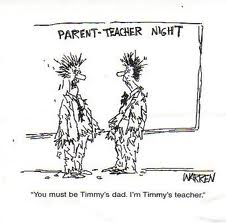
However, it's not all serious: there are cartoons to lift the spirits (like the one below) and stories of buying supplies or gifts for students during one's grocery shopping. All of these morsels of humour and hope are a drip-feed to get teachers through the next day, week, month or year - and that is a valuable thing in what can be a stressful profession.
But ultimately, Teacher Tales makes the reader remember that teaching is more rewarding than stressful. As teachers read this book, they will remember their own embarrassing moments, best students, worst students, field trips, best and worst teachers, assignments from students that they've almost wanted to pin on their own fridge, and in the end, the greatest learning curve they've ever been on.

For a full list of Chicken Soup for the Soul titles, see the official website.
There’s always that one special teacher or student, and Chicken Soup for the Soul: Teacher Tales regales all educators with its heartfelt, inspiring, and humorous stories from inside and outside the classroom. Stories from teachers and students about their favorite memories, lasting lessons, and unforgettable moments will uplift and encourage any teacher. A foreword by Anthony Mullen, 2009 National Teacher of the Year, and stories from all the 2009 State Teachers of the Year. - See more at: http://books.simonandschuster.com/Chicken-Soup-for-the-Soul-Teacher-Tales/Jack-Canfield/9781935096474#sthash.bC8EbLOU.dpuf