Showing posts with label italian literature. Show all posts

Saturday, 23 February 2013

The Flying Creatures of Fra Angelico (Antonio Tabucchi)

--The blurb--
"The reader meets a flying creature of ambiguous species in a priest's vegetable garden, and a revolutionary who is told her incredible future by Mademoiselle Lenormand, a fortune teller from the shadow world." 

--The review--
With the popularity of artists such as Laura Pausini, Eiffel 65 and Andrea Bocelli, and the success of Italian films such as Scialla!, it seems only naturally that the English-speaking public should also be interested in contemporary literature by Italian authors (Dario Fo and Umberto Eco are just two Italian writers who are still alive and still popular today, and whose works are already considered classics). So how does Antonio Tabucchi, who died in 2012, measure up to these greats?

Tabucchi was a prolific writer and academic who published 31 works between 1975 and 2011, including the greatly-lauded Indian Nocturne. Expectations are therefore great. Specifically, what of his 1987 collection of short stories, The Flying Creatures of Fra Angelico? 

There are certainly elements that are worthy of applause. Tabucchi was clearly wildly imaginative and a talented creator of beautiful description. The story entitled Messages From The Shadows is perhaps the best example of this, proving mysterious, elegant and poetic. The Flying Creatures of Fra Angelico, which is the first story in the collection, is eminently readable and should appeal broadly.

However, there were several problems, which can be attributed respectively to the writer, the translator, and those responsible for formatting this book for Kindle.

Several aspects of the story were unsatisfying, thanks to various instances of unsophisticated syntax, abrupt endings, undeveloped plotlines, telling rather than showing, pretention, narcissism, poor punctuation, awkward phrasing, and a general lack of clarity, precision and direction. However, due to reading The Flying Creatures of Fra Angelico in translation, it is not necessarily possible to tell whether this is the fault of Tabucchi himself, or his translator (in this case, Tim Parks, who has been nominated for the Booker Prize twice for his own works of fiction). For this reason, I would not completely discount reading other works by Tabucchi if translated by others.

Formatting problems for the Kindle edition of the text were equally bothersome: paragraphing was destroyed by random gaps and lines were interspersed with odd sequences of unrelated text and symbols. Equally, instinct tells the reader that pictures are supposed to accompany and thus enhance the text; none of these images were, however, visible in the text's Kindle edition. This is a great shame, as given that the collection's title is so heavily rooted in art, it is almost certain that the inclusion of images would greatly supplement the stories.

So while perhaps Tabucchi does not reach the dizzying heights of Fo and Eco in the annals of 20th-century literature with The Flying Creatures of Fra Angelico, this one work alone is not reason enough to discard his oeuvre completely. Perhaps instead seek out Pereira Maintains, which won Tabucchi the Viareggio Prize in 1994 - a prize also accorded to another Italian great, Primo Levi.

Saturday, 31 July 2010

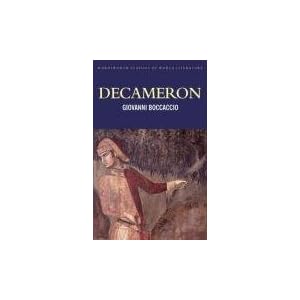
The Decameron (Giovanni Boccaccio)

--The blurb--
"1348. The Black Death is sweeping through Europe. In Florence, the plague has carried off one hundred thousand people. In their Tuscan villas, seven young women and three young men tell tales to recreate the world they have lost, weaving a rich tapestry of comedy, tragedy, ribaldry and farce."

--The review--
At around 700 pages, modern readers often expect an unreadable epic that is trapped in the past in which it was created. What you are treated to with The Decameron, however, is a relatively accessible collection of one hundred short stories, which can be enjoyed at your leisure and in a similar manner to Bible stories (mostly minus the preaching): anybody expecting something boring is proved wrong with the collection of thoroughly engaging thrills, chills and spills.

The project is an obviously ambitious undertaking, and it would be unreasonable to expect something of this magnitude to succeed entirely. For one thing, it is impossible, even having read all of the short stories, to remember the details of each and every one. Some of the longer stories also fail to hold the reader's interest: this is not necessarily because they are long (Boccaccio himself, at the end of the short stories, defends in his conclusion the inclusion of the longer stories by simply saying "well, if you had anything better to do, you wouldn't be reading any of these stories at all - long OR short", which seems fair enough) but because they are tedious. By their nature, the shorter stories are snappier and more concise, and in any case, even if all of the stories were of exactly the same length, it would be difficult for any author to sustain their prowess equally across such a large number of stories.

Content-wise, some of the stories can also become repetitive: the vast majority involve adultery of some kind, and the confusion of lust for love by our naive Italian forefathers. Lust and love are treated interchangeably and for the modern reader this can become wearying or frustrating. However, Boccaccio is an absolute master of the witty comeback and most of the stories are not boring at all. The predecessor of Keats' poem Isabella, or the Pot of Basil, was very illuminating to read in its original prose form, and the very first story of the collection, about a saint whose behaviour was so appalling that he should never have really been one in the first place, carries many fascinating implications about the foundations of religion.

Even though the stories are not always beautifully or tersely written, quite often Boccaccio's surrounding descriptions are, and the structure of smaller stories within a larger framework is refreshing and accessible, even if we do not really get to know the storytellers themselves very well at all (they are portrayed as mere vessels for the stories, which are the real stars of the show). The breadth and detail of content means this is a collection that readers can return to over and over again; it is easy to see how the process of getting to know the stories one by one could become a real pleasure.

Other works by Giovanni Boccaccio
The Crow (c.1365)
On Famous Women (c.1375)
The Elegy of Lady Fiammetta (c.1343)
The Filocolo (c.1336)
The Filostrato (c.1340)
Teseida (c.1341)
On The Fates of Famous Men (c.1355)