Showing posts with label modern fiction. Show all posts

Saturday, 16 March 2013

The Best Exotic Marigold Hotel (Deborah Moggach)

--The blurb--
"Enticed by advertisements for a newly restored palatial hotel and filled with visions of a life of leisure, good weather and mango juice in their gin, a group of very different people leave England to begin a new life in India. On arrival they are dismayed to find the palace is a shell of its former self, the staff more than a little eccentric, and the days of the Raj long gone. But, as they soon discover, life and love can begin again, even in the most unexpected circumstances."

--The review--
Film tie-ins are rarely going to have a negative effect on the reception of an author's work, but equally rarely does it raise awareness, as many of the films that are spawned by books are by authors that are already well-known. Think of recent releases: The Life of Pi, Cloud Atlas, Les Misérables, Anna Karenina and The Great Gatsby are all by established authors whose canon (whether in whole or in part) is considered classic. However, one hopes that the 2012 release of The Best Exotic Marigold Hotel will have significantly boosted the profile of writer Deborah Moggach, whose novel-publishing history in fact stretches back more than thirty years.

If done well, the film should have encapsulated Deborah Moggach's engaging plot successfully, as well as managing to recreate the unforgettable characters with which it is peopled. Novels tend to focus on the young, whereas Moggach has chosen to zoom in on a group of old folks whose families are trying desperately (for various reasons) to send them off to the nearest retirement home. Such an approach perhaps risked being stuffy or predictable, but in the author's capable hands there was not only chemistry between the group (and sparks flying between individuals) but fiery personalities to keep readers amused when characters were alone. Varying degrees of intellect and likeability help, too, to create a realistic cast. This is followed up right the way through their lives' outcomes: the fact that not all of the pensioners sail off into the sunset is also a true reflection of what we can expect in real life.

Juxtaposed with this dose of reality is the idyllic setting of India, where much is made of the awe-inspiring sunsets, distinctive streets, tourist attractions and unique bazaars. However, even here Moggach does not pull any punches, equally taking the opportunity to highlight India's problems of poverty and access to education and health services. Nonetheless, in doing so, she does not make her novel into a deliberate polemic: her commentary on Indian society does not go into detail and as such, is no more than another part of her story's patchwork, which also incorporates poignancy, a thrusting plot, and great humour.

Humour is the main characteristic of The Best Exotic Marigold Hotel, and even if at times we can see where the jokes are going, this does not in the end make them any less amusing. A secondary, but also important, feature is the book's revelatory nature: not only does Moggach carefully control what we learn about her characters and when we learn it, but she also keeps them on an equally tight leash, only letting them realise new things about themselves at meticulously chosen moments. This, too, leads to the reader's own realisations: not just about their own attitudes to their elderly relatives, but also about what we would like for ourselves when we become old.

The book's original title, These Foolish Things, is an interesting extra dimension to the novel, as throughout the characters' attempts to grasp their new surroundings and whether or not they have been satisfied with their long lives, there is a persistent theme of them firstly hanging doggedly onto objects that we might consider frivolous, which is a way of distracting them from or enabling them to cope with their various states of desperation; and secondly, wondering if they are worrying over nothing. Thirdly, the book's original title could have ironic undertones: things, people or decisions in our lives that we could consider foolish or unimportant can actually turn out to be very important indeed with the hindsight that old age provides.

Readers will therefore be left with a sense of satisfaction and enlightenment, and a feeling that they have been entertained by high-class writing. Moggach's powers of description, momentum, character-building and humour are not to be ignored, and whether you have read The Best Exotic Marigold Hotel, or seen the film, or both, it will surely spur you on to investigate the rest of her work.

other novels by Deborah Moggach
You Must Be Sisters (1978)
Close to Home (1979)
A Quiet Drink (1980)
Hot Water Man (1982)
Porky (1983)
To Have and to Hold (1986)
Driving in the Dark (1988)
Stolen (1990)
The Stand-In (1991)
Ex-Wives (1993)
Seesaw (1996)
Close Relations (1997)
Tulip Fever (1999)
Final Demand (2001)
In The Dark (2007)
Heartbreak Hotel (2013)  

Saturday, 23 February 2013

The Flying Creatures of Fra Angelico (Antonio Tabucchi)

--The blurb--
"The reader meets a flying creature of ambiguous species in a priest's vegetable garden, and a revolutionary who is told her incredible future by Mademoiselle Lenormand, a fortune teller from the shadow world." 

--The review--
With the popularity of artists such as Laura Pausini, Eiffel 65 and Andrea Bocelli, and the success of Italian films such as Scialla!, it seems only naturally that the English-speaking public should also be interested in contemporary literature by Italian authors (Dario Fo and Umberto Eco are just two Italian writers who are still alive and still popular today, and whose works are already considered classics). So how does Antonio Tabucchi, who died in 2012, measure up to these greats?

Tabucchi was a prolific writer and academic who published 31 works between 1975 and 2011, including the greatly-lauded Indian Nocturne. Expectations are therefore great. Specifically, what of his 1987 collection of short stories, The Flying Creatures of Fra Angelico? 

There are certainly elements that are worthy of applause. Tabucchi was clearly wildly imaginative and a talented creator of beautiful description. The story entitled Messages From The Shadows is perhaps the best example of this, proving mysterious, elegant and poetic. The Flying Creatures of Fra Angelico, which is the first story in the collection, is eminently readable and should appeal broadly.

However, there were several problems, which can be attributed respectively to the writer, the translator, and those responsible for formatting this book for Kindle.

Several aspects of the story were unsatisfying, thanks to various instances of unsophisticated syntax, abrupt endings, undeveloped plotlines, telling rather than showing, pretention, narcissism, poor punctuation, awkward phrasing, and a general lack of clarity, precision and direction. However, due to reading The Flying Creatures of Fra Angelico in translation, it is not necessarily possible to tell whether this is the fault of Tabucchi himself, or his translator (in this case, Tim Parks, who has been nominated for the Booker Prize twice for his own works of fiction). For this reason, I would not completely discount reading other works by Tabucchi if translated by others.

Formatting problems for the Kindle edition of the text were equally bothersome: paragraphing was destroyed by random gaps and lines were interspersed with odd sequences of unrelated text and symbols. Equally, instinct tells the reader that pictures are supposed to accompany and thus enhance the text; none of these images were, however, visible in the text's Kindle edition. This is a great shame, as given that the collection's title is so heavily rooted in art, it is almost certain that the inclusion of images would greatly supplement the stories.

So while perhaps Tabucchi does not reach the dizzying heights of Fo and Eco in the annals of 20th-century literature with The Flying Creatures of Fra Angelico, this one work alone is not reason enough to discard his oeuvre completely. Perhaps instead seek out Pereira Maintains, which won Tabucchi the Viareggio Prize in 1994 - a prize also accorded to another Italian great, Primo Levi.

Tuesday, 15 January 2013

The Help (Kathryn Stockett)

--The blurb--
"Amidst the turbulence of the Civil Rights movement, three Mississippi women quietly start their own revolution with a book, some toilets and a chocolate pie. Enter a vanished and unjust world: Jackson, Mississippi, 1962. Where black maids raise white children, but aren't trusted not to steal the silver...There's Aibileen, raising her seventeenth white child and nursing the hurt caused by her own son's tragic death; Minny, whose cooking is nearly as sassy as her tongue; and white Miss Skeeter, home from College, who wants to know why her beloved maid has disappeared. Skeeter, Aibileen and Minny. No one would believe they'd be friends; fewer still would tolerate it. But as each woman finds the courage to cross boundaries, they come to depend and rely upon one another. Each is in a search of a truth. And together they have an extraordinary story to tell..."

--The review--
Given that the highly successful The Help was published in 2009, it would appear that there are still some readers who are a little late to the party (including this writer). However, latecomers should not delay further - Kathryn Stockett's début novel deserves immediate attention. Even if you read nothing else in 2013, make this vibrant and moving opus a priority.

The novel's frequent changes in narrator could be confusing or frustrating, but instead serve to keep up the novel's pace and heighten tension in a positive way. Stockett's mastery of dialect, humour and malapropism is evident from the first pages, and this also keeps the reader hooked. It's perhaps inevitable that such dexterity is not consistently sustainable throughout the book: its weaknesses are that Mae Mobley sometimes speaks with far more perspicacity than is realistic for a three-year-old, that the friendship that purportedly existed between Hilly and Skeeter is insufficiently developed, and that the chapter on the Benefit is redundant (as its happenings could have been told just as easily in half the space through other characters' direct and overheard speech). However, this ultimately does not detract from enjoyment of The Help overall.

Stockett generally controls and develops the relationships in the novel effectively, reinforcing the bonds between Skeeter and Aibileen so that they go from strangers to friends in a realistic and heart-warming manner. As third protagonist Minny is drawn in, and their plans become even more intricate, the reader too becomes increasingly involved, making the unfolding of the trio's story addictive. All characters, without exception, are vivid and human, as well as taking on multiple dimensions so that no one group or person is clearly designated as hero or villain. 

Setting, lifestyle and history is also deeply ingrained in the story-telling, meaning that from Stuart's Confederate shrine of a home to the iced tea and grits prepared lovingly by Aibileen, the reader is left with a more developed understanding of the culture and circumstances in which the plot of The Help is enshrined. It's possible that the ending is a little rushed; however, by this stage readers feel so engaged in the characters' cause that the denouement is simply able to wash over them. The endings to each character's tale provoke mixed emotions, but are wholly appropriate after all that has gone on. The fruits of Stockett's meticulous research are well worth her efforts as readers shut the book with a sense of significance, satisfaction, and the desire to immediately reread (while waiting, of course, for Stockett's next book).

Sunday, 13 January 2013

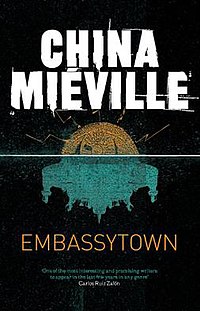
Embassytown (China Miéville)

--The blurb--
"Embassytown: a city of contradictions on the outskirts of the universe. Avice is an immerser, a traveller on the immer, the sea of space and time below the everyday, now returned to her birth planet. Here on Arieka, humans are not the only intelligent life, and Avice has a rare bond with the natives, the enigmatic Hosts - who cannot lie. Only a tiny cadre of unique human Ambassadors can speak Language, and connect the two communities. But an unimaginable new arrival has come to Embassytown. And when this Ambassador speaks, everything changes. Catastrophe looms. Avice knows the only hope is for her to speak directly to the alien Hosts. And that is impossible."

--The review--
Dystopian literature has a strong history, and any newcomer on the scene has a hard nut to crack. However, with positive coverage in several high-quality publications such as the Financial Times, China Miéville's Embassytown, published in 2011, is doing a great deal to bring this writer to the fore: Miéville's reputation has been building up gradually, with his first novel being published in the year 1998. The Guardian even went as far as to aver that Embassytown would be nominated for the Booker Prize. So how far does this novel contend with established dystopian classics such as The Handmaid's Tale, The Time Machine, and Brave New World?

All of the initial signs are promising, with Miéville raising questions from the book's very first moments. What is the embassy of the title? Who are the shiftparents? What is the voidcraft and the Arrival Ball? What is the edge? Confusing yet enthralling, Embassytown is packed with fantastical and charming oddities, such as string septets. Imaginative, rich, and full of possibilities for future rereads, Miéville cleverly combines intriguing new aspects with hints of familiarity: the "thumb-sized vespcams hunting for images to transmit" without doubt carry echoes of the surveillance society in which some people argue that we live today. To begin with, the novel is poetic yet lucid; we are lulled by the author's clever use of alliteration, and simultaneously unsettled by the content. Continued questions make us keep reading; we want to know why communication will be difficult for the principal characters, and what the meanings of Miéville's foreboding neologisms (miab, yawl...) could be. The language of the ambassadors and hosts also proves a masterful creation that ultimately constitutes one of the novel's highlights.

However, as time goes on Miéville fails to build on the aspects of society that we already find familiar. One of the hallmarks of good science fiction is the writer's ability to build on the reader's fear that one day this could be their world; however, Miéville focuses more on the realm of fantasy, and many of the bizarre constructions and the characteristics of the people that make up Embassytown go unexplained. Even though characters and situations are developed, readers are left with too many crucial questions unanswered for these to be fully effective or moving. This is not usually a characteristic of well-written science fiction; it is possible, however, that readers who are better versed in reading a wider range of science fiction will benefit more from Embassytown and be better able to read between the lines.

While the author could have the chance to take his place in the dystopian fiction hall of fame, Embassytown would need far greater clarity for this to occur (which could be resolved if Miéville slackened his writing pace, as he currently seems to publish novels relatively frequently). However, the earlier comment about rereads still stands; the novel is so rich in detail and ambition that it's possible that readers' questions may be answered upon further inspection.

other novels by China Miéville
King Rat (1998)
Perdido Street Station (2000)
The Tain (2002)
The Scar (2002)
Iron Council (2004)
Un Lun Dun (2007)
The City and The City (2009)
Kraken (2010)
Railsea (2012)

Sunday, 19 February 2012

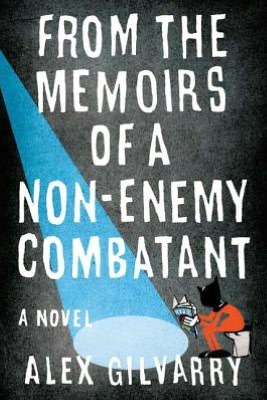
From The Memoirs of a Non-Enemy Combatant (Alex Gilvarry)

--The blurb--
"Boyet Hernandez is a small man with a big American dream when he arrives in New York in 2002, fresh out of design school in Manila. With dubious financing and visions of Fashion Week runways, he sets up shop in a Brooklyn toothpick factory, pursuing his goals with monkish devotion (distractions of a voluptuous undergrad not withstanding). But mere weeks after a high-end retail order promises to catapult his (B)oy label to the big time, there's a knock on the door in the middle of the night: the flamboyant ex-Catholic Boyet is brought to Gitmo, handed a Koran, and locked away indefinitely on suspicion of being linked to a terrorist plot. Now, from his 6' x 8' cell, Boy prepares for the trial of his life with this intimate confession, even as his belief in American justice begins to erode."

--The review--
With the recent passing of 9/11's 10th anniversary, it's only natural that there should be an even greater resurgence of literature on this theme than ever before as the memories of that day are freshened for all. Alex Gilvarry's attempt is a slightly off-the-wall, behind-the-scenes view of the paranoia of post-9/11, this time through the eyes of a so-called terrorist, who Gilvarry wants us to believe is an innocent man, bringing into question our belief and trust in the governments that preside over us.

Part first-person memoir, part third-person biography, it's therefore not dissimilar in this respect to the other hybrid text I read recently, the definitely non-fictional Along The Cherry Lane. While characters in From The Memoirs of a Non-Enemy Combatant are strong, there is another respect in which it differs from Along The Cherry Lane: even though we are presumably supposed to sympathise with and warm to Boyet Hernandez (or Boy, as he is frequently referred to), it is difficult to do this given his sheer naïveté in associating with such clearly dodgy characters. The characters therefore do not appeal to us in the way that they are perhaps intended to, and some (like the Russian models Boy uses for his shows) are apparently supposed to be funny (or at least, I didn't find the novel as amusing as several other readers and reviewers apparently did - but I suppose it's all a matter of taste), but are far too caricatured for us to truly be able to engage with them. If the writer was trying to be satirical, in this respect I don't believe him to have been successful.

However, there is certainly one very intriguing aspect of the style: even though not fully appropriate for a 'confession' (as it's often referred to), factual 'mistakes' made by the clearly very human Boy are corrected by the author/narrator through footnotes, and his trial is also chronicled through the footnotes in the repeated references to articles in various high-profile newspapers on the subject, complete with dates. Even though we know it is not a true story (a quick Google search reveals this; in addition, I was amused to find that there are real people named Boyet Hernandez), this meticulous set-up and attention to detail almost makes us think it could be - and that if this story were true, what other details in the novel could also be true (particularly in relation to the treatment of prisoners and the bureaucracy of the American justice system).

This unusual novel lingers in a strange way, despite its flaws. Is it clever? Yes. Is it witty? To my mind, not really. But if there is one thing that Alex Gilvarry is not, it's an imitator. Having never read any book like this before in its subject matter and style makes me feel like this is an entry onto the scene of a truly intriguing new literary talent.

Thursday, 18 August 2011

A Week in December (Sebastian Faulks)

--The blurb--
"Over seven days we follow the lives of seven major characters: a hedge-fund manager trying to bring off the biggest trade of his career; a professional footballer recently arrived from Poland; a young lawyer with little work and too much time to speculate; a student who has been led astray by Islamist theory; a hack book-reviewer; a schoolboy hooked on skunk and reality TV; and a Tube driver whose Circle Line train joins these and countless other lives together in a daily loop. The writing on the wall appears in letters ten feet high, but the characters refuse to see it - and party on as though tomorrow is a dream."

--The review--
Having enjoyed Sebastian Faulks' previous historical works, I had believed that there would be no reason why I would not also gain pleasure from reading his next snapshot of (albeit modern) history. It was therefore of great disappointment to me that in this novel, there appears to have been the same decline in quality as I am also starting to see in the works of other authors of a similar generation.
I'm still not sure where this decline has come from. Is it born of a desire to be 'cool'? Or 'edgy'? Or 'political'? Or is it just laziness? By using surroundings and products by name with which readers are already so familiar, you cut out the middle man: the need for description. If the reader already knows what you're talking about, you don't need to describe, and there is a nasty hackneyed side effect too. Even if you try to replace some of these 'brand names' with made-up conflations, as Faulks tries to do (e.g. 'YourPlace' for a certain social networking site), we as readers get the feeling that he is trying too hard, and yet not hard enough at the same time, and that some of the richness that we seek to find in literature is therefore lost. It's hardly the savage social satire that it is deemed to be on the book's back cover. Thankfully (in a way), it seems that Amazon reviewers agree with me: today the average review score (aggregated on the basis of 199 reviews) is a mere 2.5 out of 5, and of those 199 reviews, a whopping 124 give it 3 stars or below. In short, the whole thing is mediocre at best.

There are several reasons for this. Firstly, it is my view that some distance is required before trying to pass comment on the times in which people live. The fullness of items of historical or cultural significance simply cannot be known yet, and in his hastiness, I feel that Faulks gives too many aspects of life in the 2000s undue importance (we will know in ten years or so, I suppose, who is right). Secondly, several characters are only drawn very sketchily, so that we do not empathise nearly enough with them, even though they are supposed to be main characters. This stretches to aspects of their day-to-day existence as well: we do not know anything like enough about Finn's obsession with reality TV show It's Madness, or of Jenni's deep interest in Second Life-style program Parallax, or of their effects on the characters, to understand and care enough about them (and subsequently the plot) ourselves. 

Other facets of the story are given far too much emphasis, such as the hedge-fund manager's scheme and the blossoming romance between two of the protagonists. These two latter personages are just so mismatched that even though we are given plenty of detail about the development of the relationship, we still don't believe in it; the trade engaged in by John Veals again, is given too much attention, to the point where readers who have little to no interest in or understanding of finance that they are unlikely to be galvanised into reading on (I just skipped these pages). The hack book-reviewer is more interesting but is not given enough page time (nor is Adam, the lawyer's brother), and the only character developed proportionately is the student led astray by Islamism, and his family. 

Is all of this because Faulks has tried to do too much? Certainly the link between all of them and Jenni's Circle Line train is nowhere near explicit enough to give the novel a coherent narrative architecture, leading to something of a patchwork effect. There are some links made between the characters, but they are vague and few, and lack the main link that is suggested in the blurb. The overriding conclusion is therefore that Faulks has failed, in spectacular style, to achieve what he had set out to do. It is a shame, to me, that writers seem to be increasingly thinking that you can't be doing the world of literature any good these days unless you're talking about 9/11, or lambasting bankers, or dropping in a veiled reference to Facebook (or preferably all three). Too many of the storylines are just left to fade out unresolved, compounding the disappointment felt by the reader in the quality of the novel.

It is to be hoped, then, that Faulks will have got back to the drawing board - and seriously - in order to redeem himself for the next release. 

Other works by Sebastian Faulks
A Trick Of The Light (1984)
The Girl at the Lion D'Or (1989)
A Fool's Alphabet (1992)
Birdsong (1993)
The Fatal Englishman (1996)
Charlotte Gray (1998)
On Green Dolphin Street (2001)
Human Traces (2005)
Pistache (2006)
Engleby (2007)
Devil May Care (2008)

Saturday, 2 April 2011

The Terrible Privacy of Maxwell Sim (Jonathan Coe)

--The blurb--
"Maxwell Sim can't make a meaningful connection. His absent father is preoccupied with poetry; he maintains an e-mail correspondence with his estranged wife under a false identity; his daughter prefers her BlackBerry to his conversation; and his best friend won't return his calls. He has seventy friends on Facebook, but nobody to talk to. Max tries to stir himself out of this rut by quitting his job to accept a strange business proposition: to drive a Prius full of toothbrushes from London to the remote Shetland Islands in a misguided promotional campaign for a dental-hygiene company. Instead, he makes a series of awkward, cruelly enlightening visits to figures from his past, falling in love with the soothing voice of his GPS system ('Emma' ) en route. Eventually he comes to wonder if perhaps it's his utter lack of self-knowledge that's hampering his ability to form actual relationships."

--The review--
Having read Jonathan Coe's works avidly for the past ten years or so, it would perhaps be fair to say that by this time my expectations were almost unreasonably high, after unequivocally enjoying every one of his books that I had read and often visiting many for rereads and never tiring of their narrative twists and turns and character developments.

So if I was disappointed by The Terrible Privacy Of Maxwell Sim it was perhaps not entirely unexpected. The main character grated on my nerves in a manner that Coe's protagonists had not done in his previous works. Worse still, this did not even have the pleasant side effect of entertaining me. Compounding this was the "product placement" that I talked to Coe about in my recent interview with him; to me, it is lazy writing that limits the reader's own visualisation - something that I did not imagine Coe being guilty of. As a consequence, I believe that the novel will date more quickly than his previous ones - he is writing about a time period in which we still live, which has not yet passed, and so which cannot yet take on the feel of nostalgia that, for instance, The Rotters' Club has: it is difficult to know what, ten years from now, we will look back on with fondness, and what, in our minds, will just seem tired or insignificant.

However, The Terrible Privacy Of Maxwell Sim is not without its merits. In spite of the aspects of it that made me cringe, we do wonder how all of the novel's seemingly different components will eventually link up, and Coe guides us successfully to the conclusion of these. His portrayal of the protagonist's descent into insanity is also far more convincing than others who have tried similar tricks recently (yes, Alastair Campbell, I'm looking at you), and it shows with dexterity how easily we can all find ourselves getting into a rut if we are not careful. The novel's investigation of loneliness and privacy is also an intriguing one (even if I, unlike Coe, believe that this could have been achieved without the "product placement" effect), and the fact that at the end of the novel Maxwell's own personal, spiritual journey to find his own sense of self-worth is in fact only just beginning is a realistic and moving resolution; to have him waltz off into the sunset with the illusion that life just works out magically would not have been anywhere near as satisfying. Having such an imperfect narrator at the novel's forefront is almost like holding a mirror up to ourselves, showing us all of our own flaws, and prompts us to ask ourselves how we too can move forward with our lives on our individual quest to vanquish various insecurities. The style in which this is all expressed may not be to everybody's taste, but the message is powerful and bound to reach out to the majority of people in some way that they can easily identify with personally.

The end of the novel is curious, as it serves as a criticism of itself and of the genre of novel-writing in general. While I can see why Coe included it, it is ultimately unnecessary: by the end of the novel, the flaws of it have faded into the background and we are left with the complexities of the plot and of Maxwell's character. We do not need the author to step in at this stage; his craft has already done its work, and it is these intricacies and layers and faults inherent in the novel that perhaps make it one of Coe's most intriguing brainchildren: while his other books are straightforward to the point of becoming instantly-loved and often-reread modern classics, this almost demands to be reread not to be wholly enjoyed but to be unravelled so that we as readers may engage not only in the uncomfortable journey of Maxwell Sim but also in our own distinctly awkward voyages into the centres of ourselves.

Other works by Jonathan Coe
The Accidental Woman (1987)
A Touch of Love (1989)
The Dwarves of Death (1990)
What A Carve Up! (1994)
The House of Sleep (1997)
The Rotters' Club (2001)
The Closed Circle (2004)
The Rain Before It Falls (2007)

Wednesday, 11 August 2010

Middlesex (Jeffrey Eugenides)

--The blurb--
"In the spring of 1974, Calliope Stephanides, a student at a girls' school in Grosse Pointe, finds herself drawn to a chain-smoking, strawberry-blond classmate with a gift for acting. The passion that furtively develops between them leads Callie to suspect that she is not like other girls. In fact, Cal has inherited a rare genetic mutation. The biological trace of a guilty secret, this gene has followed her grandparents from the crumbling Ottoman Empire to Detroit and has outlasted the glory days of the Motor City, the race riots of 1967, and the family's second migration, into the foreign country known as suburbia. Thanks to the gene, Cal is part girl, part boy. And even though the gene's epic travels have ended, her own odyssey has only begun."

--The review--
When Homer Simpson decides, in yet another new line of work, to get a fake qualification online that allows him to conduct marriage ceremonies, quite a few people step up to tie the knot under his dubious jurisdiction. One of these couples is composed of Brandine and Cletus, a recurring hick-town couple in the show. Just as Homer is about to pronounce them man and wife, he suddenly stops and says "Hey, are you two brother and sister?!", to which the couple gaily reply, "We's all kinds of things!"

It is this premise of incest, and the disastrous chain of events that it can provoke, that provides the basis of Eugenides' second novel, Middlesex. Even though the novel's approach can seem slightly contrived in places, it is mostly believable, with the author assuming the female voice very successfully. Epic in its scope, the novel is not only detailed in its plot construction and scientific research, but also gives the reader a sweeping panoramic view of twentieth-century American history. This ambition could easily leave the reader lost, but Eugenides not only traverses the different generations and time periods with ease but does well, too, in making the novel accessible as well as unusual. Writing the novel chiefly from Callie's point of view, Eugenides occasionally slips into a more omniscient tone than might be considered appropriate, and yet in conjunction with the resolution of the novel, it does end up seeming appropriate after all.

In spite of the novel's length, and the author's sophisticated use of vocabulary, it has all the momentum of a runaway freight train, compelling the reader to read on. The characters are highly human and the spanning across three generations is something that I believe to have been influenced by Zadie Smith's White Teeth. It is possible, too, that Charlie Anders drew a little inspiration in Choir Boy from the relationships that Eugenides depicts. However, one aspect of the characterisation that will be lost on the vast majority of readers is the naming of protagonist Callie's brother only as Chapter Eleven, which is an obscure political reference that I had to look up in order for it to be explained. Even if it does hold some minor element of foreshadowing, this ultimately does not enhance the story in any way, and hinders rather than helps the reader.

Colm Toibin's introduction to the novel also does not help the reader in any meaningful way: to my mind, introductions to novels should help to explain to the reader or shed further light on issues arising in the novel. Toibin's introduction, however, is more of a book review in itself, and while admittedly it is a good one, his opinion is the sole focus, and this for me has no place in an introduction (or at least very little). In any case, Eugenides' work speaks for itself, with him handling the transition between scenes with dexterity and ease. Particularly interesting is the non-chronological order in which the story is told, which leads to increasing curiosity on the reader's part not only about how Callie has got to the present day but also about Callie's burgeoning relationship with Julie. The last we see of Callie and Julie is when Callie is just about to tell Julie about her past, and even though we don't get to see Julie's reaction, this feels right: we feel as if we ought to creep away quietly and let them get on with it in private.

The novel is neither wholly a sentimental family saga nor wholly an academic treatise on gender versus sex; its blend of various genres and topics makes it more significant than this, particularly as attitudes to sexuality and gender become more open and understood, especially in relation to the recent case of Caster Semenya. In trying to alert people to and inform people about the subject of hermaphrodism and intersexuality, Eugenides certainly succeeds. As previously mentioned, it also serves as a microcosm of American history over the past century, and also incorporates James Bond-style elements, such as car chases and dodgy deals. The reader is left beyond satisfied in virtually all respects, this highly influential work deserving a place on every modern bookshelf.

Monday, 8 March 2010

White Teeth (Zadie Smith)

--The blurb--
"One of the most talked about fictional débuts of recent years, WHITE TEETH is a funny, generous, big-hearted novel, adored by critics and readers alike. Dealing - among many other things - with friendship, love, war, three cultures and three families over three generations, one brown mouse, and the tricky way the past has of coming back and biting you on the ankle, it is a life-affirming, riotous must-read of a book."

--The review--
When a book is so densely surrounded by hyperbole, it is easy to become quickly cynical (partly, perhaps, a form of self-protection: we don't want to believe the hype in case we are disappointed), particularly when the author's youth is so publicly lauded as part of it. Is the book being praised just because of its prodigious origins? Or is the buzz that has been generated accurate?

Happily, in the case of White Teeth, its various compliments and accolades are entirely deserved. As well as being engaging and colourful, its characters are well-drawn and very human, and the novel is interspersed with appropriate humour while simultaneously remaining true to what seems to be, ostensibly, its original purpose without being didactic: the idea that we cannot escape our heritage and our past. Smith effectively combines the notions that we can take control of our own lives and that we are at the same time tethered to a loosely defined destiny that is owned by our personal history. The old "nature versus nurture" chestnut is thus rehoused in an innovative way, and Smith's talents are successfully manifested.

Many different cultures are united in this novel, without it seeming contrived, and the result is a realistic yet positive boost in the name of multicultural Britain (but again, Smith manages to achieve this without seeming preachy). The slightly unresolved nature of the ending is also appropriate, and we find out later the origins of the novel's title and the way in which this successfully encapsulates the gaps and similarities between modern Britain's various cultures, as well as (perhaps) the aspirations of those who come to Britain seeking something better.

If there is any criticism to be found here, it's that the jumping back and forth between different time periods can be a little overwhelming, even though this ultimately serves a useful purpose. The novel is an ambitious project and rereadings are therefore merited in order to get a fuller sense of it. However, the accomplishment held between these pages is not invisible even on first reading, and even though I never was keen on the idea of Smith's parody of EM Forster as her second novel, I would perhaps be keener to read more of her work now; the girl done good.

Other works by Zadie Smith
The Autograph Man (2002)
On Beauty (2005)

Thursday, 19 November 2009

A Long Way Down (Nick Hornby)

--The blurb--
"Narrated in turns by a dowdy, middle-aged woman, a half-crazed adolescent, a disgraced breakfast TV presenter and an American rock star cum pizza delivery boy, A Long Way Down is the story of the Toppers House Four, aka Maureen, Jess, Martin and JJ. A low-rent crowd with absolutely nothing in common - save where they end up that New Year's Eve night. And what they do next, of course. Funny, sad, and wonderfully humane, Nick Hornby's new novel asks some of the big questions: about life and death, strangers and friendship, love and pain, and whether a slice of pizza can really see you through a long, dark night of the soul."

--The review--
The downside of the writers' maxim "write what you know" is that this causes some writers to be guilty of monotony. Nick Hornby is not one of these - while similar characters may occasionally reappear, the situations in which they find themselves are so wildly diverse that this is soon forgotten. In A Long Way Down, Hornby also throws together an almost completely random cast, too, and kicks off in medias res, so that the reader's main goal is to work out how this kaleidoscope of characters all ended up in the same place, with the same aim, at the same time.

This in itself is immediately attention-grabbing, as is the darkly awkward backdrop against which it's set. Hornby takes a risk with grouping four people on the roof of a tall building with the same shared purpose of committing suicide, as it initially seems to the reader that there's only one way this could go: presumably they cannot actually go through with their aim, or there would be no book. Indeed, the answer to this question is repeatedly deferred, but the deferral is not irritating: it allows us to find out more about the characters, reach a conclusion that is (arguably) more appropriate than the obvious, and carry out a stark assessment of the ways in which we view the problems of others. There is superficiality in droves, but in spite of this, all of the characters seem equally seriously trapped, and it is easy for us to see how they might believe that this is the only way out.

Subsidiary characters are also well-developed - even those whom we actually never meet, such as Jess' sister Jen. They are all accorded the required level of importance to make the novel an effective one, and it is perhaps this that contributes to the resolutions that occur at the novel's end (resolutions which, it should be mentioned, do their job well without everyone necessarily sailing off into the sunset). The novel is unconventional, so it's worth going in with patience and an open mind. It is different to Hornby's previous work; instinct tells me that it is perhaps also not as good, though perhaps only rereadings will be able to confirm that. It was certainly a gamble for Hornby, who could easily stay in the romantic comedy genre for the entirety of his career (or even not write again at all should he so wish), but maybe it is only through such risky bets that real winners emerge.

Other works by Nick Hornby
High Fidelity (1995)
About A Boy (1998)
How To Be Good (2001)
Slam (2007)
Juliet, Naked (2009)

Saturday, 31 October 2009

A Short History of Tractors in Ukrainian (Marina Lewycka)

--The blurb--
"Two years after his wife dies, Nikolai, a Ukrainian who migrated to London after the Second World War, meets and falls for Valentina, a fellow Ukrainian who is nearly 50 years his junior. His daughters, Vera and Nadia, who have had a poor relationship with each other since their mother died, suspect Valentina of being after Nikolai’s money and of wanting a way to ensure that she and her son can remain in the West. Valentina is brash and manipulative, but she unites the previously feuding Vera and Nadia in their desire to have her removed back home. As a result of their renewed contact with each other, Nadia learns of family secrets."

--The review--
In setting us up with an outwardly classic scenario (old man falls for bimbo barely half his age), one could be forgiven for thinking that this might be a predictable or boring read. However, even from the unconventional title itself, Lewycka immediately shows us that this is not the case at all, and from the novel's first moments, the traditional Ukraine collides with modern-day Britain with a crash.

None of the characters are painted as angels; they all have their very realistic faults. While Vera and Nadia come across as being fairly normal, they are contrasted by the extreme caricatures in the forms of Valentina and their father. This is realistic and well-sustained as well as being imbued with pathos when appropriate; and, despite the fact that all characters come from the same foreign country, and despite the fact of Valentina and Nikolai likely having the same level of English, and Vera and Nadia sharing a similar level too, the dialogue never becomes two-dimensional, with Lewycka managing to maintain distinct personalities and unwavering mastery of dialect. The novel is very sensory and visual as a result, thanks to this successful development of character as the foreground to the often murky physical settings.

Equally, pace and humour play their part, and it becomes easy to see how this novel propelled Marina Lewycka to seemingly overnight acclaim. The reader becomes tranfixed by the text, wanting to see the novel through to its (highly fitting) end. While the ways in which Lewycka transforms the basic situation make it unique, it still remains grounded enough for readers to see places, circumstances, and even people that they know in the novel's web. Even though extracts from Nikolai's book (from which the title comes) can drag a bit, and seem dry in comparison to the rest of the novel, one suspects that this was exactly Lewycka's intention. The result is a compelling, amusing read that should hook even the most cynical onto the author's work; I certainly look forward to dipping my toe into more.

Other works by Marina Lewycka
Two Caravans (2007)
We Are All Made of Glue (2009)

Saturday, 10 October 2009

One Flew Over The Cuckoo's Nest (Ken Kesey)

--The blurb--
"Boisterous, ribald, and ultimately shattering, Ken Kesey's One Flew Over the Cuckoo's Nest is the seminal novel of the 1960s that has left an indelible mark on the literature of our time. Here is the unforgettable story of a mental ward and its inhabitants, especially the tyrannical Big Nurse Ratched and Randle Patrick McMurphy, the brawling, fun-loving new inmate who resolves to oppose her. We see the struggle through the eyes of Chief Bromden, the seemingly mute half-Indian patient who witnesses and understands McMurphy's heroic attempt to do battle with the awesome powers that keep them all imprisoned."
Blurb from www.amazon.co.uk

--The review--
One Flew Over The Cuckoo's Nest is a novel that consistently appears not only in lists of the best novels ever written but also in lists of books that have attracted controversy. This combination of popularity and provocation makes me wonder why I didn't read it before, and it did not disappoint.

That's not to say this is an easy novel: with complex sentences, dense fields of text, and many an abstract idea to absorb, this poses an intellectual challenge as well as confronting us emotionally with horrific scenes of the treatments used in mental hospitals at this time. It's also difficult to realise what exactly is wrong with the Chief mentally, if indeed anything; Kesey approaches the Chief's thoughts with such sensitivity and realism that they can seem almost normal to us.

However, there's plenty to make this approachable, too, despite the novel's combination of intellect and gruesomeness: the diversity of the characters in the novel is to be commended, as is the ease with which readers can visualise them. Kesey keeps the pace, matching the Chief's languorous thoughts and visions with events that are hilarious and intimidating in equal measure. Kesey also grounds himself as a key influence in literature that is to come on the subject of mental illness: echoes of his work can be seen in Clare Allan's Poppy Shakespeare, to give just one example.

Equilibrium is continuously disrupted in the novel, with Kesey leaving us quite often not knowing what to expect next, although perhaps not with the same intensity of twists and turns as in Roald Dahl's short stories for adults. The ending, though, is fitting, balancing out the arguable injustice of McMurphy's fate with the eerie calm of Chief Bromden's.

Other works by Ken Kesey
Sometimes A Great Notion (1964)
Caverns (1989)
Sailor Song (1992)
Last Go Round (1994; with Ken Babbs)