Showing posts with label european literature. Show all posts

Friday, 5 August 2011

The Captive/The Fugitive (Marcel Proust)

--The blurb--
"In the two novels – The Captive and The Fugitive – contained in this volume, Proust’s narrator is living in his mother’s apartment in Paris with his lover, Albertine. However, this is far from an idyllic state of affairs. His obsessive love for her means that their relationship is shadowed by jealousy and headed for tragedy."

--The review--
These two parts of the In Search Of Lost Time series are where confusion can arise as to whether the series is a six-part one or a seven-part one. Originally written as two separate novels, The Captive and The Fugitive are now so commonly packaged together that the series is more often regarded as a six-part affair than the seven-part opus intended by the author. Nevertheless, editors are not being silly to put these two parts together in one volume: the result is probably the clearest narrative arc that I have seen so far across all other volumes of Proust's epic.

This is not to say that the flaws present in other volumes cannot be seen here. Unsurprisingly, the two parts are still pervaded by overrated social gossip (about which the reader does not care, since those characters being gossipped about have not been developed nearly fully enough to make us care) and Proust's circular and obsessive version of love. It is the superficial whisperings that weaken the end of The Fugitive in particular, and Proust's jealous and jaded feelings towards Albertine that bring us down again in between moments where it does seem, briefly, as if he really does love her in a form that most people would recognise.
But we must remember, too, that ultimately there are as many kinds of love as there are hearts - unrequited love and love that is suffused with paranoia may not be the same as reciprocal love, but they are types of love nonetheless. Lust, then, perhaps inevitably, features strongly again in these two volumes, as various revelations are finally released into the open to spice up proceedings. It is perhaps this feeling of "He/She did what with who?!" that makes these two volumes more readable and exciting - and that because they concern characters that we already know well.

Equally, Proust keeps the reader on their toes - having made us feel at the end of Sodom and Gomorrah that we knew what would happen next (namely, a car crash of a marriage with Albertine), he then turns around and proves us all wrong in shocking literary style that would prove to be classic (the demise of a key character is replicated in such classics as Gone With The Wind, if you would like a clue). Occasionally he also continues to provide lightning bolts of lucidity that are ultimately what the reader continues to read for, in search of something universal with which we can all identify: "one remembers an atmosphere because girls were smiling in it," the narrator says, recalling a party. He also makes curious, thought-provoking statements, such as the notion that "memory has no power of invenion", which backs up his idea that "it is powerless to desire anything else, let alone anything better, than what it has already possessed", but fails, in my mind, to recognise the idea that memory is indeed so capable of invention that it can twist and contort to an alarming degree what has actually happened to us. He harks back to more ancient ideas in his notion that when we recover from grief, it is not really us that is 'the recovered one' but rather another 'self' waiting for us in reserve for when such traumatic things happen to us, to 'fill in' for our original self.

Such fullness combined with such scandal is probably what spurs the reader on to the final volume, in conjunction with the sudden extra narrative momentum that appears in The Captive and The Fugitive. I shall be equally interested to see the filmic version of these two volumes in order to reinforce my own personal Proustian journey in search of lost time.

Other works by Marcel Proust
Swann's Way (volume 1)
Within a Budding Grove (volume 2)
The Guermantes Way (volume 3)
Sodom and Gomorrah (volume 4)
Time Regained (volume 6/7)

Monday, 21 March 2011

Le Spleen de Paris (Charles Baudelaire)

--The blurb--
"Set in a modern, urban Paris, the prose pieces in Paris Spleen constitute a further exploration of the terrain Baudelaire had covered in his verse masterpiece, "The Flowers of Evil": the city and its squalor and inequalities, the pressures of time and mortality, and the liberation provided by the sensual delights of intoxication, art and women."

--The review--
Marketed as a series of prose poems - a format which I ordinarily adore - I was looking forward to my first taste of one of France's most famous authors. Split into several relatively short sections, it has readability on its side not only in these terms but also in terms of the fact that funnily enough these "prose poems" did not seem to be especially poetic by the standards of modern day prose poems; to me they just seemed like pieces of very good yet accessible descriptive writing, which in itself was not unenjoyable.

Reading this in the original was a difficult experience due to the at times strange sentence constructions that pervaded it; however, in translations this may have been eradicated. This was exacerbated by the fact that several of the prose poems just weren't that memorable, seeming to repeat the same themes over and over again, particularly stating the theme - still common in France today - that the French, even the upper class ones with the greatest security of money and home, feel duty bound to sympathise with the poor for fear that they could too end up in their position (even when this is not in the least bit likely). 

The two segments worth reading, however, are the haunting "The Eyes of the Poor", which most effectively describes the plight of the impoverished, and "The Rope", which is a frankly terrifying tale which has a hint of the Henry James about it. These perhaps most fully exemplify the literary meaning of 'spleen' as used in this collection's title, meaning 'an unexplained melancholy or disgust'. Learning that Edgar Allan Poe was one of Baudelaire's influences comes as no surprise, particularly after reading "The Rope", and it perhaps also fulfils the criterion of there being something for everyone contained within Paris Spleen, as the work spans horror-type stories and morality tales as well as debauchery and beautiful descriptions; in this respect it is not dissimilar to Boccaccio's Decameron - although, of course, in a much shorter and more distilled form.

While the different segments do at times seem to merge together, this work is certainly not without its richness and merit, even though it seems to be much maligned by UK readers (with only one review of the book existing on Amazon UK). However, I certainly found it for the most part to be a more analytical experience, rather than the continuous rushes and gushes of emotion described by American reviewers online. Nevertheless, I would not abandon hope in the works of Baudelaire, and I look forward to investigating even more of them.

 Other works by Charles Baudelaire (selected)
The Flowers of Evil (1857)
Artificial Paradises (1860)

Tuesday, 31 August 2010

First Grey, Then White, Then Blue (Margriet de Moor)

--The blurb--
"Magda in life - no less than Magda in death - was an enigma. A free spirit, alluring but private, loving yet remote, she effected the lives of those around her in ways beyond measure. For her husband Robert, who wanted to possess her, body and soul, what Magda gave him was never enough. He murdered her, leaving her lover to discover her body. As friends gather for her funeral, the mystery of Magda's life is slowly, tantalizingly, revealed. Who really knew Magda, and what truths has her death revealed?"

--The review--
Dutch writer Margriet de Moor published her first novel in the 1990s, but despite having published three more books since, all of which have been translated into English, is pretty quiet on the British literary scene. It is eminently puzzling, in some ways, as to why this should be the case. Of course this may be out of choice on the part of the author, but it may also be attributable to the work itself.

The latter reason seems to be countered in the negative: de Moor is able to write gruesomely and poetically in equal measure, which makes for a positively unique effect. Sustaining imagery and trains of thought with success, de Moor combines simplicity in terms of the number of characters with complexity as she jumps across time, making the tale of Magda deliberately non-chronological. In addition to spotlighting arbitrary aspects of the lives and relationships of Magda, Robert, Erik, and Nellie, this murder mystery is unlike others in being solved right at the beginning, with the rest of the book theoretically being devoted to unravelling it.

I say 'theoretically' because by the end of the book we are not much closer to understanding Magda. We have already heard from Robert and Erik about their contact with her and their roles in her life, so by the time Magda starts to speak our interest is piqued - her side of the story is already highly desirable and it is possible that the motivation behind her murder may finally be revealed. But while readers are given a lot more detail about her two-year absence prior to the murder, and while this is all very interesting and beautifully described, it does not give any concrete answers regarding the novel's principal premise.

The most intriguing segment is possibly the final one, when Nellie is preparing to go to Magda's funeral with her son Gaby. Even though it is no more illuminating in explaining the causes and background of the crime, it still gives a feeling of tying up the novel satisfyingly, especially since Gaby is finally given a voice here too. But the feeling of a lack of answers is still frustrating, and although this may be partly solved in a reader's mind by further readings of the book, this yawning chasm between mystery and truth, even if part of the book's beauty, may also explain why Margriet de Moor's works are still relatively unknown in the English-speaking world: the work can be as beautiful and poetic and gruesome as it likes, but if it is still too enigmatic for the general population, it may just not make it to the other side.

Other works by Margriet de Moor
Back Views (1988; short stories)
The Virtuoso (1996)
The Duke of Egypt (2001)
The Drowned (2005)

Sunday, 29 August 2010

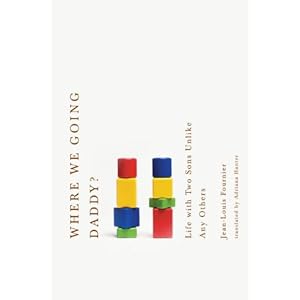
Where We Going, Daddy?: Life With Two Sons Unlike Any Other (Jean-Louis Fournier)

--The blurb--
"Jean-Louis Fournier did not expect to have a disabled child. He certainly did not expect to have two. But that is precisely what happened to this wry French humorist, and his attempts to live and cope with his Mathieu and Thomas, both facing extremely debilitating physical and mental challenges, is the subject of this brave and heartbreaking book. Fournier recalls the life he imagined having with his sons—but his boys will never really grow up, and he mourns the loss of every memory he thought he’d have.
   Though a devoted father, he does not shy away from exploring the limits of his love, the countless times he is filled with frustration and disappointment with no relief in sight. Mathieu and Thomas can barely communicate, and each in turn repeats learned phrases, such as “Where we going, Daddy?” (a favorite in the car) in what feels to Fournier to be an eternal loop."

--The review--
Having read Fournier's wry and sardonic God's CV, I had a little soupçon of what I thought I could expect from Where We Going, Daddy? However, even when reading it in French (under which it is published as Où on va, papa?), which is not my native language, I was hit with the full force of the emotion and surprise that Fournier packs into this short work, a fiction/non-fiction hybrid, with which to move his readers. And deeply moving it indeed is: perhaps too sentimental for some, Fournier explores all aspects of life as a parent of disabled children, from what happens when they are old enough to vote to how you feel when you think the au pair has done what you sometimes feel like doing and thrown them out of the window.

This little overview of the situations covered shows what Fournier is like as a writer; as well as having the potential to move you, he also has the potential to appall and shock you, dispensing black humour at the most unexpected turns in the road. He reveals unflinchingly his perceived failings as a parent and as a human being, and does not make a secret of his use of jokes to help keep him sane and in some small way to make fun of himself. But in spite of the sense of gallows humour exhibited here, Where We Going, Daddy? is ultimately a tale of the heart-rending variety. It is not in the least cheery and does not seek to be cheesy or inspirational, American-style. It is perhaps self-pitying in places, but as someone without disabled children, you think to yourself: but wouldn't you be, too? Those who manage to rise above such a situation and be relentlessly positive in the face of it are likely few and far between; I would imagine that a greater majority of parents of disabled children feel what Fournier expresses here. It is an assumption, to be sure; but this novella almost certainly delivers a much-dodged insight into the lives of these parents, and thus makes a valuable contribution to the world in enabling greater understanding. Immediately you are inside Fournier's mind and life.

While delivering risky literature in his tone, topic and approach, Fournier also delivers readable literature: there are no chapters as such, but the segments and anecdotes are short, allowing full reflection on each before moving on. While short, it is a book you can take your time over as the subject matter weighs heavily on your mind and heart, thus changing you.

The one question left for me as a reader was the marginalised topic of Fournier's other child, his 'normal' daughter Marie. We are given little or no indication as to how this affected her, or indeed Fournier's wife and the mother of the three children. The book is undeniably self-centred in this regard, but equally this is the source of its impact.

Laden with linguistic devices such as metaphor and repetition, this book is not difficult to read, but rather is strangely compelling as it lays out its images in easily understandable ways. While the narrative is not finished, this is an appropriate way to stop: life, too, for all of us, albeit in very different ways to Fournier, is also often messy, unfinished, and unexplained in its alleged dispensations of justice. It is parents of the disabled who perhaps feel this most keenly. Important to remember too, though, is that this is Fournier's experience - he is not trying to generalise the experience of all parents with disabled children, but if he manages to resonate with a few, he will have done well. And equally, if Fournier's book incites even one person to change their attitude towards disabled people, he has done his job and left his mark on the world. With this being his first and so far only work to have been translated into English, it is hoped that more will follow and that his literary and social influence will continue to spread far and wide.

Other works by Jean-Louis Fournier
Poet and peasant/Poète et paysan (2010)
Blasted God!/Satané Dieu! (2005)
Little Meaulnes/Le Petit Meaulnes (2003)
I'm Not Going To Hell/J'irai pas en enfer (2001)
The Dark Girl/La Noiraude (1999)
My Dad Never Killed Anyone/Il a jamais tué personne mon papa (1999)
I'll teach you to be polite, little idiot/Je vais t'apprendre la politesse, p'tit con (1998)
God's CV/Le CV de Dieu (1995)

Saturday, 31 July 2010

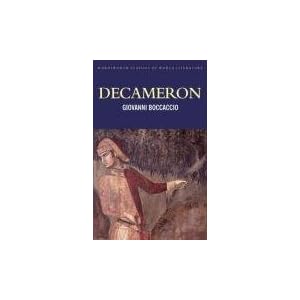
The Decameron (Giovanni Boccaccio)

--The blurb--
"1348. The Black Death is sweeping through Europe. In Florence, the plague has carried off one hundred thousand people. In their Tuscan villas, seven young women and three young men tell tales to recreate the world they have lost, weaving a rich tapestry of comedy, tragedy, ribaldry and farce."

--The review--
At around 700 pages, modern readers often expect an unreadable epic that is trapped in the past in which it was created. What you are treated to with The Decameron, however, is a relatively accessible collection of one hundred short stories, which can be enjoyed at your leisure and in a similar manner to Bible stories (mostly minus the preaching): anybody expecting something boring is proved wrong with the collection of thoroughly engaging thrills, chills and spills.

The project is an obviously ambitious undertaking, and it would be unreasonable to expect something of this magnitude to succeed entirely. For one thing, it is impossible, even having read all of the short stories, to remember the details of each and every one. Some of the longer stories also fail to hold the reader's interest: this is not necessarily because they are long (Boccaccio himself, at the end of the short stories, defends in his conclusion the inclusion of the longer stories by simply saying "well, if you had anything better to do, you wouldn't be reading any of these stories at all - long OR short", which seems fair enough) but because they are tedious. By their nature, the shorter stories are snappier and more concise, and in any case, even if all of the stories were of exactly the same length, it would be difficult for any author to sustain their prowess equally across such a large number of stories.

Content-wise, some of the stories can also become repetitive: the vast majority involve adultery of some kind, and the confusion of lust for love by our naive Italian forefathers. Lust and love are treated interchangeably and for the modern reader this can become wearying or frustrating. However, Boccaccio is an absolute master of the witty comeback and most of the stories are not boring at all. The predecessor of Keats' poem Isabella, or the Pot of Basil, was very illuminating to read in its original prose form, and the very first story of the collection, about a saint whose behaviour was so appalling that he should never have really been one in the first place, carries many fascinating implications about the foundations of religion.

Even though the stories are not always beautifully or tersely written, quite often Boccaccio's surrounding descriptions are, and the structure of smaller stories within a larger framework is refreshing and accessible, even if we do not really get to know the storytellers themselves very well at all (they are portrayed as mere vessels for the stories, which are the real stars of the show). The breadth and detail of content means this is a collection that readers can return to over and over again; it is easy to see how the process of getting to know the stories one by one could become a real pleasure.

Other works by Giovanni Boccaccio
The Crow (c.1365)
On Famous Women (c.1375)
The Elegy of Lady Fiammetta (c.1343)
The Filocolo (c.1336)
The Filostrato (c.1340)
Teseida (c.1341)
On The Fates of Famous Men (c.1355)

Sunday, 25 July 2010

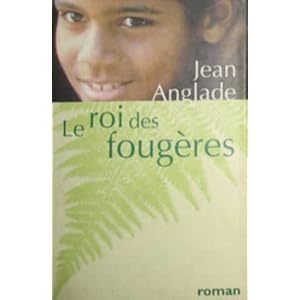
Le roi des fougères (Jean Anglade)


--The blurb--
"How did the young Antilles boy, Zébédée Lhasard, son of Pamphile Lhasard, tramway driver from Clermont-Ferrand, become Prince of the Ferns? How did he come to share the cave of a forger of Roman antiquities on the slopes of the Puys? Jean Anglade unveils, with humour and poetry in equal measure, this strange destiny, and traces a beguiling portrait of the Auvergne at the edge of the 1950s."

--The review--
The King of the Ferns, by Jean Anglade (not to be confused with actor Jean-Hugues Anglade!), is not available in English, and the author himself is virtually unknown outside of France (which is perhaps not helped by his reclusive nature even in France, with him rarely if ever appearing on television, and with him not having won any literary prizes in nearly 50 years). However, in France his output at least is extremely prolific, with him having released 40-50 novels and novellas, as well as multiple history books, plays, poems, translations and essays, among other projects. At the age of 95, he's still writing, with his most recent attempt having been released just a few months ago. But is what he's writing any good?

While imperfect, it thankfully appears that quantity is not being prized over quality. Anglade has produced a lovely readable little novella (just 96 pages in all) that is concise, compelling, and carries the reader along with its imagery. It peters out a bit due to its predictable ending, but this is compensated for by the vivid setting of Clermont-Ferrand and the eccentric and minimal cast with which we are presented.

Although only available in French, those who are not fluent in the language should still easily be able to handle The King of the Ferns: if anything it makes good practice for those who are in the process of learning it.

The only other difficulty - apart from the ending - is perhaps determining this story's target audience. While fairytale-ish (due to its light style and happy ending), it is absolutely not for children, as proved by one fairly sombre and horrible scene - teens and up might be a better target.

Selection of other works by Jean Anglade
L'Immeuble Taub (1957)
La Foi et La Montagne (1961)
Une pomme oublié (1974)
La Noël aux prunes (1983)
La soupe à la fourchette (1999)
Les délices d'Alexandrine (2009)
Des chiens vivants (2010)

Wednesday, 28 October 2009

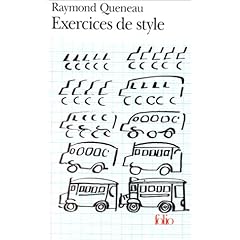
Exercices de style (Raymond Queneau)

--The blurb--
"On a crowded bus at midday, Raymond Queneau observes one man accusing another of jostling him deliberately. When a seat is vacated, the first man appropriates it. Later, in another part of town, Queneau sees the man being advised by a friend to sew another button on his overcoat. "Exercises in Style" retells this unexceptional tale ninety-nine times in ninety-nine different styles. An 'Abusive' chapter heartily deplores the events, 'Opera English' lends them grandeur. Raymond Queneau rendered Barbara Wright (the English translator) his 'heartiest congratulations', adding, 'I have always thought that nothing is untranslatable. Here is new proof'."

--The review--
While a great deal of foreign literature is translated, it often remains a niche interest, with very few people being aware of the authors and works in question. Raymind Queneau is one of these hidden gems, being in his lifetime a prolific poet and essayist as well as academic and author. He has not even risen to stardom significantly more following the publication of a graphical version of Exercices de style by Matt Madden four years ago. So how does such a successful French author remain so minor when his works are translated into English?

Queneau relies heavily, in several of his works, upon wordplay, which may not always translate well or hold appeal for a wider audience. Others may not resonate well with the sense of humour of other countries, or run the risk of seeming so pretentious that they pass the regular reader by. Liking some of Queneau's novels perhaps relies on a love for the surreal or absurd, and none of these qualities build up a picture of an author whose works might be lovable in any sort of mainstream way. Certainly Exercices de style, one of his most well-known works, is best when taken in small doses. The repetitive nature of its construct means there is no narrative thread as such that needs to be followed each time the book is picked up. However, despite the repetitive nature of it, there is, perhaps surprisingly, always something new to find.

Queneau is consistently innovative and imaginative throughout this novella, not only employing voices that will appeal to linguists (the past and present tenses, subjunctive mood, and passive voice appear to name but a few), but also those that appeal to a wider range of interests (such as the chapters centred on gastronomic, zoological, and medical themes). As a classicist I was especially tickled by the chapter on Hellenicisms. This keeps the central, very simple narrative interesting, lacing the story with surprising variety.

The author's style is therefore something of the unexpected. It's unrealistic to expect any work of art to appeal to everyone, but there should be something in this to reach out to a good 90%. It's relatively short, and yet contains a great enough multitude of perspectives to keep readers returning. A great, accessible and slightly wacky introduction to the unconventional Queneau which will take any adventurous reader on a great journey.

Other works by Raymond Queneau
Witch Grass (1933)
The Last Days (1936)
Children of Clay (1938)
A Hard Winter (1939)
Pierrot (1942)
The Skin of Dreams (1944)
We Always Treat Women Too Well (1947)
The Sunday of Life (1952)
Zazie in the Metro (1959)
The Blue Flowers (1965)
The Flight of Icarus (1968)

Sunday, 20 September 2009

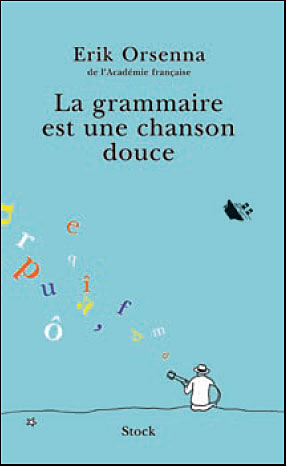
La grammaire est une chanson douce (Erik Orsenna)

--The blurb--
"In Orsenna's witty rumination on words and grammar, 10-year-old Jeanne and her 14-year-old brother, Thomas, are shipwrecked on a strange island where words have become independent. Rendered mute, the siblings visit the Word Market, where one can buy the perfect word for any occasion. They also travel to a town full of independent words that strut around without the need for human beings to utter them. Such word adventures help restore the siblings' power of speech."

--The review--
Erik Orsenna is possibly one of the world's few remaining polymaths. He is not only a graduate of the London School of Economics (with a degree in politics, philosophy and economics), but also wrote a book to rival Nick Hornby's 31 Songs (in the form of History of the World in Nine Guitars, with Thierry Arnoult), and is known for writing books with titles that professional pedants die for (as well as Grammar is a Gentle, Sweet Song, he has also written the as-yet-untranslated Les chevaliers du subjonctif). Further to this, there's another reason why his books should be more widely known to adults: the editions of La grammaire... published by the French publisher, Stock, contain sublime illustrations, which are also by the author. Adults sometimes like pictures in their books, too (even if they don't want to admit it).

Happily, the Saint-Exupery-style illustrations are not the only positive aspect of La grammaire.... Orsenna is skilful in his use of child characters, putting him on a par with the more well-known Jostein Gaarder (particularly in relation to Gaarder's Hello? Is There Anybody There?) and with the work that made Antoine de Saint-Exupery so stratospherically famous, Le Petit Prince. Other similarities to these books include Orsenna's fantasy-soaked setting and imaginative style, so it is understandably pleasing to have this Saint-Exupery link confirmed towards the end of the novella, even if the author isn't necessarily someone whose work Orsenna desires to emulate directly.

Orsenna is also wonderfully expressive and didactic, particularly in one passage where he compares constructing a phrase to decorating a Christmas tree: "You start with the naked tree, and then you decorate it to your whims and desires...Pay attention to your phrase: if you burden it with too many garlands and baubles - that is to say adjectives, adverbs and the like - it can collapse too." Whether Orsenna is deliberately didactic is difficult to say, but either way, he is not irritating in this, and he is successful. Overall, the story is well-constructed, its ending is satisfying, and its two main characters, Jeanne and Thomas, are as well-drawn as the other characters that they meet along the way. This is an enchanting hook into Orsenna's work, and, with its cleverness and wit, proves enjoyable for children and for grammar buffs alike.

Other works by Erik Orsenna*
Portrait of the Gulf Stream: In Praise of Currents (2008)
Tidings from the Isle of Flight (2005)
History of the World in Nine Guitars (1999)
André Le Notre: Guardian to the Sun King (1999)
Love and Empire (1993)

*noted here are only the works that have been translated into English; a wider selection is available in French.

Sunday, 16 November 2008

Tout le monde s'en va (Wendy Guerra)


--The blurb--
"This debut novel takes the form of a private journal, that of Nieve, who is growing up in Cuba in the 1980s. She confides to the diary the defining moments of her existence, from childhood to the cusp of womanhood.
Torn between artistic and bohemian parents who are splitting up, she will soon know a future made up of constant departures and successive separations. The reader follows the personal, intellectual, political and artistic evolution of this young girl. As a child, just as her parents have separated, she goes to live in Cienfuegos with her mother and her mother's Swedish lover, who gives her a love of games and of reading. However, her father obtains custody of her and takes her to the mountains with his troupe of puppeteers. Having been subjected to maltreatment from her father, Nieve is then placed under the care of a Child Protection Centre (Castrist jargon for an orphanage), before being able to live with her mother again and leave with her for La Havane, where they never stop hoping for a permit to leave Cuba.
As the months and pages go on, Nieve's pen becomes more self-centred, to the point of becoming more self-analytical. Her experiences with relationships contribute to the awakening of her artistic sensibility and political conscience. Creative and artistic compulsion is at the heart of this work, as are the themes of accomplishment and resistance."
*blurb from www.fnac.com; translation mine

--The review--
Published under the title "Todos se van" in Spanish, this oeuvre is unfortunately as yet unavailable in English. However, since none of us know what the future holds, let us proceed. Realistic child characters, both in personality and language, are difficult to create and still maintain integrity. Donna Tartt's "The Little Friend" was spoilt for me because of this. However, Wendy Guerra not only manages to achieve realistic dialogue and thoughts for the narrator's age at the start of the book (six or seven) but also manages to successfully capture the character's growth throughout the book (again in terms of the use of language as well as sophistication of thought).

The other characters are also all painted excellently, with both their good and their infuriating points shining through. The imagery is therefore vivid: the neurotic mother, the alcoholic father, the increasingly self-righteous teenager. However, I didn't feel that I could really 'connect' with Nieve, though perhaps (in an existentialist sort of way) I wasn't meant to - it's always difficult to tell whether or not this is the author's intention. However, I could empathise with some of the emotions, even though attachment to the character herself was not strong.

Learners of French or Spanish would do well to read this book: the language becomes progressively more complex in a realistic way, which serves as a very positive tool for learning. The novel is also not over-peopled with characters, meaning that while emotions meander as the character grows, the story also possesses a quality of sharp focus. It is a sophisticated and well-constructed coming-of-age story that deviates from the clichéed examples of this genre that are usually cited. However, this difference from other well-known exemplars is not easy to pin down: it does have a certain je ne sais quoi. Some qualities that do come to mind, though, are Nieve's obstinacy, which is admirable rather than irritating; a lack of attempt to be amusing, as is often common in fictional young diarists; and a lack of whininess, which makes the character more likeable than her other fictional contemporaries.
Reading about Wendy Guerra's life gives the reader some sense that Tout le monde s'en va is to an extent autobiographical, but this in no way seems to cheapen it, particularly as there is no particular overriding message or patronising missive of morality from the author as the reader reaches the book's end.

A promising novel from an author who deserves to be better-known across Europe.

Other works by Wendy Guerra
Platea a oscura (1987) - poetry
Cabeza rapada (1996) - poetry