Showing posts with label proust. Show all posts

Wednesday, 16 November 2011

Time Regained (Marcel Proust)

--The blurb--
""Time Regained" begins in the bleak and uncertain years of World War I. Years later, after the war's end, Proust's narrator returns to Paris and reflects on time, reality, jealousy, artistic creation, and the raw material of literature - his past life."

--The review--
I have often criticised throughout my reading of Proust's epic his frequently over-complicated and vague style which seems designed to tie our brains in knots. The final volume of the heptalogy, Time Regained, starts off much more clearly and lucidly, which makes us feel that the narrator has the benefit of hindsight at last - which, with it being set more towards the end of his life, seems fitting. At least initially, it is less furious and intense, and more thoughtful.

However, we are soon treated to a glut of the meaningless gossip that pervaded earlier volumes. While this gives us a clue as to the nature of the narrator's life and social circle, it is maddening at the same time - if you have no time for celebrity-type gossip in real life, you are unlikely to have much patience for it in literature. Some of it is perhaps intended to show characters up as being hypocritical, but the targets of their hypocrisy probably took place so long ago that the effect is lost. Proust's political commentary on the war is equally uninteresting and is clearly aimed at those who already have knowledge of or opinions on the subject at hand. 

There are even examples of bad style, such as the line "To return to Mr Charlus..." (it is surely an elementary rule of narrative writing that such transitioning phrases are not required), and the fact that the first-person narrator has access to conversations and information in this volume that simply would not be possible. Punctuation needs to be more varied (a person can only take so many commas, although thankfully a semi-colon does appear...on page 320), and the volume is also loosely or badly organised, to the degree that we risk missing key events. But then again, are all of our own thoughts beautifully organised? Probably not.

To go on: we do not end up caring much for the death of one of the recurring characters due to the estrangement between himself and the narrator. The narrator's self-deprecation and false modesty is extremely annoying (especially when in the same breath he then goes on to talk as if he were an expert), and yet we must admit that it is natural for even the hugely talented to have doubts from time to time.

Plenty of the novel, however, still rings true today. Narcissistic though they may be, it is the narrator's thoughts and relationships that are of interest, not the author's attempts at political comment (it should be noted that supreme effort is apparently required to divorce narrator and author in this work of autobiographical-fiction-meets-history-and-philosophy). There is great irony in the author's recognition that all we do, or are, is so insignificant against the world's might.

The passages of memory after the narrator's return from convalescence are truly beautiful and testify to the author's powers of description. Despite certain episodes seeming contrived, the author's ability to still be relevant and appreciated today is staggering: his comments on pop art (how far is it truly enjoyed by 'laymen' and how far is it still a middle-class hobby?) are as accurate now as when they were written. He is correct that things from our childhood reawaken in us a sense of hope and wonder, and he posits ideas that still give us plenty to consider (for instance: is something still real if only we experience it, or does it have to be shared or common in order to qualify? Does truth go beyond fact?).

While a new edition is perhaps needed in order to increase mass appeal (Lydia Davis' looks promising), this does not mean that Time Regained (or even the heptalogy as a whole) is not worth pursuing in its current form. Proust has the ability to make us laugh (with his caustic descriptions of characters) and to make us cry (with his moving descriptions of landscapes and feelings). By the end of the seven volumes, most people have probably spent a year or more with Proust, and by then he's like an annoying family member: he's eccentric, digressive, annoying, boring at some moments, confusing at others; but he's also incisive, witty, intelligent, thought-provoking, sensitive and deeply poetic. In short, in spite of his shortcomings, we love him anyway.

Other works by Marcel Proust
Swann's Way (volume 1)
Within a Budding Grove (volume 2)
The Guermantes Way (volume 3)
Sodom and Gomorrah (volume 4)
The Captive/The Fugitive (volume 5/6)

Friday, 5 August 2011

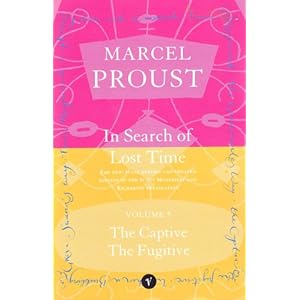
The Captive/The Fugitive (Marcel Proust)

--The blurb--
"In the two novels – The Captive and The Fugitive – contained in this volume, Proust’s narrator is living in his mother’s apartment in Paris with his lover, Albertine. However, this is far from an idyllic state of affairs. His obsessive love for her means that their relationship is shadowed by jealousy and headed for tragedy."

--The review--
These two parts of the In Search Of Lost Time series are where confusion can arise as to whether the series is a six-part one or a seven-part one. Originally written as two separate novels, The Captive and The Fugitive are now so commonly packaged together that the series is more often regarded as a six-part affair than the seven-part opus intended by the author. Nevertheless, editors are not being silly to put these two parts together in one volume: the result is probably the clearest narrative arc that I have seen so far across all other volumes of Proust's epic.

This is not to say that the flaws present in other volumes cannot be seen here. Unsurprisingly, the two parts are still pervaded by overrated social gossip (about which the reader does not care, since those characters being gossipped about have not been developed nearly fully enough to make us care) and Proust's circular and obsessive version of love. It is the superficial whisperings that weaken the end of The Fugitive in particular, and Proust's jealous and jaded feelings towards Albertine that bring us down again in between moments where it does seem, briefly, as if he really does love her in a form that most people would recognise.
But we must remember, too, that ultimately there are as many kinds of love as there are hearts - unrequited love and love that is suffused with paranoia may not be the same as reciprocal love, but they are types of love nonetheless. Lust, then, perhaps inevitably, features strongly again in these two volumes, as various revelations are finally released into the open to spice up proceedings. It is perhaps this feeling of "He/She did what with who?!" that makes these two volumes more readable and exciting - and that because they concern characters that we already know well.

Equally, Proust keeps the reader on their toes - having made us feel at the end of Sodom and Gomorrah that we knew what would happen next (namely, a car crash of a marriage with Albertine), he then turns around and proves us all wrong in shocking literary style that would prove to be classic (the demise of a key character is replicated in such classics as Gone With The Wind, if you would like a clue). Occasionally he also continues to provide lightning bolts of lucidity that are ultimately what the reader continues to read for, in search of something universal with which we can all identify: "one remembers an atmosphere because girls were smiling in it," the narrator says, recalling a party. He also makes curious, thought-provoking statements, such as the notion that "memory has no power of invenion", which backs up his idea that "it is powerless to desire anything else, let alone anything better, than what it has already possessed", but fails, in my mind, to recognise the idea that memory is indeed so capable of invention that it can twist and contort to an alarming degree what has actually happened to us. He harks back to more ancient ideas in his notion that when we recover from grief, it is not really us that is 'the recovered one' but rather another 'self' waiting for us in reserve for when such traumatic things happen to us, to 'fill in' for our original self.

Such fullness combined with such scandal is probably what spurs the reader on to the final volume, in conjunction with the sudden extra narrative momentum that appears in The Captive and The Fugitive. I shall be equally interested to see the filmic version of these two volumes in order to reinforce my own personal Proustian journey in search of lost time.

Other works by Marcel Proust
Swann's Way (volume 1)
Within a Budding Grove (volume 2)
The Guermantes Way (volume 3)
Sodom and Gomorrah (volume 4)
Time Regained (volume 6/7)

Sunday, 10 April 2011

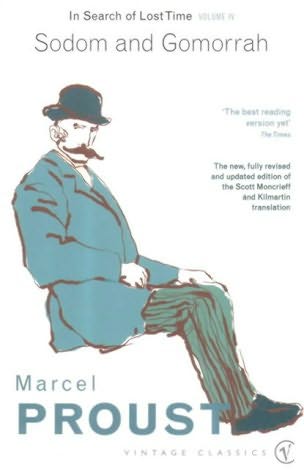
Sodom and Gomorrah (Marcel Proust)

--The blurb--
"In this fourth volume, Proust's novel takes up for the first time the theme of homosexual love and examines how destructive sexual jealousy can be for those who suffer it."

--The review--
In presenting us with yet more hundreds of pages of high society goings-on (or, perhaps more to the point, non-goings-on), Proust seems out to bore us. However, the situation becomes more interesting and poignant when St Loup and Swann reappear, and we agree more with Saint-Loup too, who seems to be suggesting that he is becoming bored with high society life, and by this stage in the epic French novel we readily acquiesce. These two characters are refreshing among the parade of faceless individuals and only slight movements of an amoebic conglomerate. 

As with other volumes of In Search Of Lost Time, though, this fourth instalments is, by turns, eerily prophetic, sublime, and thoughtful. The narrator continues also to give us academic and philosophical food for thought: we are forced to consider our own narcissism, for one thing. Do we not all, in some way, consider our own lives as a cast of a few special ones moving against a background of superficial and two-dimensional others? If this is the case then Proust has replicated our own situations very accurately, even if this in a setting that contemporary readers do not recognise. On a more academic level, the discussion of the etymology of place names is relevant to the theme of name versus place raised in earlier volumes, but was interesting to me as a topic that I had considered as a subject of my master's degree thesis, so this interest may therefore not be so piqued for others. The same applies to the discussion of sex versus gender which takes place later in this volume. More universally intriguing is perhaps the nature of dream and sleep; Proust asserts his curiosity that we do not count the pleasures experienced in sleep as part of our everyday life's catalogue of happy moments.

The author is consistent in his inconsistency in the provision of gleams of light. The prose is still often impenetrable and opaque, and it is difficult to tell how much of this can be traced back to the author himself and how much of it can be laid at the translator's door. While certain gems keep the reader going, and such passages are clearly successful, these are counteracted by the lack of success found in the author's use of malapropism. The narrator's persona also continues to be difficult to deal with: while he is becoming more assertive, he is still manipulative, irritating, wimpish, neurotic and possessive, with his separation anxiety serving as an omnipresent undercurrent. This is simultaneously annoying and interesting as it does in some ways provide narrative momentum: we wonder, as a result of his nature, what purpose his relationship with Albertine really serves, and it is a relief to the readers to know that some of the servants featured in the novel also find his neuroses ridiculous, and that not everyone in the novel is taking the narrator as seriously as he is taking himself. The Balbec hotellier is another voice of reason - even though the narrator assumes that he says "I can tell you have nothing better to do" out of jealousy at not having been invited, the reality is that he says what the rest of us are thinking.

The reader longs for the narrator to return to the pleasant, peaceful and beautiful seaside retreat of Balbec in the hope of escaping the high society circles in which he has been moving in Paris. This unbearable circle of people is unfortunately not entirely left behind in the French capital, but this is slightly compensated for by other characters appearing who are more interesting - even if they are equally unconvincing, caricaturish, and an embodiment of petty inside politics. The audacity and tactlessness expressed by some of these members of the gentry would be hilarious with the right delivery, and further comedy can be ferreted out from the Verdurins' fickleness.

It is difficult to link the title to the book's content, as its theme does not supply a consistent thread - apart from a few throwaway tidbits we are not given much. This is something to be grateful for in other ways, though - if the alternative were a full-on diatribe of the ilk found in Part 1, Chapter 1, then most readers would likely pass. Proust as a precursor to the Austenesque humour that is so known and loved in British society today provides light to contrast the narrator's indecisiveness; he really seems to want to romanticise the fact of him being a womaniser, and seems more in love with the idea of being in love than ever. We end the volume feeling that his continuing liaison with Albertine is going to be a very bad car crash to say the least, and wondering how the author will pick up the pieces.

Other works by Marcel Proust
Pleasures and Days (1896)
Swann's Way (volume 1; 1913)
Within A Budding Grove (volume 2; 1919)
The Lemoine Affair (1919)
The Guermantes Way (volume 3; 1920/21)
The Captive/The Fugitive (volumes 5/6; 1923/25)
Time Regained (volume 7; 1927)

Wednesday, 23 February 2011

The Guermantes Way (Marcel Proust)


--The blurb--
"After the relative intimacy of the first two volumes of In Search of Lost Time, The Guermantes Way opens up a vast, dazzling landscape of fashionable Parisian life in the late nineteenth century, as the narrator enters the brilliant, shallow world of the literary and aristocratic salons. Both a salute to and a devastating satire of a time, place, and culture, The Guermantes Way defines the great tradition of novels that follow the initiation of a young man into the ways of the world."

--The review--

By this point in Proust's six-volume epic novel, the reader has already quashed around 1300 pages of prose. It being fair to say that these 1300 pages have not been especially accessible or easy to read, it is therefore also fair to say that the reader’s hopes are raised by the comparatively accessible beginning of The Guermantes Way. However, this effect sadly tapers.

This is reinforced by the volume's "War and Peace" quality, in the respect that the military and political discussion will be more enjoyable for some than for others. This aspect relies on prior knowledge and could inhibit understanding or enjoyment of this volume of the novel for those not in the know (including myself). Proust consequently risks losing his readers’ attention as a result.

However, there are some gleams in the night. Proust is masterful of the dry insult and witty comeback; even today, anyone with this power at their disposal is likely to be able to muddle through any situation life throws at them. The dialogue in this volume is also much more enjoyable than it has been in previous volumes, tension is managed well, and Mr Charlus also comes into his own as a great, amusing character. Could this prove to be some of the character development we have longed for during the reading of the past nearly two thousand pages?!

Alas, the author does not sustain this skilful depiction of character. The timing of the appearance of the grandfather for just about the first time in the entire novel means that he is unconvincing in his grief: Proust has not invested the time or energy in making us care about him by building up his character more. The author also continues to tell rather than show, with places remaining easy to visualise while people are not always so; this suggests that the author can describe well but chooses not to, which seems a highly bizarre trait to be attached to such a highly acclaimed novel.

There are other, more academic, points which make this volume interesting, perhaps as redemption for the above. Proust is metacritical, talking about the skills of authorship frequently. We have the fun of trying to work out if he is making Marcel deliberately ironic or just pretentious, and the deeper enjoyment of the volume being more like a work of philosophy in places than a work of fiction. The first slightly strange translation is also seen in this volume, with the word ‘formed’ being used for ‘educated’ or ‘trained’, as a sign of the translator or editor taking the French ‘former’ (to train or educate) or ‘formation’ (education or training) a little too literally.

By the end of this volume we are more or less halfway through the opus; we should be rolling along by now but to the contrary are still having to work hard. However, Proust still knows how to throw in a few details that mean we don’t just give up here. Is the doctor incompetent, or just wrong? And is the ending as predictable as the final sentences lead us to believe, or is there a massive twist coming? Here’s hoping for the latter.

Within A Budding Grove (Marcel Proust)


--The blurb--
"In this second volume of In Search of Lost Time, the narrator turns from the childhood reminiscences of Swann's Way to memories of his adolescence. Having gradually become indifferent to Swann's daughter Gilberte, the narrator visits the seaside resort of Balbec with his grandmother and meets a new object of attention—Albertine, "a girl with brilliant, laughing eyes and plump, matt cheeks.""

--The review--
As with volumes 1 and 3 of In Search of Lost Time, the second, Within A Budding Grove, is not without its merits and, in addition to the sheer beauty of the language used, again toys with some interesting semantic issues in the second part of the volume and confirms previous suspicions that Proust makes it easier for us to visualise places than people.

What is clear, though, is the growing irritation at Marcel's behaviour and personality that steadily increases throughout the volume. For want of a better phrase, the man acts like a total pansy; this act wears thin after several hundred pages. However, it could be argued that Proust cleverly replicates the maddening temperament that overtakes us all when in the sights of unrequited love. This makes the volume become quite blurry in its similarity, and while this dreamlike quality is perhaps Proust's trademark, it can make it difficult for the motivation to continue to be consistently maintained.

The politics of France at this time and of the high society that Marcel is beginning to be aware of and to inhabit are not laid on so heavily in this volume as in volume three; this is a blessing rather than a curse, as it, in its own special way, probably helps to render this volume more accessible.
Proust also successfully chronicles the nature of teenage obsession with certain interests and people; upon reading, we too are transported back to those same feelings of intensity, which are more important to us than Marcel’s specific situation. The word “Berma” could be replaced with any other word; this, if you like, is another in the sequence of the reader's own madeleine moments. Equally, there is relevance to be found in Marcel’s meeting with Bergotte, the author that he idolises; the idea that perhaps we should never meet our heroes is arguably ever truer in an increasingly celebrity-obsessed Western world.
Although Proust has had accusations of anti-Semitism levelled at him for his portrayal of Bloch and his family, this to me is unfounded; the impressions and opinions expressed here are likely an honest social portrait of the time, rather than setting out to be deliberately malicious. He, along with other authors such as Enid Blyton and Hergé, are to be valued rather than condemned for such representations; rather than making their work into nothing more than museum pieces, they are important living parts of history.
But in spite of all of these various positive aspects, the reader still longs for more movement in terms of characterisation and momentum in the plot, to match in some small way the massive voyage of self-discovery and mapping of history that is taking place. Really all that the reader has is the image of a character who is not enamoured with any specific female but whose attentions constantly flicker; in love with the idea of being in love, he comes across as little more than fickle and silly.
And yet it is perhaps this interior evolution of character which encourages the reader to continue; in spite of the volume's deep flaws, it is not enough to be completely off-putting.


I selected this post to be featured on my blog’s page at Book Blogs.

Sunday, 25 July 2010

Swann's Way (Marcel Proust)

--The blurb--
"In this opening volume of Proust's great novel, the narrator seems at first to be launching a fairly traditional life-story. But after the prelude the narrator travels backwards rather than forwards in time, in order to tell the story of a love affair that had taken place before his own birth. Swann's jealous love for Odette, together with the comic antics of the Verdurins and the adoring members of their 'little clan', provide a prophetic model of the narrator's own love-relationships and peregrinations in salon society."

--The review--
Choosing whether to read this in translation or in the original French will be personal to everyone. When it comes to fluency in a language, it's my belief that there exists a fine line between understanding and appreciation: you can know the meaning of the words (or the parts) without being fully able to appreciate their beauty (or the whole). It was in fact my French fiancé, who has read the entire series of In Search of Lost Time, in French, on the grounds that he (whose English is better than my French) would not feel able to fully enjoy it in English, who recommended that I read the opus in my own mother tongue, English. Taking him at his word (for now at least; I may choose to read parts of it in French later), I therefore embarked on it in English. So far, no regrets.

The translation (by Moncrieff, with Enright as editor) is beautifully rendered and very poetic (although part of this quality may be an accident of the translation itself). Almost Biblical in its timeless principles of life, it contains many comforting and useful words of life in a way that may be more recognised today by readers of Charlotte Brontë. However, less accessible to the modern reader are the relationships contained therein: the relationship between the narrator and his mother is highly Oedipal, and the relationship between Swann and Odette is just one long series of mind games. The meaning of this latter relationship is continually unclear: we are not sure if he wants to sleep with her (despite his statement that he does not find her attractive - although this too changes later on), or if he is just using her to further his own integration into the Verdurins' prestigious social circle. Swann's own insecurity in his relationship, and the fact that he can never seem to decide whether he likes her or not, keeps readers in suspense with great success.

The beauty inherent in this novel does not mean that weaknesses are nonexistent. The style may be offputting to some: think a combination of James Joyce's Ulysses, and Joseph Heller's Catch-22, which has then been aged quite a bit. It rambles considerably and at times often does not seem to be about very much. None of the characters are especially likeable and there also exists a narrative flaw of which Philip Roth and others are often guilty - the narrator has access to information about Swann and Odette that he could not possibly have been privy to, which casts doubt on his reliability. However, this being a seven-volume epic, it is possible that this will be resolved later, and simultaneously, it is precisely this ambiguity of motive and feeling which so perfectly encapsulates the madness of the kind of love or lust being experienced.

Odette and Swann's relationship, while weird, is a constant source of interest: she is playing mind games with him just as much as he is playing them with her, and the evolution of her character proves extraordinary, with her being portrayed as innocent and infatuated initially, before it is then implied that she puts her own self-interest above any positive qualities that Swann may have. Further to this, the language used by Proust is highly sexual and sensual, although we are not told explicitly about the relationship's physical status.

The first volume's poetry, complexity and highly synaesthetic approach all serves to hook the reader totally and utterly, despite the faults in the novel's construction, leaving readers awaiting the next instalment with bated breath.

In Search of Lost Time - list of instalments
volume 1 - Swann's Way
volume 2 - Within A Budding Grove
volume 3 - Guermantes' Way
volume 4 - Sodom and Gomorrah
volume 5/6 - The Captive and the Fugitive
volume 7 - Time Regained