Sunday, 24 March 2013

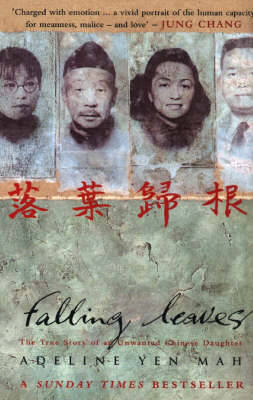
Falling Leaves (Adeline Yen Mah)

--The blurb--
"Thought to bring bad luck because her mother died giving birth to her, Adeline Yen Mah was discriminated against by her family all her life. Falling Leaves is both the[...]story of how she survived that rejection and [a] saga of a Chinese family, from the time of the foreign concessions to the rise of Communist China and the commercial boom of Hong Kong."
adapted from Amazon.co.uk

--The review--
My family stretches all around the world, from London to Dublin and from Paris to Shanghai. Since reading Paul French's Midnight in Peking, visiting Thailand in 2005, hearing about my parents' recent trip to China to see my delightful 11-month-old half-Chinese half-English cousin, and beginning to plan my own trip to Japan in 2014, my own interest in all things Asiatic has increased. So when one of my students said that she had purchased the adult version of Adeline Yen Mah's memoir Chinese Cinderella (which we are currently studying) and offered to lend it to me, I gratefully accepted.

Chinese Cinderella is naturally a shorter book and focuses on Adeline's childhood, going from her birth to her departure for university. With more focus on specific childhood incidents, it is geared more towards children's sense of humour and pathos. As befits its target audience, Falling Leaves diverts from these focal points, giving a broader overview of China's history throughout Adeline's life and going beyond the scope of Chinese Cinderella, passing through the writer's adult life right up to 1990. 

Naturally there is some repetition of stories, so those who have read Chinese Cinderella may find aspects of Falling Leaves a little tiresome. However, these stories are glossed over and are interspersed with new information, so they are not greatly to Falling Leaves' detriment. Newcomers to the events of the Cultural Revolution and the Tiananmen Massacres will be left with jaws dropped and minds opened, as Yen Mah incites the reader to want to know more.

Equally shattering are the attitudes and behavioural patterns of the majority of the writer's family members. As these patterns and attitudes were ongoing throughout Yen Mah's life, it is difficult at times to understand why she continued to be so generous towards them emotionally and financially when she would have been better to cut all ties with them, especially when she does prove herself able to cut ties with destructive forces at other points in Falling Leaves. However, at the same time, it is easy to see how each of us is all of our ages at once, and how inside Adeline is still the little girl desperately seeking the approval of Joseph, Jeanne, and her siblings. In this way, her treatment to the last by them is simultaneously predictable and unfair.

Comforting elements in this story include the power of hope and imagination in the face of adversity, and the notion that our real family can at times be the people we choose for ourselves. Equally inspiring is the encouragement that it gives to us all to face up to our past - whether our personal past or that of our country - and use it to create a better tomorrow. Yen Mah remained dignified, poetic and concise throughout, without losing lucidity or becoming patronising. Anyone who has ever felt unwanted by their family or simply been interested in Asian history should read Falling Leaves - and further to this, you'll find me ordering a copy of A Bitter Revolution online, so that after beginning to understand Adeline's struggle, I can perhaps begin to comprehend the struggle of China itself.

other works by Adeline Yen Mah
Chinese Cinderella (1999)
Watching The Tree (2000)
A Thousand Pieces of Gold (2002)
Chinese Cinderella and the Secret Dragon Society (2003)
China, Land of Dragons and Emperors (2008) 
Chinese Cinderella: The Mystery of the Song Dynasty Painting (2009)

Sunday, 17 March 2013

The Great Divorce (CS Lewis)

--The blurb--
"The narrator finds himself in the grey limbo of Hell, where the disgruntled and ghostly inhabitants take a bus-ride to the plains of Heaven, where they meet angels and the souls of those already there."

--The review--
 While CS Lewis is today first and foremost known for his Chronicles of Narnia series, it was as a specialist in English and philosophy that he made his living, working as a tutor in these subjects at the University of Oxford. In addition, he was a prolific writer for adults of non-fiction (and some fiction, too), with The Great Divorce being just one example. As a piece of fiction, it is arguably more accessible to a wider market than Lewis' philosophical essays, such as The Four Loves. The chapters are very short and for the most part the story proves eminently readable, even if the dialogue in places is not wholly realistic.

Lewis is skilled in raising a sense of mystery about where the bus travellers are going exactly, and is able to incorporate an element of magic that is often missing from adult fiction, although some parts are glossed over in favour of the author fast-tracking the reader to his main points, meaning that there is some scope for further development. This includes the at times rather protracted philosophical conversations, which could be clarified. The sense of time and the alternative universe in which they were living or came from prior to the characters boarding the bus is not fully explained or explored either, but in some ways this matters less: the novella's level of mystery is, as mentioned, important, and is partly explained later on, making The Great Divorce worth persevering with.

Through his use of metaphor, Lewis effectively encapsulates what humans feel regarding 'justice' and 'injustice', and 'good' and 'bad' people, and takes an interesting look at atheism and how people prepare themselves for death. As the narrator continues on his journey, we see a pattern often followed by children's stories and Christian allegory, whereby only the worthy remain, with Lewis taking elements of the greatest moralistic tales of Dickens, Dahl, Blyton and Bunyan. Unfortunately, the way in which these ideas is presented is concise yet long-winded, short yet confusing. 

Nonetheless, the writer forces us via his narrative to take a good look at our own flaws, attitudes, and reactions to situations and people. We can be overshadowed by our own personal tragedies and Lewis aims to help us see the futility in this. We need to let them go before we can be happy - and if we go away from The Great Divorce having realised this, then the author has ultimately achieved his aim (in spite of The Great Divorce's disappointing and clichéd ending), making it well worth seeking out the rest of his oeuvre.

other works by CS Lewis
A full list can be found on Wikipedia.
However, The Pilgrim's Regress (1933), The Screwtape Letters (1942), The Four Loves (1960) and Screwtape Proposes A Toast (1961) may prove good starting points.

Saturday, 16 March 2013

The Best Exotic Marigold Hotel (Deborah Moggach)

--The blurb--
"Enticed by advertisements for a newly restored palatial hotel and filled with visions of a life of leisure, good weather and mango juice in their gin, a group of very different people leave England to begin a new life in India. On arrival they are dismayed to find the palace is a shell of its former self, the staff more than a little eccentric, and the days of the Raj long gone. But, as they soon discover, life and love can begin again, even in the most unexpected circumstances."

--The review--
Film tie-ins are rarely going to have a negative effect on the reception of an author's work, but equally rarely does it raise awareness, as many of the films that are spawned by books are by authors that are already well-known. Think of recent releases: The Life of Pi, Cloud Atlas, Les Misérables, Anna Karenina and The Great Gatsby are all by established authors whose canon (whether in whole or in part) is considered classic. However, one hopes that the 2012 release of The Best Exotic Marigold Hotel will have significantly boosted the profile of writer Deborah Moggach, whose novel-publishing history in fact stretches back more than thirty years.

If done well, the film should have encapsulated Deborah Moggach's engaging plot successfully, as well as managing to recreate the unforgettable characters with which it is peopled. Novels tend to focus on the young, whereas Moggach has chosen to zoom in on a group of old folks whose families are trying desperately (for various reasons) to send them off to the nearest retirement home. Such an approach perhaps risked being stuffy or predictable, but in the author's capable hands there was not only chemistry between the group (and sparks flying between individuals) but fiery personalities to keep readers amused when characters were alone. Varying degrees of intellect and likeability help, too, to create a realistic cast. This is followed up right the way through their lives' outcomes: the fact that not all of the pensioners sail off into the sunset is also a true reflection of what we can expect in real life.

Juxtaposed with this dose of reality is the idyllic setting of India, where much is made of the awe-inspiring sunsets, distinctive streets, tourist attractions and unique bazaars. However, even here Moggach does not pull any punches, equally taking the opportunity to highlight India's problems of poverty and access to education and health services. Nonetheless, in doing so, she does not make her novel into a deliberate polemic: her commentary on Indian society does not go into detail and as such, is no more than another part of her story's patchwork, which also incorporates poignancy, a thrusting plot, and great humour.

Humour is the main characteristic of The Best Exotic Marigold Hotel, and even if at times we can see where the jokes are going, this does not in the end make them any less amusing. A secondary, but also important, feature is the book's revelatory nature: not only does Moggach carefully control what we learn about her characters and when we learn it, but she also keeps them on an equally tight leash, only letting them realise new things about themselves at meticulously chosen moments. This, too, leads to the reader's own realisations: not just about their own attitudes to their elderly relatives, but also about what we would like for ourselves when we become old.

The book's original title, These Foolish Things, is an interesting extra dimension to the novel, as throughout the characters' attempts to grasp their new surroundings and whether or not they have been satisfied with their long lives, there is a persistent theme of them firstly hanging doggedly onto objects that we might consider frivolous, which is a way of distracting them from or enabling them to cope with their various states of desperation; and secondly, wondering if they are worrying over nothing. Thirdly, the book's original title could have ironic undertones: things, people or decisions in our lives that we could consider foolish or unimportant can actually turn out to be very important indeed with the hindsight that old age provides.

Readers will therefore be left with a sense of satisfaction and enlightenment, and a feeling that they have been entertained by high-class writing. Moggach's powers of description, momentum, character-building and humour are not to be ignored, and whether you have read The Best Exotic Marigold Hotel, or seen the film, or both, it will surely spur you on to investigate the rest of her work.

other novels by Deborah Moggach
You Must Be Sisters (1978)
Close to Home (1979)
A Quiet Drink (1980)
Hot Water Man (1982)
Porky (1983)
To Have and to Hold (1986)
Driving in the Dark (1988)
Stolen (1990)
The Stand-In (1991)
Ex-Wives (1993)
Seesaw (1996)
Close Relations (1997)
Tulip Fever (1999)
Final Demand (2001)
In The Dark (2007)
Heartbreak Hotel (2013)  

Thursday, 14 March 2013

A Proper Place (Joan Lingard)

--The blurb--
"A Protestant girl and a Catholic boy from Northern Ireland cope with family members, the baptism of their child, and a move from the Liverpool slums to a Cheshire farm."

--The review--
History teaching in British schools is something that has been under the microscope a lot lately, with historians being split over Michael Gove's curriculum plans, and everything being discussed from what sort of history should be taught to whether black children are being turned off history. The problems seem to be as follows: that students will not be able to come back to topics when they are older and will understand them differently thanks to the newly proposed chronological approach; that the new system would stress facts and dates over real understanding; and even that 'the whole story' would still not be told. As Benjamin Zephaniah pointed out in his October 2012 speech, part of the problem is a lack of accessibility and key human details being missed out. Book series for children such as the Horrible Histories have already done a great deal to get primary school children fired up about history - however, there is little in the way of exciting material for teenagers.

This is where books such as Joan Lingard's Kevin and Sadie series could come in to play on the 'human interest' aspect of history and thus draw in the young. The fourth instalment, entitled A Proper Place, continues to do what its predecessors, including Across the Barricades, started, by getting inside the lives and minds of a struggling young couple who yearn, as the title suggests, to just have a place of their own in times of great difficulty. With Kevin and Sadie having always lived in bustling towns, a move to the countryside could have easily been portrayed as unnecessarily traumatic or overly rosy. However, Lingard manages this well, pointing out the advantages and disadvantages with flair, while also succeeding in pointing out the reality of how people change and move on when they relocate, even if they only move a short distance away. 

Another successful aspect of the Kevin and Sadie quintet is the author's portrayal of them as plucky young people who can be overly optimistic, but equally quick to become moody or angry. This helps to prevent readers from idolising them, as we are able to recognise when they behave stupidly, and this also means that Lingard's didactic purpose is never far away. Tensions between Kevin and Sadie's respective backgrounds are more prominent in A Proper Place, as they are in its sequel, Hostages to Fortune. This follows on appropriately from the earlier books in the series, where the historical facets were kept more distant from the story. In this way, young people reading can learn more about the tougher times in Northern Ireland's recent history while simultaneously being engaged by a story combining romantic love and young tearaways.

An effective addition to the series is Kevin's young brother, Gerald, who gets sent to Kevin and Sadie by his mother to get his life in order. His wildness adds a further dimension by bringing out new elements of Kevin and Sadie's personality, particularly as he is living and working with them and so constantly being in close proximity to them. His happy ending is an inspiration to readers, showing that even the very worst behaviour can be forgotten and turned around with a little hard work. Equally, Kevin and Sadie themselves are hardworking and hopeful, with modest aspirations, even if at times they can be rash and silly, which, it is hoped, shows young teenagers that they are not expected to emulate characters whose achievements are impossible to imitate. 

However, one also has the feeling that the world has changed greatly since the mid-1970s, with the job and housing markets now being very different places, with more emphasis on urbanisation and a university education (and a rural lifestyle and vocational outlook being marginalised). This does not mean that Lingard's views are overly idyllic: even if they are presented innocently in some places, she does not shy from the realities of the Northern Ireland that Kevin and Sadie have escaped, without resorting to gratuitous violence. This therefore does not stop the Kevin and Sadie series being a compulsive read, and one to thoroughly recommend to young teenage readers.

Other works by Joan Lingard*
The Twelfth Day of July (1970)
Into Exile (1973)
Across the Barricades (1973)
Hostages to Fortune (1976)

*All of these books comprise the remainder of the Kevin and Sadie quintet. A far more exhaustive list of Joan Lingard's books for children and adults is available on Wikipedia.

Wednesday, 13 March 2013

Bookish Bits and Bobs: Writing on the go

SPONSORED POST
 Many bloggers are serialists. They keep more than one blog, they write novels, and they write poetry. They probably also read books on a tablet or ebook reader. And, of course, there just aren't enough hours in the day to do all of these things.

However, tablets can be expensive and are eminently stealable. Plus, many cannot afford a tablet AND a normal computer, and tablets are not always well-adapted to high-volume typists. So one attractive solution is this new generation of laptops that are also tablets, such as the Microsoft Surface and the Dell Duo. The HP Envy x2 is another device that is a Windows 8 notebook PC and a tablet in one thanks to its detachable keyboard. Appealing for its sleek design and all-day battery life, it also has an HD Touch display for times when you want to jettison some extra weight and leave the keyboard at home. Cnet.com says in its review that it's easy to detach, too, so that you don't have to spend hours faffing in the morning when trying to get your tablet into your bag.

But how do these devices perform when it comes to on-the-go writing for blog-mad writers? The HP Envy x 2 definitely seems to come out favourably: it has five-finger capacitive touch functionality, meaning that wordsmiths should be able to continue to type normally even without the keyboard. The 11-inch screen also competes with normal laptop sizes, meaning that with luck, you shouldn't have to squint. And as most writers are readers too, they'll also be pleased with the fact that the HP Envy x 2 comes with the Amazon Kindle Reader already loaded onto the tablet. The tablet alone also has 7-hour battery life (compared with 12 with the tablet and keyboard together) meaning that writing is possible throughout your commute. Review site NetbookCheck.net also states that "The touchscreen proves to be equally accurate and responsive so that the automatically opened virtual keyboard is quite suitable for writing emails or texts." In addition, it appears very slim and lightweight (the tablet itself is a mere 700g, with the tablet and keyboard together weighing 1.4kg), even with the keyboard, meaning that it is genuinely portable without being cumbersome.

Many are waiting for hybrid and tablet prices to drop before taking the plunge into this new technology phase, and as wannabe writers are famously hard up, they are probably doing the same. However, once this happens, you can be confident that there'll be many writers out there who find it even easier to fit their writing around their day jobs.

Tuesday, 12 March 2013

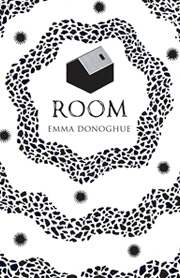
Room (Emma Donoghue)

 --The blurb--
"Room is the story of a five-year-old called Jack, who lives in a single room with his Ma and has never been outside. When he turns five, he starts to ask questions, and his mother reveals to him that there is a world beyond the walls."

--The review-- 
When a book is nominated for a major prize, as Emma Donoghue's Room was in 2010, it's difficult to know if they can live up to the hyperbole that comes to surround them. This can end well (as with The Shadow of the Wind) or badly (as with The Finkler Question), although this is of course all subjective. Room, however, thankfully falls into the former category for this reader. Immediately compelling thanks to the situation in which the characters find themselves, the fact that there are so few characters also adds to the novel's intensity.

The star of the show is not the villainous Old Nick (we don't see enough of him for that, even though he does provide a pervasive brooding presence that is constantly in the background) or even the supportive Ma, but the five-year-old narrator named Jack, who bursts onto the page in an explosion of enthusiasm and the adorable grammatical error of a child who is still learning to speak English correctly (interested readers find on Donoghue's website that Jack's errors were inspired by those of her own five-year-old son, Finn). Jack's advanced numeracy and literacy doesn't alienate readers in any way, nor seem an unrealistic proposition: if you were cooped up in a sealed room with a small child for many years with no possibility of escape, it's not beyond the realms of possibility that you would begin teaching them to read, write, add, and multiply. And if the child has a quick mind, there's nothing to say that they would not advance quickly.

However, in spite of this, Jack is still into all of the normal five-year-old boy things, which makes for a touching contrast with his clearly abnormal living situation. As readers we are so much a part of his heart and mind by the middle section that when Jack and Ma start making plans that are so big that they pose a danger to them both, our hearts begin to beat faster as we read and will it to go well for them. Donoghue increases suspense by ensuring that not all goes to plan. Naturally, this quickening pace and "human interest" nature of the storyline means that we continue to read compulsively: there is no chance of putting the book down and abandoning it for a week or more as we move on with other projects.

The story ends on a high note (albeit not without several 'lows' beforehand) without proving mawkish. While there would have been mileage for the author to continue the story, she chooses not to, allowing Jack and Ma's possible future to play out in our own heads only. It is the fact that the story is cut short (although not in a way that seems too abrupt) that allows it to retain its power and stay firmly implanted in readers' minds. Presumably, this was part of what did it for the Booker Prize judges in 2010, and, it is to be hoped, part of what will do it for you too.

other novels by Emma Donoghue
Stir Fry (1994)
Hood (1995)
Slammerkin (2000)
Life Mask (2004)
Landing (2007)
The Sealed Letter (2008)

Monday, 11 March 2013

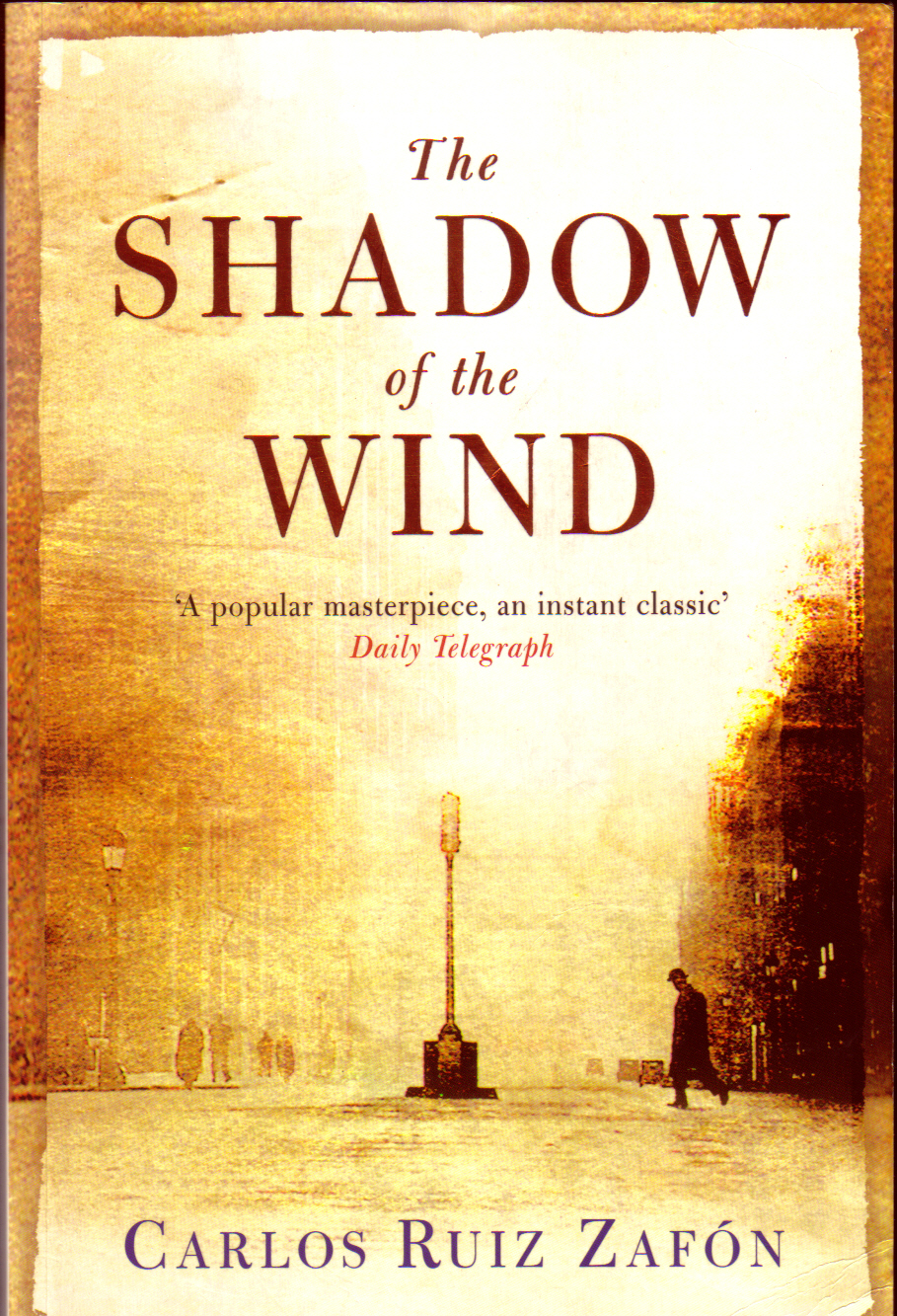
The Shadow of the Wind (Carlos Ruiz Zafon)

--The blurb--
"Hidden in the heart of the old city of Barcelona is the 'cemetery of lost books', a labyrinthine library of obscure and forgotten titles that have long gone out of print. To this library, a man brings his 10-year-old son Daniel one cold morning in 1945. Daniel is allowed to choose one book from the shelves and pulls out 'The Shadow of the Wind' by Julian Carax. But as he grows up, several people seem inordinately interested in his find. Then, one night, as he is wandering the old streets once more, Daniel is approached by a figure who reminds him of a character from the novel, a character who turns out to be the devil. This man is tracking down every last copy of Carax's work in order to burn them. What begins as a case of literary curiosity turns into a race to find out the truth behind the life and death of Julian Carax and to save those he left behind."

--The review--
A myth persists that ranks Paris, France, as the city of light and romance. However, other cities (European ones, in particular) would also be able to stake a legitimate claim on this title, such as Venice, San Francisco, and Barcelona, with the potential of the latter specifically being heightened by Carlos Ruiz Zafon's The Shadow of the Wind, published in 2001 and being celebrated to great fanfare ever since. Can such a spotlighted book really live up to the hype and dethrone Paris as the city of love?

Those who have visited Barcelona will be able to visualize its imprinted walls, twisting path designs and hidden passages as they read; those who have not will be surely incited to visit. The sweeping setting, combined with the novel's secret trysts, haunted houses and curses that stretch across the years, make for a heart-racing read as readers follow the teenaged narrator, Daniel, through the streets of this Catalan city. Any book lover will surely, after reading, wish to roam Barcelona's alleyways searching for the entrance to the cemetery of lost books, wondering if there is a real-life guardian at the door as in The Shadow of the Wind. While it is not a fully realistic novel, with there being too many coincidences and fanciful occurrences for that, Ruiz Zafon's grasp of poetic description and fast-paced action makes this seem less significant. The length of the book may appear off-putting, but needn't be: the author's ability to build suspense and keep us turning the pages means that the sheer volume of it seems to disappear beneath our fingertips.

Another appeal of the novel is its imperfect protagonist, Daniel, and the company he keeps: all are very human and thus are moody and do make mistakes (at best), or harbour murderous instincts (at worst). In spite of this, they fit well into the adventurous setting, allowing readers to lose themselves completely in the story's waves of description, exciting plot, and dramatic turn of phrase. Occasionally concision is lost, meaning that there is a risk of forgetting why certain events occurred, but this does not detract from overall enjoyment of the story, meaning that there is without doubt scope for future rereads, whether alone or in conjunction with the rest of the series (Zafon has so far released two subsequent books, intending the series to eventually have four parts).

The novel's ending is nicely cyclical, with the end scene being a mirror of the first, right down to the dialogue. This, too, demonstrates superb planning and execution, and contributes to the reader's desire to turn right back to the beginning and start reading again, preferably while on a trip to Barcelona. Now, find me a book about Paris that does that...

other works by Carlos Ruiz Zafon
The Prince of Mist (1993)
The Midnight Palace (1994)
The Watcher in the Shadows (1995)
Marina (1999)
The Angel's Game (2008)* 
The Prisoner of Heaven (2011)*

*part of The Shadow of the Wind series

Thursday, 28 February 2013

Bookworm News (February 2013)

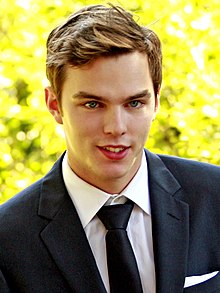
Nicholas Hoult, who will reportedly play Stephen
The sun is shining and the birds are singing
Birdsong, by Sebastian Faulks, is one of the best works of First World War-rooted literature I've read (although if you can recommend others, I'm all ears), and far surpasses his more recent works. Now Birdsong fans can breathe a sigh of nostalgia thanks to a film version of the novel being released, hot on the heels of the 2012 BBC miniseries. Rupert Wyatt has adapted the script and will be directing this version of the modern classic, and Nicholas Hoult is rumoured to be starring in the main role. No release date has yet been set for the film, but you can be sure that I'll be in the queue at the cinema as soon as it comes out.

Also up for adaptation is Tolstoy's War and Peace, which will be adapted for the BBC by Andrew Davies (who to date has already adapted such classics as Pride and Prejudice and Bleak House). While it sounds like it could be a little dumbed down according to the Telegraph's report (which states that "lengthy philosophical elements of the book will be left out"), the emphasis on romance and on human relationships is not without appeal. There are already whispers on the wind that Davies hopes to cast an unknown as Natasha - and after her sterling performance as Kitty in the recently released Anna Karenina, I do hope fervently that rising star Alicia Vikander will be considered.
 
Pass it on
Amazon was last week granted a new patent to sell used ebooks and other digital objects, Wired magazine reports. Purportedly working similarly to Amazon Kindle's ebook lending process, the original owner of the digital file would transfer the access rights to the buyer permanently. However, I'm not sure how far this can really work: how can you ensure, for instance, that the old user would really delete all traces of the file from their own computers, rather than simply continuing to use them? It seems that Bill Rosenblatt, a consultant and expert witness in digital content patent cases, is also worried about an issue that equally plagues the second-hand market for physical books: the fact that the publisher loses control completely once the book leaves their hands. I think there's still a lot to iron out here before this can really be put into practice.

Victoria Barnsley, HarperCollins CEO
Just browsing? That'll be £2, please
Several book lovers (including myself) are often guilty of using physical bookshops as mere showrooms: we go in, we look around, we make a list, and then buy the books off cheaper websites later. The CEO of HarperCollins UK, Victoria Barnsley, has suggested a solution to this problem: charging book lovers for the right to browse. Some shoe stores apparently exercise this policy already in America to sort the wheat from the chaff, and while I agree that it could do this, I also think that it could reduce the number of people buying unexpectedly. How many times have I gone in not intending to buy and yet come out with something anyway? Quite a few, in fact. It seems to me that knowing you will buy before you even enter the shop, because you are in effect forced to purchase, also removes some of the excitement and limits customers' ability to research a purchase. My view? It's a risky strategy that, like Amazon's ebook second-hand store idea, will require careful thought.

Saturday, 23 February 2013

The Flying Creatures of Fra Angelico (Antonio Tabucchi)

--The blurb--
"The reader meets a flying creature of ambiguous species in a priest's vegetable garden, and a revolutionary who is told her incredible future by Mademoiselle Lenormand, a fortune teller from the shadow world." 

--The review--
With the popularity of artists such as Laura Pausini, Eiffel 65 and Andrea Bocelli, and the success of Italian films such as Scialla!, it seems only naturally that the English-speaking public should also be interested in contemporary literature by Italian authors (Dario Fo and Umberto Eco are just two Italian writers who are still alive and still popular today, and whose works are already considered classics). So how does Antonio Tabucchi, who died in 2012, measure up to these greats?

Tabucchi was a prolific writer and academic who published 31 works between 1975 and 2011, including the greatly-lauded Indian Nocturne. Expectations are therefore great. Specifically, what of his 1987 collection of short stories, The Flying Creatures of Fra Angelico? 

There are certainly elements that are worthy of applause. Tabucchi was clearly wildly imaginative and a talented creator of beautiful description. The story entitled Messages From The Shadows is perhaps the best example of this, proving mysterious, elegant and poetic. The Flying Creatures of Fra Angelico, which is the first story in the collection, is eminently readable and should appeal broadly.

However, there were several problems, which can be attributed respectively to the writer, the translator, and those responsible for formatting this book for Kindle.

Several aspects of the story were unsatisfying, thanks to various instances of unsophisticated syntax, abrupt endings, undeveloped plotlines, telling rather than showing, pretention, narcissism, poor punctuation, awkward phrasing, and a general lack of clarity, precision and direction. However, due to reading The Flying Creatures of Fra Angelico in translation, it is not necessarily possible to tell whether this is the fault of Tabucchi himself, or his translator (in this case, Tim Parks, who has been nominated for the Booker Prize twice for his own works of fiction). For this reason, I would not completely discount reading other works by Tabucchi if translated by others.

Formatting problems for the Kindle edition of the text were equally bothersome: paragraphing was destroyed by random gaps and lines were interspersed with odd sequences of unrelated text and symbols. Equally, instinct tells the reader that pictures are supposed to accompany and thus enhance the text; none of these images were, however, visible in the text's Kindle edition. This is a great shame, as given that the collection's title is so heavily rooted in art, it is almost certain that the inclusion of images would greatly supplement the stories.

So while perhaps Tabucchi does not reach the dizzying heights of Fo and Eco in the annals of 20th-century literature with The Flying Creatures of Fra Angelico, this one work alone is not reason enough to discard his oeuvre completely. Perhaps instead seek out Pereira Maintains, which won Tabucchi the Viareggio Prize in 1994 - a prize also accorded to another Italian great, Primo Levi.

Sunday, 10 February 2013

Bookish Bits and Bobs: Every Error You Make, Every Step You Take, I'll Be Watching You

As an English teacher, I'm always keenly interested in anything which promises to improve student spelling, punctuation and grammar. My current technique for marking runs roughly as follows: I grade out of 20, and for every four errors you make, you lose 1 mark. This generally works well and results in an accurate grade for the student (assuming you follow my school's scale, which states that anything between 10 and 13 counts as satisfactory, 14 and 15 count as good, 16 and 17 count as very good, and that anything scored at 18 or over counts as excellent). For dyslexic students, I don't take away a point until they reach 8 mistakes. However, even with this system in place, adjustments sometimes still need to be made, with me giving a grade roughly corresponding to the system above (if I think it's good in terms of structure or content, for example, I'll give a 14 or 15). Why do such adjustments need to be made? Because if I followed that system to the letter every single time, I would find that some students make so many errors that their grade would actually be in minus numbers.


My interest was naturally piqued, then, when I heard about this: a new grammar pen that vibrates with every error you make, in real time, as you write. There are plenty of perks: the pen's Orthography setting would encourage students to self-correct and eventually to avoid making the mistakes altogether. It's also not as expensive as a tutor or voice-activated software, and continues to encourage the art of handwriting. This is reinforced by the pen's Calligraphy mode, which is designed to help students improve legibility and form when they write. This would all be done thanks to the pen's built-in sensors, which are supposed to detect variations in letter formation and subsequently alert users to errors with a light vibration.

All of this seems to be a logical next step given the current tools available, such as autocorrect within word-processing programmes. But could this lead to an over-reliance on technology for a generation for whom this is already becoming a serious problem? I agree that no one piece of technology could trigger such complacency, but it does all build up to a culture of using one's brain less. It's already bad enough when students rely on autocorrect to fix their mistakes: the work comes in, and there are still errors because they haven't gone through the process of having a human proofread it (whether that's the student themselves, or somebody else, such as a peer or family member).

The pen would also run into the same problems as machine translation: the pen is not an encyclopaedia, and so would be limited by a lack of human knowledge and context. 'Bear' and 'bare' are both perfectly correctly-spelled words, but only the human knows that we 'grin and bear it' and yet 'bare all'. Ultimately, the human still needs to reread their work - the pen may reduce the number of mistakes, but it needs to be supported by human critical thinking.

Other criticisms have also been mentioned by those who have heard about this idea. In relation to the above, some quite rightly point out that the pen would seem too scolding or critical in a way that a human reader or teacher may not: the pen tells you that you've made a mistake, but doesn't tell you why it's wrong or how to fix it. More jocularly, some commenters joke that their poor spelling would make the pen go up in smoke within a paragraph, leading me to question how the pen would be powered (no functional prototype currently exists). The pen may not go up in smoke thanks to repeated errors, but if battery-powered, it could prove costly to run, meaning that the makers of the pen, Lernstift, may wish to consider a mains-powered mechanism. However, the amount of money that Lernstift will have available to spend on working this out is dependent on public support: the company hopes to source crowdfunding of up to €1.5 million for the purpose.

So, in the face of all this, how can people improve their standards of spelling, punctuation and grammar?

My answer as an education professional would always be to read, read, and read some more, whether it's comic books, newspapers, magazines, books, or even blogs like this one. Reading widens vocabulary and cements knowledge, meaning that with luck, if you see commonly-mistaken words enough times, you will eventually become familiar with their spelling. This also works for punctuation and grammar: if you read enough, you will notice patterns of punctuation use (particularly concerning the demon semi-colon, whose patterns of usage seem to trouble many), know when and how to use English's rare subjunctives (we know mainly from reading that it's "Long live the Queen", not "Long lives the Queen"), and know how to make subject and verb agree in complex sentences. Reading also provides that much-valued context - so that you know when to use 'deign' and not 'Dane' - and encourages you to challenge yourself and broaden your interests (eventually, when your favourite author is no longer writing books or you begin to tire of your currently favourite genre, you will begin to look elsewhere).

Equally, the classic spelling lesson technique of 'look - cover - say - write - check', while more laborious, works for the trickier words. In addition, I would advocate speaking clearly. This doesn't mean speaking like the Queen of England, but just being sure to enunciate: of course you will always write 'tetnus' instead of 'tetanus' if you never pronounce the 'a'. Finally, playing with words is also helpful: try crosswords, making words from the letters on car registration plates, and playing Word Mole on your Blackberry (did I mention I'm a bit addicted to this game at the moment).

While technology is certainly not useless in allowing people to improve - as evidenced by my game recommendation above, and by the fact that so many people read on the go these days thanks to the exhaustive storage capacities of Kindles and iPads - it's important to harness the power of our brains in conjunction with it. We need to stay conscious, rather than being in thrall to machines, and to be aware of what they cannot do for us, as well as being aware of what they can do. And in the meantime, I should probably pick up that pile of marking that's still in my work bag from Friday, so that I can tell myself I didn't bring it home in vain - and hope wholeheartedly that my Grade 11 didn't make too many spelling mistakes.